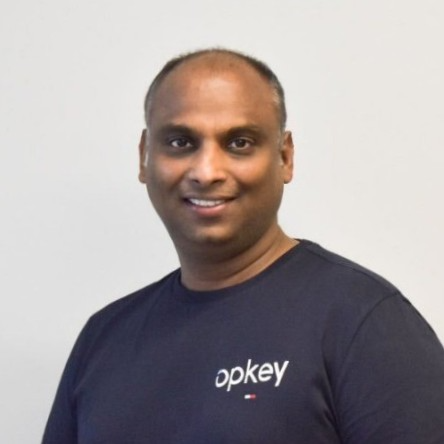
Every three months, somewhere inside a Fortune 500 finance department, a project manager opens an email from Oracle or Workday or SAP announcing a routine cloud update. The email is short. The consequences are not. A single field changes on a purchase-requisition screen, a workflow rule flips a default, and three days later a supply-chain team in Ohio cannot close the month. Pankaj Goel has spent roughly twenty years thinking about this specific email. He runs the company you call to make sure it does not ruin your quarter.
Opkey, which Goel co-founded in 2016 with two friends he has known most of his working life, sells no-code, AI-driven test automation for the big enterprise systems that other companies keep buying and then failing to fully use. Oracle Cloud, Workday, SAP S/4HANA, Salesforce, Coupa, Veeva - if it costs seven figures and updates on a fixed schedule, Opkey has scripts for it. According to the company, roughly 72% of the Fortune 1000 are customers of some kind, and there are more than 250 enterprise logos on the wall. The pitch is that testing an ERP system is not a project you finish. It is a subscription you pay for as long as you use the software. This is either a very cynical observation or a very good business, depending on where you sit.
Goel is a second-time founder, which shows. He co-founded Crestech Software Systems in 2005 and ran it as CEO until 2015, a decade spent doing outsourced testing services for enterprises before deciding, apparently, that services was the wrong container for the actual product. Opkey is the container he built next. It is a platform, not a consulting firm. It is priced like software. It has a proper category, one Goel keeps trying to name - ERP Ops - the way an earlier generation of founders named DevOps and then let the market do the rest of the work. Category creation is a slow game. Goel appears to be playing it patiently.
Before Crestech, Goel worked at Adobe Systems on the automation teams for InDesign and Illustrator. This is the kind of detail that either matters a lot or not at all. The strange thing is that it has never really stopped mattering. The problem Goel worked on at Adobe - how to make sure that a professional desktop-publishing product does not silently break when the underlying software changes - is structurally the same problem Opkey now solves for cloud ERP. The stakes are larger. The scripts are more legible. The instinct is the same. Watch what humans do twice, and automate the second one.
The lineage before Adobe includes stops at Oracle in Hyderabad and at HCL Technologies, which is worth flagging because it gave Goel domain knowledge for the exact software his company now tests. Founders who ship into enterprise IT tend to have spent time inside enterprise IT, and Goel is a fairly clean version of that pattern. He holds a Bachelor's in Electronics and Communication from the Indian Institute of Technology at Banaras Hindu University, an IIT with slightly less prestige-signaling than the Bombay or Delhi campuses but a similar record for producing engineers who go on to run things.
Opkey's August 2024 Series B was $47 million, led by PeakSpan Capital, with participation from existing investors. That took the company's total funding to roughly $66 million, which is a mid-sized enterprise SaaS round in the current climate - large enough to matter, small enough not to require heroics to justify. The stated use of proceeds was familiar: sales, marketing, R&D, geographic expansion, particularly into Noida and Bangalore, where Opkey does much of its engineering. The stated ambition was less familiar: to define ERP Ops as a category. Goel used the phrase "continuous assurance," which is the kind of language that either becomes a slide in every enterprise pitch deck five years from now or quietly disappears. Both outcomes are compatible with a good business.
In March 2024 the company launched Opkey One, which it describes as an AI-driven test automation platform. What "AI-driven" means in practice, if you read the product pages carefully, is a combination of impact-analysis models that predict which tests to run when a system updates, self-healing scripts that adapt when a screen field is renamed, and generative components that write test scripts from natural-language descriptions. These are not novel primitives. They are, however, exactly what a well-run testing platform should be doing in 2026, and Opkey is doing them at scale for the specific software systems that pay for it. In a market where every SaaS company is claiming to be AI-native, Goel's version of the claim has the virtue of being boring, testable, and shipped.
The other thing Goel does, in the founder-CEO mode that most B2B category leaders eventually adopt, is talk in public. He sits on the Forbes Technology Council. He appears on the Cloud Wars Live podcast to explain the mid-market ERP opportunity. He posts on LinkedIn under the handle @pankajunlimited, which is also his Medium byline, and he has spoken on panels at Oracle AI World about agentic AI and ERP applications. None of this is unusual for a founder in his position. What is somewhat unusual is that Goel appears to prefer talking about the shape of the market to talking about himself. His public writing is closer to trade-press analysis than founder mythology, which is either genuine humility or a very effective form of it.
The company is headquartered in Dublin, California, with offices in Pittsburgh, New York, Noida, Bangalore, and Australia. Goel himself is based in the Dallas area. This is the standard enterprise-SaaS geography of a company that raised in the US, engineers in India, and sells wherever the customers are. Opkey has 370 employees per public estimates and does something on the order of $32 million in revenue. Both numbers imply a company that has real customers, real churn, real forecasting problems, and real headcount decisions - all the boring markers of a business that has crossed the line from experiment into operation.
The interesting question about Goel is not what he has built, which is legible in the press releases, but what he is betting on. The bet, as far as one can tell, is that cloud ERP is fundamentally a testing problem in disguise. Every business that moves to Oracle Cloud or Workday now inherits a change-management burden that the vendor keeps light on the sales call and heavy on the invoice a year later. The customer either accepts that burden as a cost of doing business, hires a consulting firm to manage it, or buys a platform. Goel is arguing for the platform, and he is arguing that the platform should be no-code so that business analysts, not just QA engineers, can own the tests. If he is right, Opkey becomes infrastructure. If he is wrong, Opkey becomes a good vendor in a busy category. Both outcomes are compatible with $66 million in funding. Only one of them is compatible with the story Goel keeps telling.
Something to notice: Opkey has been quietly certified as an official Workday test automation partner, which is the kind of press release that reads like nothing but is actually load-bearing. Workday is famously choosy about who gets to interact with its cloud from the outside. Certification means Opkey is on a very short approved list. In a world where the biggest ERP vendors are all trying to own their own testing stories, being the third-party option that the vendor itself blesses is a competitive position that is hard to construct on purpose. Goel appears to have constructed it on purpose.
The last thing worth saying about him is that Pankaj Goel is not, on the evidence, a founder with a taste for spectacle. There is no biography-of-the-founder book. There is no Twitter beef. There is a company that has grown steadily for a decade, a category name that keeps showing up in analyst reports, and a customer list that quietly includes most of the Fortune 1000. The email from Oracle still goes out every quarter. Somewhere in Ohio, a supply-chain team still closes the month on time. That is the product.