To work at a startup is to be told, breathlessly, that everything moves fast. The claim is so universal it has lost all meaning. And yet here is a company that has the indecency to mean it — where the gap between “we should” and “we did” is measured not in quarters, but in the hour between two cups of coffee.
There is a particular kind of person who reads the words “we move fast” on a careers page and feels, deep in the soul, a weary skepticism. They have heard it before. They have lived its disappointments. To them, Pallet offers an unfashionable rebuttal: proof. “We can get to a meeting, make the decision,” one team member explains, “and then in the next hour will act on that decision, make the changes in our business.” It is the sort of sentence that sounds like exaggeration until you realise it is simply a description.
Pallet is building the AI backbone of logistics — the agents and systems that quietly automate the workflows moving the physical economy, the unglamorous machinery that gets goods from A to B. It is a Series B company, certified as a Great Place to Work, sixty-five people strong and growing. But the numbers, charming as they are, are not the story. The story is what it feels like to be inside a room where ambition has stopped apologising for itself.
A company, by the numbers
Autonomy is not a perk. It is the job description.
Ask anyone at Pallet to compress the culture into a single word and they reach, almost reflexively, for the same two: autonomy and ownership. It is a tidy answer, and like most tidy answers it conceals a great deal of effort. Ownership, here, is not a slogan stitched onto a tote bag. It is the daily expectation that you will see a better way to do something and — this is the radical part — actually go and do it.
The company hires, deliberately, for potential rather than pedigree. “We hire for potential,” one employee says, “so I’m able to learn a lot, learn really quickly, implement what I’ve learned, and then also uplevel myself in my career.” The arrangement is gloriously self-interested on both sides: the company gets people hungry to grow, and the people get a place that lets them.
What emerges is a workplace that takes its mission with deadly seriousness and itself not seriously at all. As one team member puts it, the balance is a culture “where people don’t take themselves super seriously, but at the same time everyone is, like, secretly in their heads thinking things just get done in days.” The result, by their own measure, is plain: “we just got more done than any other company I’ve worked at.”
How would I describe Pallet’s culture in one sentence? Autonomy and ownership.— A member of the Pallet team
Five values, zero ego
Speed & Quality
High urgency, married to a long-term quality mindset. Fast need not mean fragile.
Job’s Not Finished
Extreme ownership and a refusal to stop improving once the box is ticked.
Make the Shot
High conviction and persistence, especially under pressure.
Fight the Right Battles
Prioritise what matters. Cut, ruthlessly, what doesn’t.
In This Together
Collaborative, transparent, team-first problem solving — everybody winning as a team.
An idea on Monday. Live by Tuesday.
There is something almost suspicious about a company that talks this much about speed and still manages to be likeable. Most velocity comes at the cost of the people generating it — a frantic, fraying thing. At Pallet, the iteration is fast but the affection is genuine. “We have an idea one day,” one engineer says, “and then the next day we’re running with it. I love that kind of fast-paced nature.”
It is, by the team’s own description, energising rather than exhausting — powered by an ambition that is contagious. “It’s the energy and also how ambitious everyone here is,” one says. “That’s really both energizing for me but also just motivating to keep working every day.” The camaraderie crosses every team line; the engineers and the operations people, it turns out, actually like each other.
Their summary of the operating model is almost a haiku of intent: “We work hard, we go fast, and we build for scale.” Three clauses, no fat. It is the kind of motto that survives contact with a Tuesday afternoon.
Where the energy actually goes
Figure illustrative — drawn from how the team describes itself, not a laboratory.
Everyone moves super quickly and as a result I think we just got more done than any other company I’ve worked at.— On what speed actually buys you
Everybody winning as a team
The most quietly revolutionary thing about Pallet may be the cheerful disregard for the borders that usually divide a company. Engineering pitches in on post-sales. Salespeople get on calls with the implementation process to make customers successful. “Everybody is willing to pitch in to help everybody else,” one leader explains. “It’s everybody winning as a team.”
This is not enforced collegiality, the dreary mandated fun of a corporate retreat. It is the natural by-product of people who, by all accounts, simply like the work and one another. “The people here love what they do,” says one. “They’re excited to be here every day. They are enthusiastic about the work that they’re doing, and it makes all the difference.” And then, the recurring marvel: “Everyone here surprises me with how, like, crazy hardworking they are — but also super smart.”
The software was never the hard part
It would be easy to assume that a company building AI agents spends its days wrestling with code. The truth is more interesting. “The hardest part about building software for logistics,” one team member admits, “is actually not the software, but having the software be able to recreate the processes and workflows that had been embedded in these companies for decades without any sort of technology.”
This is the unglamorous heart of the mission. Pallet uses large language models to deliver its product, then watches it like a hawk — checking that what ships is accurate, iterating on prompts to drive down cost, keeping constant oversight on a system that must never stop improving. The engineering, in other words, is the easy bit. The art is translating a half-century of human habit into something a machine can faithfully perform.
The hardest part about building software for logistics is actually not the software — it’s recreating the processes embedded in these companies for decades, without any sort of technology.— On the real difficulty of the work
A business, not a bonfire of capital
Ambition is cheap; revenue is not. Pallet is a Series B company with $50M raised and a roster of backers who do not hand out cheques for vibes. More to the point, it has paying customers and products that solve genuine problems — the rare startup whose romance is balanced by a balance sheet.
What landing here looks like
A Macbook & coffee chats
New hires onboard in the San Francisco office, set up their machine, and spend the morning meeting teammates over coffee.
Context, not confusion
Everyone meets their hiring manager on day one to learn what they’ll work on and to ask anything. A People Ops buddy helps unblock the rest.
Set up to succeed
The week closes with a manager check-in — how it’s going, a plan for week two, and the high-level objectives of the role.
The people, unedited
“Everyone here genuinely cares about the success of the company — people are emotionally and financially invested in making it work.”
— A Pallet employee“You’re given extraordinary opportunities to take ownership early. I joined at 22 and was trusted to lead projects that directly impact the business.”
— A Pallet employee“This team moves fast and makes decisions quickly — it’s a place for people who like to build, not wait.”
— A Pallet employee“Management gives real, constructive feedback and actually listens. It’s a culture of improvement, not ego.”
— A Pallet employee“Engineers own projects end-to-end, ship fast, and see their work impact customers immediately.”
— A Pallet employee“Exceptional coworkers, genuine leadership, and a shared drive to become the #1 logistics AI company.”
— A Pallet employeeLunch is on the house. So is the ride home.
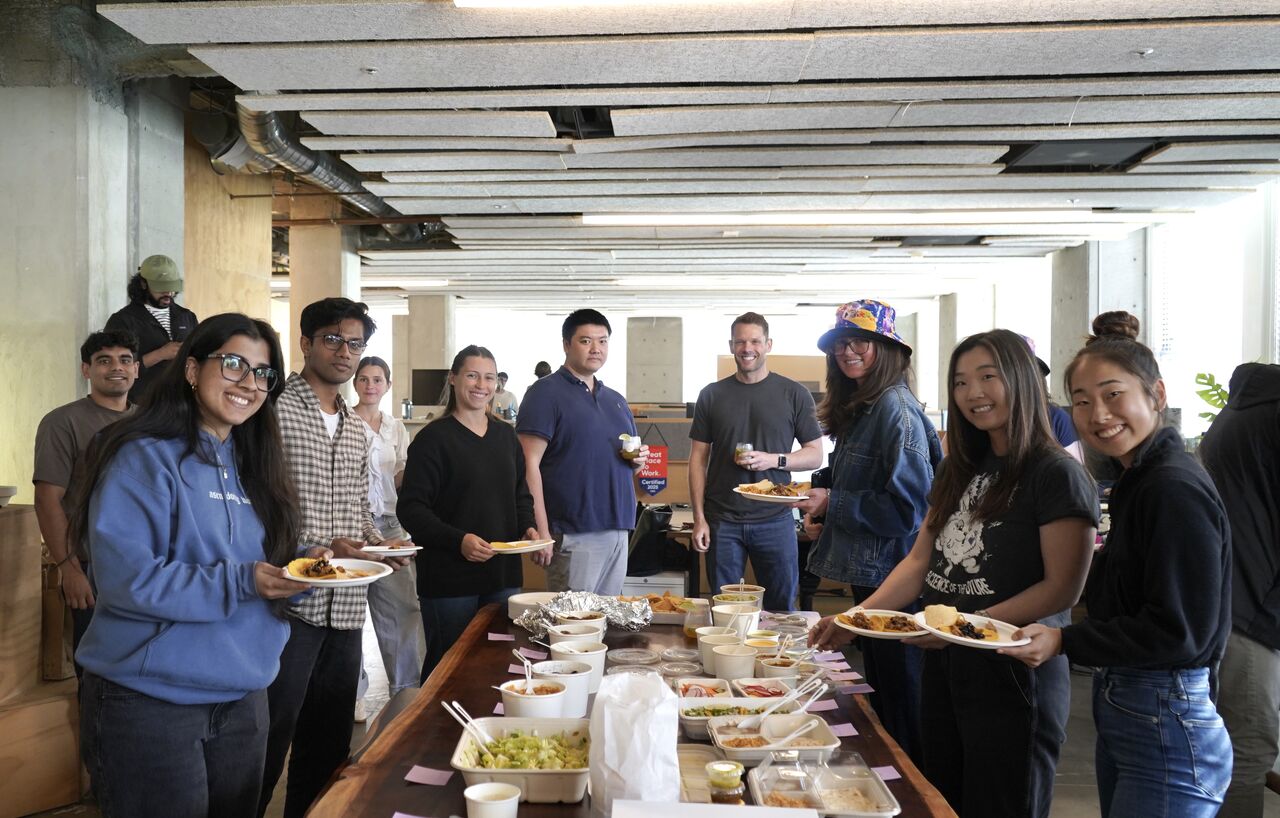
Culture is also the sum of a hundred small kindnesses. Pallet’s, by its own account, include a fully covered Uber if you ever stay late, lunches five days a week, a learning stipend, and the occasional pilgrimage somewhere warmer than San Francisco.
Automate the physical economy.
And the vision behind it: to build the intelligence infrastructure behind the global movement of goods. As the founder puts it — “since we are going to be a generational sales organization and a generational product organization, we’re going to be a generational company.”
A wager on decades
There is a temptation, when writing about a company that moves this quickly, to mistake the speed for the substance. It is not. The speed is merely the most visible symptom of something rarer: a group of people who have decided, collectively and without irony, to be good at the work and good to each other at the same time. The founder’s closing pitch is not a discount or a perk. It is an invitation to stay: “join Pallet for decades to come.” Most companies ask for your next two years. This one, charmingly, is playing a longer game — and seems to be having rather a lot of fun doing it.
Hear it from the team — Pallet, on building fast and shipping things that matter.