The Recruiter Who Recruits Herself, Too
Most people in talent acquisition have a single job: find candidates, screen candidates, close candidates. NishA Acharya has a different job. She is the person who understands the entire game - the hiring manager's anxiety, the candidate's ambition, the market's blind spots - and uses that knowledge to move tech careers forward, including her own.
As the US Talent Acquisition Recruiting Lead for EY Technology Consulting's Americas team, she sits at the intersection of where elite consulting meets cutting-edge engineering. Her job is to find the people who can help Ernst & Young's clients navigate AI transformations, cloud migrations, and every digital disruption in between. She has been doing this for over 14 years - long enough to have watched three complete technology cycles reshape what "good" looks like in tech.
Your career is your biggest asset - know how to leverage it.
- NishA AcharyaBut here is what makes her unusual: she did not start as a recruiter. She started as a builder. Before EY, Acharya founded and served as CTO of her own tech consulting company - meaning she has been on the other side of the table. She has felt what it is like to hire people, to build a team from scratch, to make the calls that determine whether a project ships or falls apart. That experience did not just add a line to her resume. It rewired how she thinks about talent entirely.
Today, that dual perspective - founder and recruiter, CTO and talent strategist - is her edge. She does not just ask "can this person do the job?" She asks "can this person grow with the organization? Can they think beyond the ticket? Do they understand what the client actually needs vs. what they asked for?"
The Leverage: Where Career Advice Stops Being Vague
There is no shortage of career advice on the internet. There is a shortage of career advice that is honest, specific, and comes from someone who has spent 14 years actually watching people get hired (and not hired) at some of the most selective organizations in the world.
That is the gap "The Leverage" fills. Acharya's newsletter is built around one idea: most professionals have more power in their careers than they think. They just do not know where it is or how to use it. The newsletter - delivered to a growing list of tech professionals - breaks down how hiring actually works, what recruiters actually look at, and how to position yourself for roles that are rarely what the job description suggests they are.
She earned AI certifications from IBM, NVIDIA, and Databricks in a single year - staying ahead of the very talent she recruits. That is not a coincidence; that is a strategy.
What sets "The Leverage" apart from the generic "5 resume tips" content that floods LinkedIn? Context. Acharya writes from inside the machine. She knows how a resume lands in a recruiter's inbox, what happens in the first 30 seconds of a screen, why a well-qualified candidate sometimes gets ghosted and a less-experienced one gets an offer. She has watched this happen thousands of times. The newsletter is, in essence, a transcript of what she wishes candidates knew before they applied.
For tech professionals navigating a market that has become both more competitive and more confusing - especially as AI reshapes entire job categories - "The Leverage" arrives as the kind of resource you wish a well-connected mentor would just send you.
When the Recruiter Learns to Code... Sort Of
In 2025, NishA Acharya earned three AI certifications in a single year: IBM AI Foundations, NVIDIA Generative AI, and Databricks Generative AI Fundamentals. This was not a branding exercise. It was a direct response to the fact that the roles she was being asked to fill were changing faster than the talent supply.
EY is now recruiting for Physical AI Engineering Consultants - a job category that barely existed three years ago. These are the people who build AI systems that interact with the physical world: robotics, autonomous systems, sensor fusion. Acharya needed to understand what she was looking for well enough to know it when she saw it.
This is what makes her position interesting: she is not just a conduit between candidates and job descriptions. She is a student of the technology itself, learning the vocabulary of the roles she recruits for. That is a meaningful differentiator in a world where many tech recruiters struggle to tell a generative AI engineer from a traditional ML engineer, let alone explain what "Physical AI" means to a candidate coming from a SWE background.
From CTO to Talent Architect: The Full Loop
NishA Acharya started her career in corporate accounting and PMO (Project Management Office) recruiting. Not the most glamorous entry point, but an instructive one - she learned how organizations think about resources, risk, and headcount before she ever learned how to source a software engineer.
Then she made a surprising move: she founded a tech consulting company and became its CTO. This was the period that would later define her entire approach to talent. Running a small company means making every hire feel like a life-or-death decision, because at that scale, it basically is. One wrong hire can tank a project. One exceptional hire can open doors you did not know existed.
The best talent strategies don't just fill roles; they build futures.
- NishA AcharyaAfter building and running her own operation, she joined EY - one of the Big Four professional services firms - as a recruiting lead. The transition was not a step down. It was a leveraging of everything she had learned as a builder, applied at enterprise scale. EY Technology Consulting's Americas team became her canvas.
Over 14 years in tech talent acquisition, she has developed a philosophy: talent is not about credentials. It is about trajectory. She looks for people who are learning faster than the job requires, who can operate with ambiguity, and who understand that in consulting, the client is always the final boss. These are the people who thrive at EY. These are the people she finds.
How She Got Here
The Pipeline Problem She Is Actually Fixing
It is easy to say you care about diversity in tech. Acharya does the harder thing: she builds actual pipelines. Her work on Women in Tech mentorship at EY, her participation in the Women in Tech Global Conference, her involvement with the Forte Foundation - these are not PR moments. They are infrastructure.
The Forte Foundation Virtual Career Fair she organized in April 2026 connected women with opportunities inside EY's consulting practice. This is how you change statistics: one conversation, one introduction, one offer letter at a time.
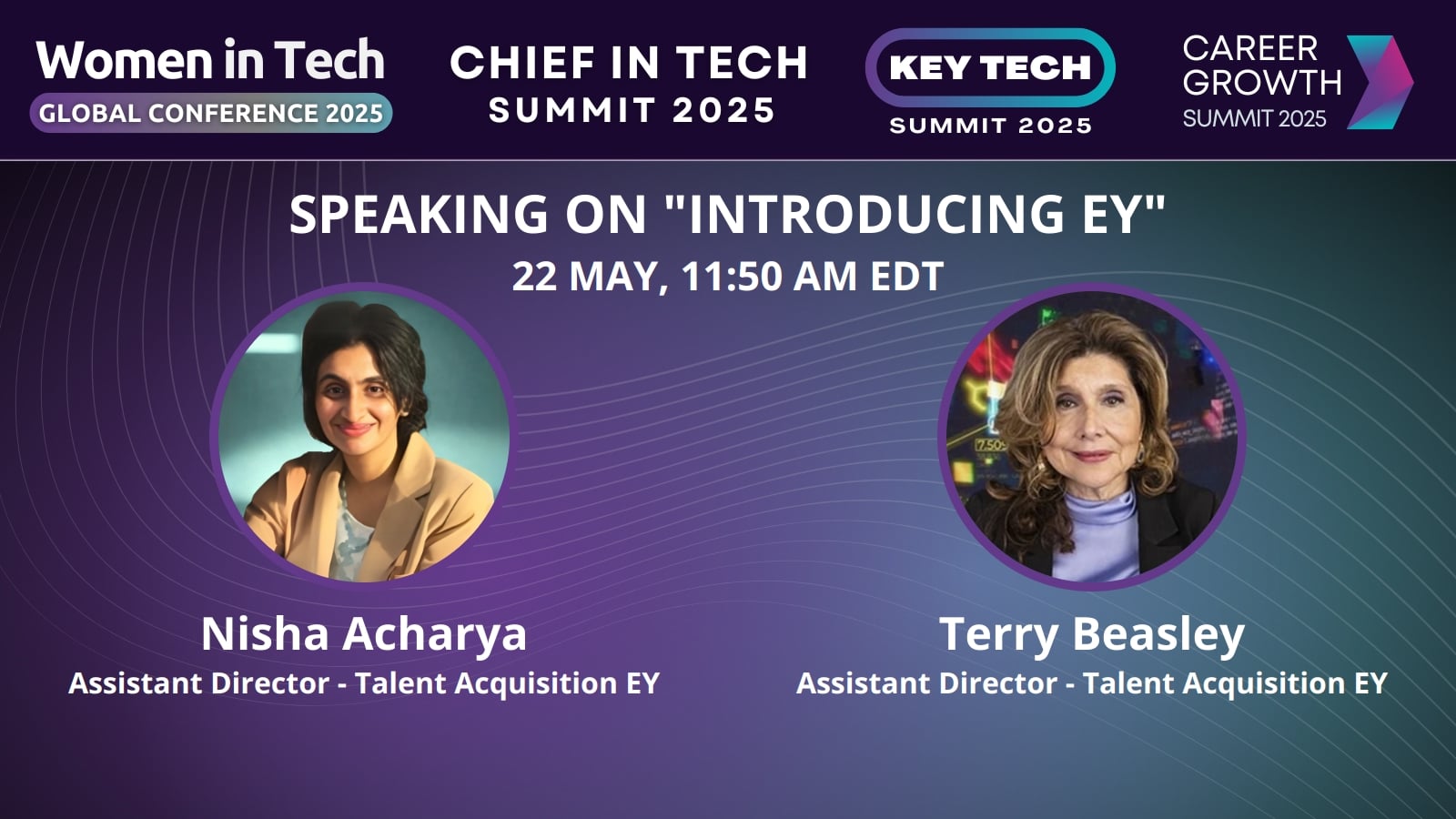
In May 2026, she will take the stage at the Women in Tech Global Conference alongside Terry Beasley to present EY's approach to STEM and Women in Technology programs. The session is not about checking a box. It is about showing what a large professional services firm can actually do - and hold itself accountable for - when it decides to prioritize the pipeline.
Five Things That Make NishA, NishA
1. She stylizes her name. It is "NishA" - with a capital A. A tiny detail that most people would file away as a typo. It is not. It is a deliberate choice that signals: I know exactly how I want to be seen. In a world where personal branding is everything, she practices what she preaches.
2. She speaks four Indian languages. Hindi, Marathi, Kannada (native/bilingual), and Gujarati. This is not just a cultural fact - it is a professional superpower. In a field where connecting with candidates from diverse backgrounds is everything, language is trust. Trust is placement.
3. She has been on both sides of the table. As a former CTO and founder, she has felt the pressure of building teams, managing delivery, and making hiring mistakes that cost real money. This gives her a compass that most recruiters do not have: she knows what a bad hire actually feels like from the inside.
4. She studies what she sells. Her 2025 sprint through IBM, NVIDIA, and Databricks AI certifications was not accidental. She believes that to recruit well in a field, you need to understand it. Not at the level of an engineer - but well enough to ask the right questions and recognize the right answers.
5. Her 14K LinkedIn following was not bought. It was built on consistent, specific, useful career content. That is a different kind of audience - one that actually reads what you write, because you have never wasted their time.