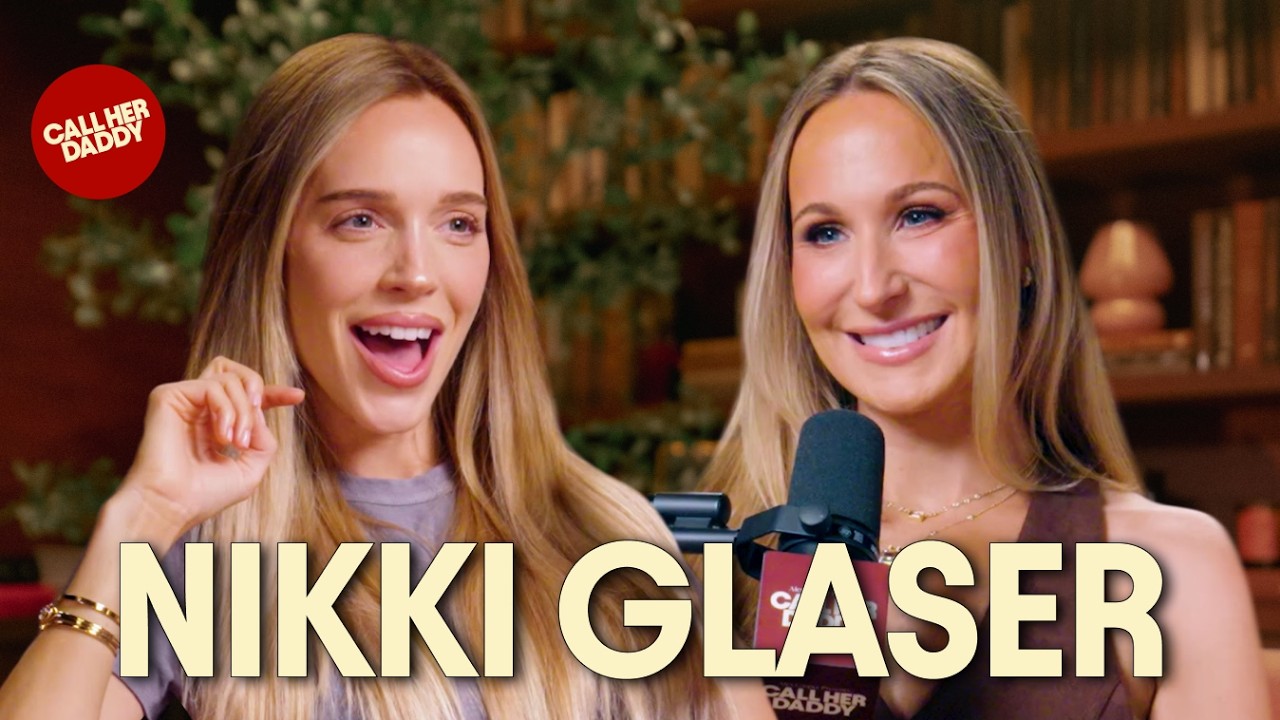
There is a single sentence, buried in nearly two hours of conversation between two of America's most commercially successful women, that quietly detonates the entire enterprise. Nikki Glaser — comedian, roastmaster, two-time Golden Globes host, the woman who told a room full of Hollywood royalty that she would shoot her boyfriend in the face for a single afternoon with Tom Brady — was asked what she wants to be remembered for. Not sharp. Not fearless. Not famous.
Nice.
That one word is the X-ray of an entire industry's contradiction. The woman who has built a career on saying the unsayable, who has dissected gang bang pornography with the clinical precision of a forensic accountant, who has publicly humiliated the most powerful people on the planet and done it better than anyone else in the room — wants, in the end, to be remembered for a quality so soft it could double as a fabric softener advertisement. That tension is the real story of her appearance on Alex Cooper's Call Her Daddy. Everything else — the vibrators, the facelifts, the Epstein detour, the boyfriend who may or may not have a hall pass — is furniture.
"I bully myself so hard that I'm able to do it to other people. When I think about what I'm going to write, I think — what would devastate me if I was this person?"— Nikki Glaser, Call Her Daddy
THE ARITHMETIC OF YES
Glaser's ascent has the shape of an overnight success and the texture of anything but. A working comedian for two decades, she spent years being respected in rooms that weren't on television. The Tom Brady Netflix roast in 2024 was, by her own account, the inflection point — a performance so surgically precise, so bracingly willing to go further than every male comic in the room, that it functioned less like a comedy set and more like a hostile takeover of an entire tier of the industry.
The Golden Globes followed. Then a second. A third is booked. A new standup special, Good Girl, is landing on streaming. By any rational measure, this is a career peak. And yet Glaser describes it with the barely-concealed vertigo of someone who has been waiting for the other shoe to drop so long that success itself has started to feel like a new kind of threat.
She tells Cooper she keeps reminding her team that the dip is coming — that every career, even the celebrated ones, has its lean years — and that the only rational response to a good moment is to say yes to everything, immediately, before the window closes. This is not false modesty. It is the psychological residue of years being underestimated, pressed into a professional philosophy. She recalls auditioning for Anne Frank in a school production and being cast as Jewish Townsperson B. She describes a comedy ecosystem where there might be, at any given time, exactly one slot available for a woman — on any bill, any roster, any given year — and knowing that the two women ahead of her in her cohort simply deserved it more, so she waited. The waiting shapes you in ways that don't disappear when the waiting ends.
Cooper built Call Her Daddy from a college experiment into a property SiriusXM reportedly acquired for north of $60 million. Their conversation has an undertow of mutual recognition: they both know what it is to be told that the thing you're best at is also the thing being held against you.
THE GHOST IN THE WRITER'S ROOM
Nothing in the conversation lands with more kinetic force than Glaser's extended meditation on the criticism that has followed her Golden Globes performances — specifically, the insinuation, circulating in certain corners of the internet and occasionally surfacing in mainstream commentary, that her success is really her writers' success.
It is worth being precise about what she is describing, because it is easy to misread as defensiveness. Glaser is not denying she works with writers. Every major comedy event — every late night show, every awards ceremony, every roast — involves a writers' room. This is not a secret. It is how live television works, has always worked, and will continue to work regardless of which chromosomes the host possesses. When Stephen Colbert is called a genius, no one publishes a correction noting the team who helped him build that persona.
The point is narrower and more damaging: the existence of writers is raised as a disqualifying fact specifically when the performer is a woman, and specifically when that woman has been too successful to ignore. Glaser describes the particular form this takes — the compliment that functions as a demotion, the praise that arrives with poison inside it — and the way it has created in her a compulsive need to prove, with every joke she writes solo, that she doesn't need the help she is also entirely entitled to use.
When a celebrated interior designer puts together a beautiful room, nobody says she didn't make the furniture. Apply the same logic to a woman in comedy, and the frame shifts entirely.— The YesPress Analysis
The comparison she makes deserves wider circulation. When a celebrated interior designer assembles a beautiful room, nobody says she didn't make the furniture. Curation, taste, editorial judgment — these are understood as skills. Apply the same logic to a woman in comedy and the frame shifts entirely, immediately, without apology. What makes this more than a personal grievance is the structural point it reveals: the demand that female comedians succeed without the infrastructure that male success is built on is not a standard applied to anyone else in entertainment. It is a standard invented for them, and it works precisely because it is framed as a compliment.
The irony Glaser deploys with cold precision: a joke about her relying on writers, performed at the Tom Brady roast, was itself written by someone hired to write jokes for the performer telling it. The architecture of the insult collapsed under the weight of its own hypocrisy. She knew the writer's name. She chose not to deploy it publicly. That restraint is, in its own way, a masterclass in the kind of nice she wants to be remembered for.
THE OFF-LEASH DOG THEORY OF LOVE
Glaser's decade-long relationship with her partner Chris is, depending on your philosophical orientation, either the most pragmatic or the most quietly romantic account of partnership you will encounter this year. She does not believe in soulmates — or rather, she believes the concept is statistically indefensible on a planet of eight billion people, the vast majority of whom you will never meet. She has landed on a more useful framework: the person you end up with is almost certainly not your optimal match, but you will never meet your optimal match, so the one who has chosen you back is already a statistical miracle worth cashing in on.
This is not cynicism. In context, it reads as a kind of rigorous honesty about what commitment actually requires — not the suspension of all other possibilities, but the active, daily decision to stop looking for a better one. The relationship has been on-and-off partly because Glaser, whose first serious relationship began at 29, wanted the experience of singlehood she had missed. She was, in her own words, collecting data on herself.
Her views on physical fidelity are presented not as progressive performance but as a specific, personal psychology she has been trying to understand for years. She traces it to its origins with disarming honesty: early in the relationship, hearing about her partner's past encounters functioned as foreplay. When those stories were exhausted, something in her wanted new material. She describes this not as liberation but as a puzzle she hasn't fully solved — acknowledging, without flinching, that there is probably something darker underneath. A man once told her, flatly, that what she was describing suggested she didn't feel like enough. She disagreed. She also couldn't entirely rule it out.
What is striking is not the arrangement but the quality of thinking behind it. Glaser is not advocating a lifestyle. She is describing herself with unusual precision — including the parts she isn't sure are healthy — and doing so without apologising or performing liberation. The off-leash dog metaphor she arrives at is genuinely illuminating: you don't need a dog on a leash to know it's yours. The dog that comes back freely is the one that chose you. She would like to be the kind of partner who trusts that.
THE FACELIFT AS STATUS SYMBOL
The cosmetic surgery conversation — which sounds, on paper, like it shouldn't be the most intellectually interesting section of a two-hour podcast and turns out to be exactly that — contains a theory about wealth and visibility that holds up under examination. Glaser and Cooper arrive, together, at the idea that visibly excellent but inexplicably natural-looking faces have become a new kind of status signal: not a mark of vanity but a declaration of means.
A subtly, expensively maintained face communicates money in the same register as a certain kind of watch or a certain postcode. The people who have it look not artificial but enviably, inexplicably well. Everyone else is supposed to wonder which probiotic they're taking. Behind the joke is something real about the impossible position women in public life occupy around their appearance — simultaneously expected to look effortlessly good and criticised for any visible effort to achieve it.
Glaser talks about growing up feeling like the less pretty sister, about the way that shaped her, about the satisfaction of now having access to tools that make the best version of herself achievable. She is not pretending this is uncomplicated. She is also not pretending she doesn't want it. The honesty is the point. The honesty is always the point.
A subtly, expensively maintained face communicates money in the same register as a certain kind of watch. The people who have it look not fake but enviably, inexplicably well — and everyone else is supposed to wonder what probiotic they're taking.— Glaser & Cooper, on the new status symbol
WHAT NICE ACTUALLY COSTS
The through-line in everything Glaser says — about her career, her relationship, her appearance, her comedy — is the same quality: an unusual willingness to describe herself honestly, including the contradictions, including the parts that don't flatter her, including the parts she hasn't resolved. It is, in a media landscape built on managed personas and strategic vulnerability, genuinely rare.
She grew up being told she was funny. She spent years being told that funny was enough. Then she spent more years discovering that funny, for women, is rarely enough on its own — that it needs to arrive packaged with likeable, and palatable, and non-threatening, and a thousand other adjectives that men in the same field never have applied to them. The moment she escaped those qualifications, the industry invented new ones.
The writers controversy is not the last version of this particular game. It will take new forms as her profile rises. She knows this. She says so. And then she pivots, almost in the same breath, to saying that she hopes her team will stay with her through the leaner years — that the dip is coming, that it always comes, that the only rational response is to do as much as possible right now while people still like her.
That last phrase — while people still like her — is the tell. Not while she's still good. Not while she's still relevant. While people still like her. Twelve years into a career that has culminated in hosting television's most watched entertainment industry event three consecutive times, and the metric she is still tracking is likeability. Not talent. Not craft. Not impact.
Nice.
It turns out nice is not the absence of edges. It is not the refusal to go to the dark place on stage. It is, off stage, the willingness to be seen clearly — to let people know exactly who is in the room. Nikki Glaser has been doing that for her entire career. The industry is only now catching up with the effort it takes.