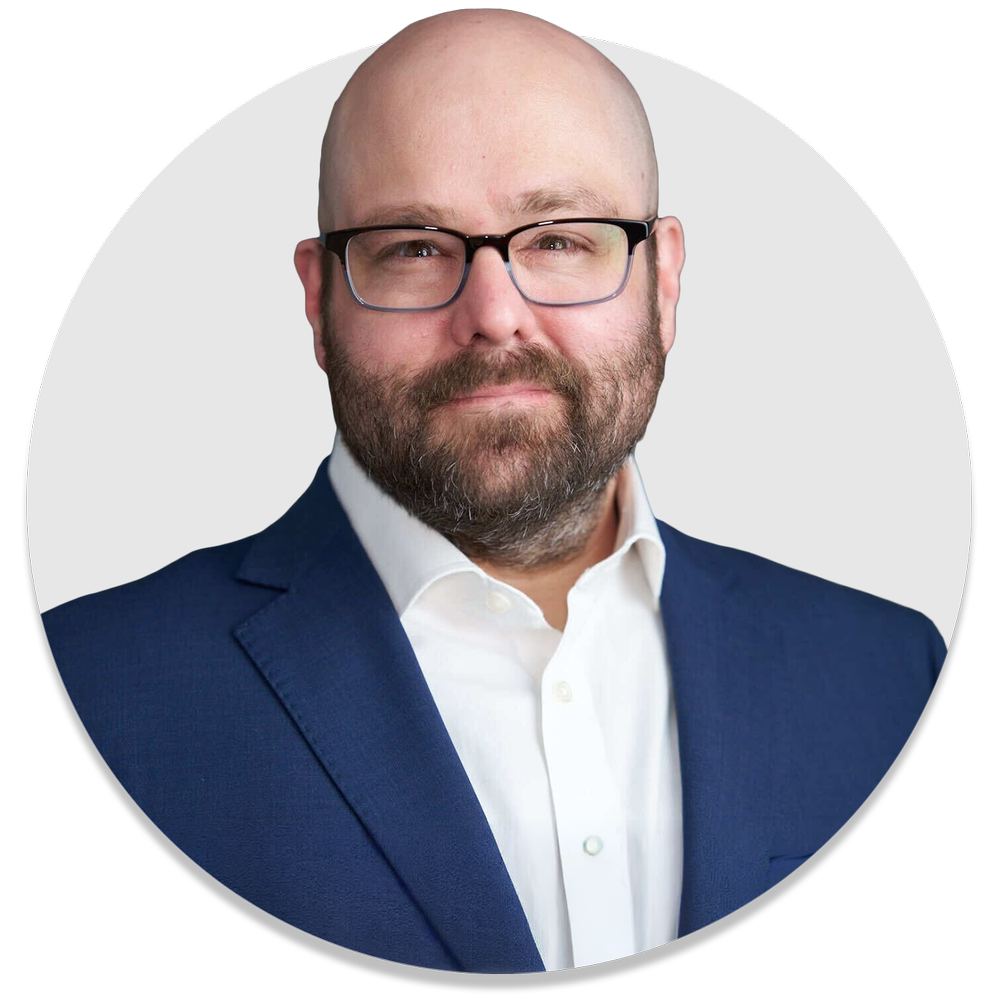
The Profile
A drug fails in people that worked perfectly in a dish. Geisse decided the dish was the problem.
For decades, the way you tested a new compound was to drip it onto a flat layer of cells stuck to plastic and watch what happened. Cheap, fast, and frequently wrong. The cells were nothing like the tissue inside a human body - no shape, no tension, no rhythm. Nicholas Geisse runs Curi Bio, a Seattle biotech built on a stubborn premise: if you want cells to predict what happens in a person, you have to make them behave like they live in one.
Today he is the company's Chief Executive Officer, a job he stepped into in February 2023 after six years as its Chief Science Officer. The promotion was less a pivot than a continuation. Since joining in 2017 he had been the one shaping the science and turning it into products - the person responsible for the strange, useful idea that mechanics matter as much as genetics when you are trying to grow a credible piece of human heart or muscle.
From pharmacology to picograms of force
Geisse did not start out as an engineer. He read biochemistry and molecular biology as an undergraduate at Boston University, then went to the University of Cambridge for a Ph.D. in pharmacology under Dr. R.M. Henderson. Pharmacology is the study of how drugs and bodies negotiate with each other - the discipline you would want at the helm of a company built to make that negotiation legible earlier.
The turn toward hardware came at Harvard. He took a postdoctoral fellowship in cardiac cell and tissue engineering at the School of Engineering and Applied Sciences under Professor Kevin Kit Parker, whose Disease Biophysics Group is famous for treating heart cells less like chemistry and more like architecture. There Geisse learned to build the instruments, not just run the experiments - measuring the faint contractile forces of engineered tissue, the picogram tugs that tell you whether a lab-grown muscle is doing its job.
I am honored and humbled to lead this extraordinary team of world-class scientists and engineers into Curi Bio's next growth phase.
- Nicholas Geisse, on becoming CEO
That training matters more than it might seem. The Disease Biophysics Group works at the boundary where cell biology meets mechanical engineering, on the idea that a heart cell is not just a bag of molecules but a structure under load, and that you cannot understand it without measuring the forces it generates. Geisse absorbed both halves - the pharmacologist's question of how a drug acts, and the engineer's discipline of how you actually quantify a tissue doing work. Most careers leave you fluent in one language. His left him bilingual.
The detour through atomic force microscopy
Between the academy and biotech leadership sits an unusual chapter. Geisse spent years at Asylum Research, a maker of atomic force microscopes - instruments that map surfaces and measure forces at the scale of single molecules. He worked across scientific, commercial, product development, and management roles, which is a tidy way of saying he learned how to sell precision instruments, design them, and run the teams that do both. Asylum was acquired by Oxford Instruments in December 2012. That combination - someone equally comfortable in a pipette, a spec sheet, and a sales call - is rarer than it sounds, and it is exactly the resume a tool-driven biotech needs in a chief executive.
Building the Mantarray
At Curi Bio, Geisse led development of the Mantarray, a platform for growing three-dimensional engineered muscle tissue and measuring how hard it can pull. The name is a small joke with a serious point: the tissues sit on tiny posts and flex, and the system reads their contractile force the way you might watch a ray glide. He also directed an active research-and-development program funded by customer partnerships and NIH SBIR grants - the unglamorous grant-by-grant scaffolding that keeps deep-tech biology alive between revenue and breakthroughs.
The work has been noticed. Curi Bio's approach earned an Xconomy 2020 'Big Idea' award, a U.S. Small Business Administration 2020 Tibbetts award, and a 2021 Edison Award - recognition that spans the worlds of journalism, government, and industrial innovation. Three different juries, one consistent verdict: the idea of human-relevant, mechanically mature tissue is worth betting on.
Two spin-outs, one thesis
Geisse is also a co-founder of Kinea Bio, like Curi Bio a spin-out of the University of Washington. The pattern is telling. He has now helped start two companies out of the same research ecosystem, both orbiting the same conviction - that the gap between a cell on plastic and a cell in a body is the most expensive gap in drug development, and that closing it is a hardware problem as much as a biology one.
It is a quietly contrarian career. Most people pick a lane: bench scientist or businessperson, biologist or engineer, academic or operator. Geisse kept refusing to choose, and the refusal turned into a competitive advantage. Curi Bio's customers are pharmaceutical and research teams who need their preclinical models to mean something - to predict, with more honesty than a flat assay can offer, how a compound will behave when it finally meets a human. The whole company is a bet that you get there by making the biology more real and the measurement more exact, at the same time.
The maturity problem
There is a reason the field keeps circling back to one stubborn obstacle: maturity. Stem-cell-derived heart and muscle cells, left to their own devices, tend to stay immature - more like the cells of a fetus than an adult. They beat, but not the way grown tissue beats; they respond to drugs, but not the way a patient would. An immature model that looks alive can still lie to you. Curi Bio's pitch, and Geisse's scientific north star, is to push those cells further along - structurally and functionally - so the tissue you test on is a fairer stand-in for the human you are trying to help. Get maturity right and the measurement starts to mean something. Get it wrong and you are back to expensive guesswork.
It helps that the company sits in Seattle, a city with a deep bench in stem cell biology and bioengineering, and that Curi Bio's model is fundamentally a business-to-business one: it sells platforms, assays, and services to the pharmaceutical and research teams who need better preclinical answers. That is the unglamorous reality behind the science. Someone has to translate a clever idea about tissue mechanics into a product a busy lab will actually buy, run, and trust. It is the precise overlap of bench credibility and commercial instinct that Geisse spent two decades accumulating, often by accident, in roles that did not obviously add up until they did.
What he is working toward
The aspiration is simple to state and hard to deliver: replace poorly predictive cell-based assays with human-relevant 3D tissues that grow up - that mature structurally and functionally until they behave like adult tissue rather than the immature stem-cell-derived cells most labs settle for. If that sounds incremental, consider the stakes. Every drug that fails late because an early model lied is years and fortunes lost. Geisse's wager is that better biology, measured better, is the cheapest place to catch the lie.
What is striking about Geisse is how little of this is about him. The quote on the day he became CEO did not mention a vision statement or a personal milestone; it pointed at the team - the scientists and engineers he called world-class, the people he framed himself as serving rather than leading. It is a small tell, and a consistent one. Curi Bio's work is collaborative by necessity, stitched together from customer partnerships, federal grants, and a scientific advisory bench drawn from the universities around it. The job of the person at the top is to keep that machine pointed at a single, hard question: can you make a piece of human tissue honest enough to trust before a drug ever reaches a patient? Geisse has spent a career assembling the unlikely toolkit to answer it, and he is not done assembling.