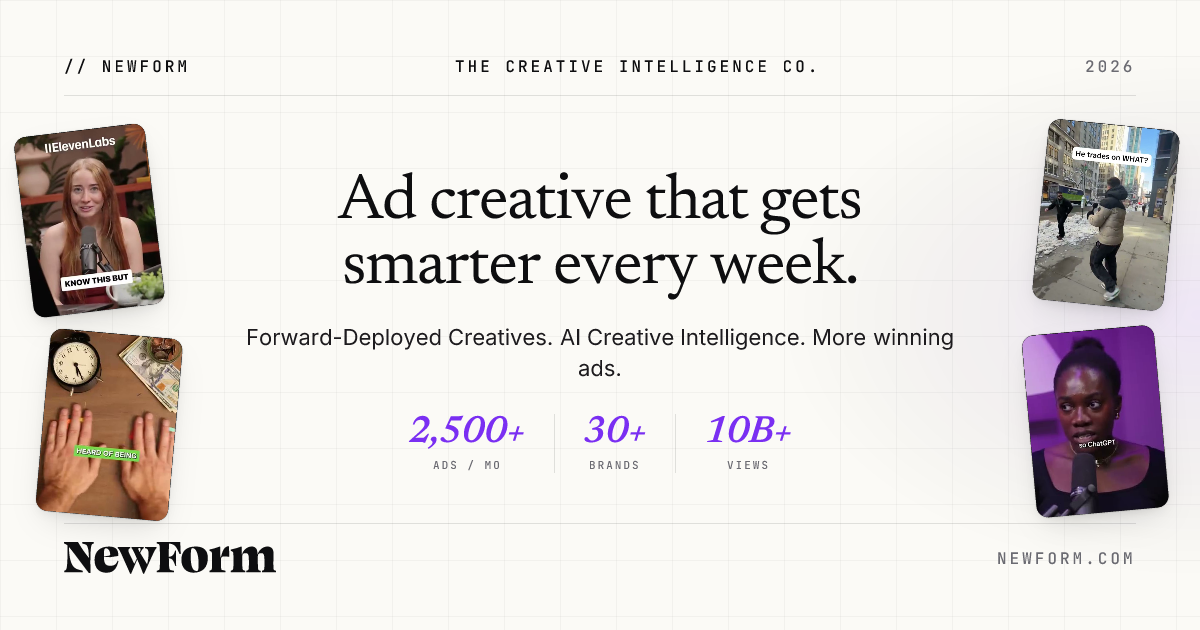
The creative studio that decided guessing was a bad business plan - so it built software to grade its own ads.
"We make ads. Framework keeps score."
In a 5,000-square-foot loft in NOMAD, a few subway stops from advertising's old Madison Avenue ghosts, NewForm is doing something the industry mostly talks about and rarely does: making ads and measuring them honestly. Strategists, producers, and engineers sit in the same room. The output is roughly 2,500 ad assets a month - written, shot, and edited by actual people - and every single one gets run through software the company calls Framework.
That is the whole trick, and it is not a small one. Most agencies make the ad and hand it off. Most ad-tech platforms measure the ad and never touch the creative. NewForm does both, on purpose, under one roof. It calls the result "creative intelligence," which sounds like a buzzword until you watch what it replaces: a marketing team arguing over which thumbnail "feels" right.
Fig. 1 - The rare company where the creatives and the data people are forced to share a kettle.
For years, paid social ran on a comfortable fiction: that media buying was the lever and creative was the decoration. Tweak the audience, adjust the bid, and the algorithm would do the rest. Then the platforms quietly took the targeting dials away. Suddenly the ad itself - the hook, the first three seconds, the face on screen - became the thing that decided whether money worked or evaporated.
Which left growth teams in an awkward spot. Creative had become the most important variable in performance marketing, and almost nobody could explain why one video beat another. The buyer blamed the creative. The creative blamed the buyer. Customer acquisition costs climbed, and everyone kept "A/B testing it," which is a polite phrase for guessing in pairs.
Hamza Alsamraee did not arrive at advertising the usual way. Before NewForm he ran Daily Math, an Instagram account that pulled in more than 200,000 followers and 100 million views, and at sixteen he self-published a calculus book that reportedly sold close to a million dollars' worth of copies. He studied mathematics and engineering at Stanford. In other words, he understood both the thing that makes content spread and the math underneath it - the exact two halves the industry kept treating as separate.
He teamed up with Andrew Presser as COO and Alec Velikanov as CTO, and the three made a contrarian bet: instead of choosing between being an agency or a software company, be both, and make the software earn its keep by grading the agency's work. Then they did the genuinely unfashionable thing and bootstrapped it, scaling to millions in annual recurring revenue before taking the venture-capital victory lap.
Pictured in spirit: the math kid, the operator, and the engineer, who decided one kettle was enough.
Framework is the part that turns a creative studio into something stranger and more useful. It auto-tests every ad NewForm ships and watches it the way an experienced media buyer would - reading hook strength, fatigue curves, and audience response in real time. Over thousands of assets, those readings stop being scattered data points and become what the company describes as "a living map of what works for your brand."
Around it sits the studio: forward-deployed creatives embedded directly inside client ad accounts, briefing, producing, testing, and improving paid ads every week. And in 2025 NewForm pushed the loop one step further with WillBot, an AI media-buying agent meant to act as an extension of the marketing team - the moment the company stopped just informing the buy and started making it.
Auto-tests every ad and reads hook strength, fatigue, and response in real time - so you know what's working, why, and what to make next.
Forward-deployed creatives embedded in your account, shipping ~2,500 assets a month, all briefed, produced, and tested in market.
An AI media-buying agent that plugs into existing workflows and acts as an always-on extension of your growth team.
A scoreboard, not a brag - though it reads like both.
Milestone timelineFintech, language apps, prediction markets - brands that live or die by what an ad costs to convert.
Strip away the studio lights and the dashboards and NewForm is chasing one thing: a world where nobody has to choose between making good ads and knowing why they worked. Where the brief, the shoot, the buy, and the learning all live in the same loop, and that loop gets smarter every week. It is a deeply unglamorous mission - operational, repeatable, measurable - which is probably why it works.
The company is a Meta, TikTok, and Google partner, runs across eight-plus languages, and treats ad-making less like art and more like a manufacturing line with very good taste. The bet underneath all of it is that performance creative is a real discipline, not a vibe, and that the teams who industrialize it will quietly win.
Generative tools have made it trivial to produce infinite ads and impossible to know which ones deserve a budget. That is the next decade's problem in one sentence, and it is precisely the problem NewForm started solving before it was fashionable. As WillBot and agents like it take over the buying, the company that already knows what good looks like - because it has measured ten billion impressions' worth - holds the advantage.
So picture that NOMAD loft again. The creatives and the engineers, still sharing a kettle, still shipping thousands of ads a month. The difference is what's on the wall: not a mood board, but a scoreboard that updates in real time. NewForm didn't make advertising more artful. It made it accountable. In a feed about to drown in machine-made content, accountable might be the rarest thing there is.
Some figures here are company-reported or approximate; funding records across "NewForm" entities are inconsistent and have been flagged where used.