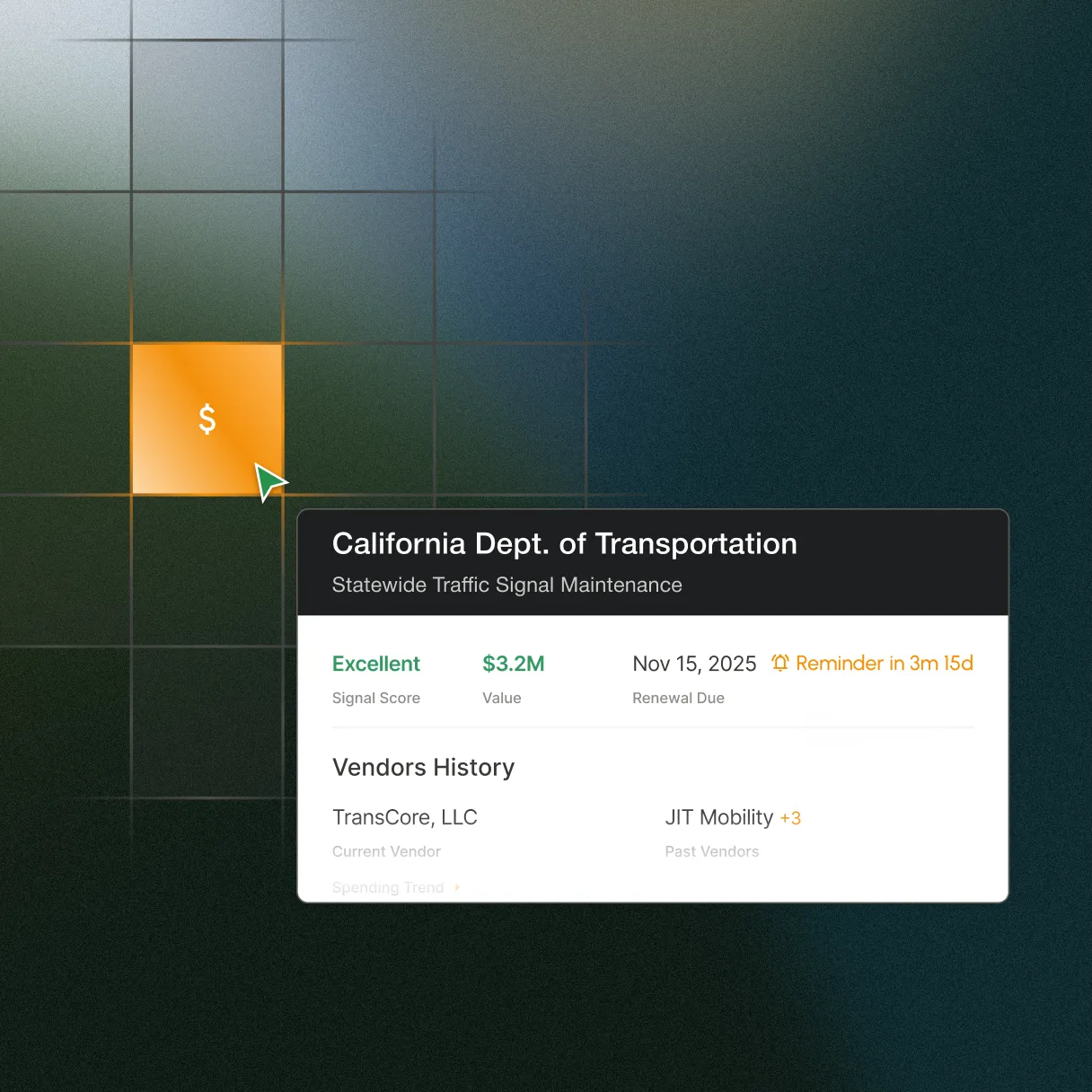
How NationGraph reads a government's mind - and turns budgets, RFPs and meeting minutes into ranked opportunities.
A school district decides what it will buy months before it asks anyone to bid. The tell shows up in a line item, a board vote at 7pm on a Tuesday, a grant that just cleared, a contract quietly ticking toward its expiration date. NationGraph's Signals product is built to read those tells - at the scale of a whole country.
Signals aggregates thousands of government data sources and converts them into ranked buying opportunities. The whole product exists to move a seller's clock forward - to let a rep act on a deal before the request for proposal is ever published.
NationGraph is purpose-built for the SLED market: state, local, education and defense buyers. It does not chase federal procurement. Instead it goes deep on the 110,000-plus institutions that publish their intentions in plain sight and assume nobody is reading - school districts, cities, counties, state agencies, special districts.
The bet underneath the product is quiet and specific: the public sector is the most transparent buyer on earth, and almost nobody bothers to read what it puts in the record. Signals reads all of it.
Raw public records go in one end. The list is deliberately unglamorous, because unglamorous is where the signal hides.
Every morning, NationGraph delivers fresh, relevant signals straight to my inbox. I see which agencies are talking about microtransit, where competitors are active, and even new funding announcements, all without lifting a finger.
Documents become opportunities in four moves. Nothing exotic - just done relentlessly and at volume.
Crawlers pull from 20M+ SLED sources around the clock: minutes, budgets, grants, renewals, news and vendor records across all 50 states.
The raw text is parsed for the moments that matter - budget movements, priority shifts, renewal cycles, operational pain points and clear intent signals.
Each opportunity gets a signal score for how likely and how timely a purchase is, then opportunities are ranked by account priority.
Curated signals land daily in the inbox and sync into Salesforce, HubSpot and Slack - alerts attached to the right accounts and contacts.
A signal score is a bet on two things at once: how likely an agency is to buy, and how soon. A grant that just landed and a contract three months from expiration are not equal, so Signals does not treat them as equal.
The scoring reads the difference between noise and intent. A single mention of "microtransit" in a budget workshop is faint. That same phrase attached to an allocated line item, a renewal window and a competitor going quiet is loud. Signals surfaces the loud ones first.
What the seller sees is not a raw feed. It is a ranked list, organized by the accounts that matter to their territory - which is why the reported outcome is 100% territory visibility instead of a spreadsheet nobody opens.
Illustrative signal factors, ranked by weight.
Anyone can buy a list of government agencies. The hard part is knowing which one is ready this quarter. Signals moves competition earlier in the cycle - from the crowded moment when the RFP drops, back to the quiet moment when the decision is still being made.
Signals is not another tab to remember. It syncs natively into Salesforce and HubSpot and pushes alerts to Slack, attaching each signal to the account and contact it belongs to.
Around the core feed, NationGraph identifies decision-makers by title and department, offers one-click FOIA request initiation, and generates personalized messaging and call scripts. Its sibling product, Automations, ranks and researches those opportunities and enables outreach at scale.
NationGraph has allowed us to be the experts in the room.
The genius is not the crawler or the score. It is the choice of hunting ground. Federal contracting is loud, contested and picked over. The 110,000 institutions below it are the opposite - transparent by law, ignored in practice, publishing the future in documents nobody has time to read.
Signals does not predict the future. It reads the paperwork the future already left behind - the grant that funds the project, the renewal that opens the door, the budget line that names the priority - and hands a seller the one thing a public buyer never gives away twice: the window, while it is still open.
Signals is NationGraph's buying-trigger engine for companies selling to state, local, education and defense (SLED) buyers. It aggregates thousands of public sector data sources - budgets, RFPs, board meeting minutes, grant awards, contract renewals and personnel changes - and converts them into scored, ranked opportunities that surface before a formal RFP is ever published. The result is delivered daily, organized by account, and synced into Salesforce, HubSpot and Slack so sellers can act on intent instead of waiting for the bid.
Last updated: