A thousand brands, one calm operator, and a quiet bet on the unglamorous
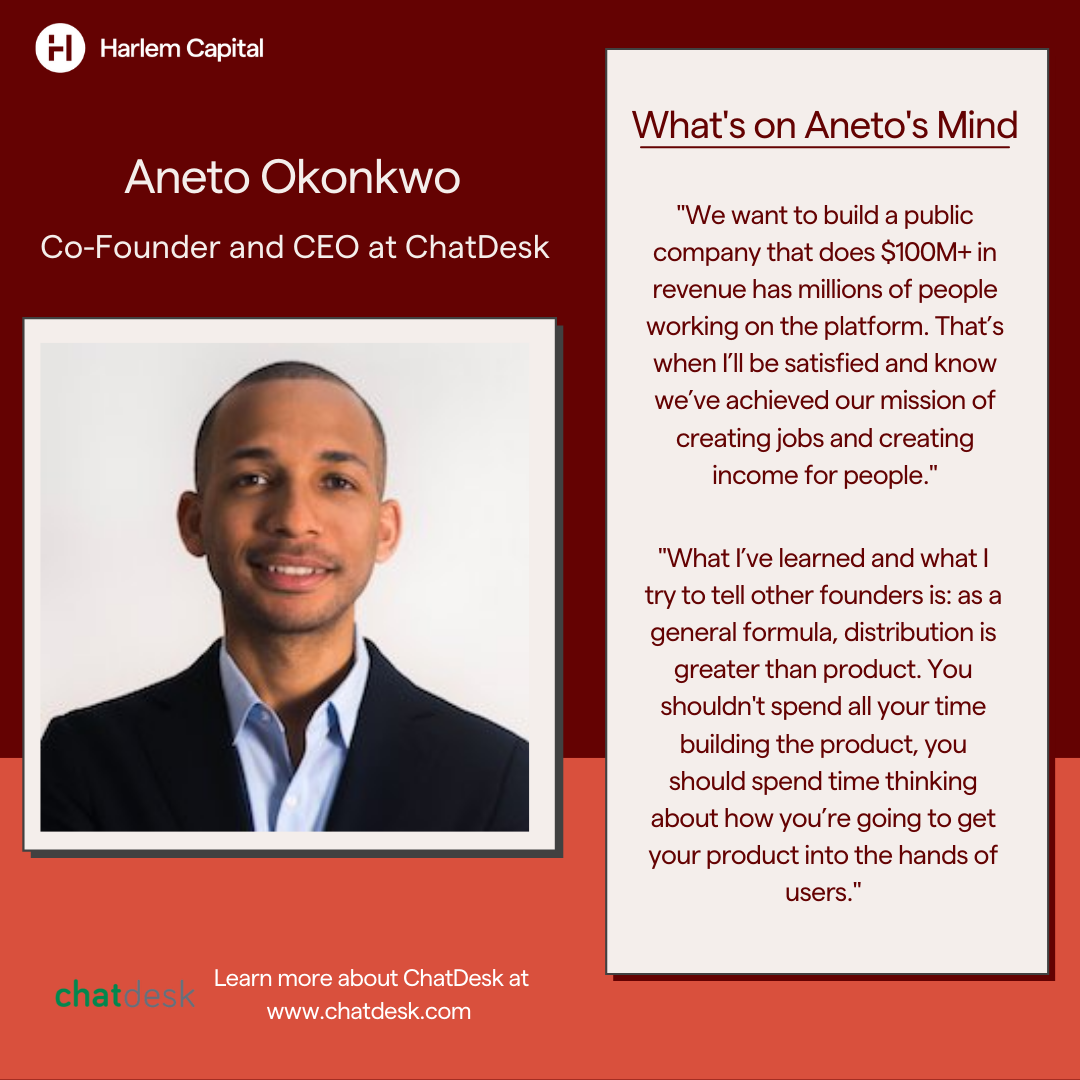
BarkBox started using his software in 2017 and never left. That is the kind of sentence Nate Okonkwo would rather you remember than his resume. The resume is impressive on its own: seven-plus years at Google building Voice Search and the Google Assistant, a stint at McKinsey, a Stanford engineering degree with a Mayfield Fellowship stamped on it. But the resume is the impressive general. The retained customer is the strange specific, and the specifics are where his company lives.
Today he is the co-founder and CEO of Remarkable AI, the New York software company that spent its first chapter as Chatdesk. The pitch in 2026 is sharper than the one in 2017: AI that helps more than a thousand brands grow revenue through personalized messaging across email, social, and SMS. Win back the customer who drifted. Answer the one who is mid-complaint at 2 a.m. Catch the shopper who almost converted. The throughline is conversation, and the wager is that software plus people beats software instead of people.
That last distinction matters to him. Chatdesk paired machine learning with US-based human agents and pushed brands past 90% customer satisfaction. The point was never to delete the humans. It was to give them better tools and, in Okonkwo's framing, better jobs.
Distribution is greater than product
For the first few years he did what every engineer-founder does. He fell in love with the product. He polished it. He shipped it. And then he learned the lesson that now shows up in nearly every conversation he has with younger founders.
The original plan aimed Chatdesk at airlines, an industry drowning in support tickets. It did not take. Airlines moved slowly and treated software like a procurement exercise. So he pivoted to e-commerce brands, who were technology-native, decided fast, and felt the pain of customer service every single day. The pivot was not a retreat. It was the unlock.
It is a tidy line, but it cost him real time to earn. The reward arrived in May 2022, when Chatdesk closed a $7 million Series A led by Cultivation Capital. The cap table read like a who's-who of people who back operators: Harlem Capital, Serena Williams' Serena Ventures, Menlo Ventures, Partech, Susa Ventures, Slow Ventures, Fika Ventures, and angels including former Uber CPO Manik Gupta and the Attentive co-founders. Revenue, the company said at the time, was growing 300% year over year.
What the platform moves
Figures as reported by the company around its 2022 Series A. Bars are illustrative, scaled relative to one another.
From Zurich to a justice problem
The Google years were not just a line on a profile. He worked on Voice Search and the Google Assistant, on SMS products that shipped globally, out of offices in California and Zurich. He was, by trade, the person who taught machines to understand what people were trying to say. There is a neat symmetry in what came next: a company built entirely around understanding what customers are trying to say.
The decision to leave was not a thirst for a bigger title. He frames customer service the way most founders frame a market opportunity, but with an extra clause. It is an industry that employs millions of people, many of them underrepresented, many of them underpaid. Build better software and you do not just help brands. You can create income and dignity for the people doing the work. That clause is the difference between a SaaS company and a mission, and it is the one he keeps coming back to.
People who meet him notice the temperature first. Charismatic but serene, is how one profile put it. Interviewers describe leaving a conversation with him feeling oddly at peace, like they had been talking to an old friend rather than a founder pitching his vision. In a category built on the chaos of inbound complaints, the calm is almost a brand.
The most important decision he made
Ask him what matters most in building a company and he does not say product, or capital, or timing. He says team. He co-founded Chatdesk with Andrew Olaleye, a Dartmouth Tuck MBA, and the partnership is part of why the company survived the airline detour and the long climb that followed. For a founder who spent years on the technical side at Google, that emphasis on people over code is its own kind of statement.
It also explains the shape of the product. Remarkable AI does not pitch a world without humans. It pitches a world where humans are armed with machine learning, freed from the repetitive volume, and pointed at the moments that actually require a person. The brands that show up in its case studies are not generic logos. They are BarkBox and Whistle and PrettyLitter and Fable in pet, Mented Cosmetics and SheaMoisture in beauty, Thinx and Factor Meals in consumer goods. Fast-growing, direct-to-consumer, and allergic to bad customer experiences. Exactly the kind of company that feels the cost of a dropped ticket in real revenue.
Why Chatdesk became Remarkable AI
A name change is rarely just a name change. Chatdesk told you what the company did: it sat at the desk where the chats came in. Remarkable AI tells you what the company is trying to make happen: the remarkable experience that turns a one-time buyer into a repeat one. The rebrand tracked a real expansion. What began as a way to scale support widened into a platform spanning three jobs at once: retain the customer with personalized winback messages, support the customer with 24/7 help that still feels human, and acquire new customers through proactive engagement on social.
The connective tissue is AI that can hold a personalized, one-to-one conversation across email, social, and SMS, at a volume no human team could match, without sounding like a machine wrote it. That is the hard part, and it is also the part his Google years prepared him for. Teaching a system to understand intent and respond naturally is not a new problem for him. It is the problem he has been working on, in one form or another, for most of his career.
He is candid that the work is not finished and that being a founder costs something. He has said the one regret he returns to is time with family. It is a small, human admission from someone who otherwise keeps the temperature low and the mission front and center. The company is still climbing. The bet is still the same one he made when he walked out of Google: that the unglamorous, overlooked work of customer service is exactly where the leverage is.
Career, in waypoints
The forgotten funnel
His most recent argument is counterintuitive in the way good arguments usually are. Everyone obsesses over acquisition. Marketers spend to bring in strangers. Meanwhile the customer who already bought, already loved the product, and then quietly drifted away sits ignored in a database. Okonkwo calls winback the forgotten funnel and makes the case that, dollar for dollar, it is the highest-return retention strategy a brand has. Remarkable AI exists, in part, to run exactly that play at scale.
There is a tell in how he talks about holidays, too. Loyal customers, he has noted, often miss the narrow window when a promotion is live, then turn up disappointed and angry, which spikes ticket volume right when a team can least absorb it. The fix is not more agents. It is better timing and better messaging, delivered before the frustration starts. That is the whole company in miniature: catch the moment before it becomes a complaint.
Five things worth knowing
- 01 — He answers to both Nate and Aneto. Same founder, two name tags.
- 02 — He once worked out of Google's Zurich office. The Alps did not slow him down.
- 03 — Serena Williams' venture fund is on his cap table. Few founders can say that.
- 04 — BarkBox has been a customer since the year the company launched.
- 05 — He says the most important entrepreneurial decision is who you build the team with.