Dispatch from Mission College Blvd
A campus in the most expensive zip codes in America - and it costs district residents nothing
It is a weekday lunch hour on Mission College Boulevard. A nursing student reviews flashcards on a bench. A few buildings over, hospitality students plate gourmet lunches in the Mission Bistro for paying guests who have no idea their meal was made by people earning a degree. Down the hall, someone picks up groceries from the campus food pantry. Outside the windows, the office parks of one of the wealthiest regions on earth hum along, indifferent.
This is Mission College: a public, two-year college sitting in the heart of Silicon Valley, roughly a mile from a stadium that hosts Super Bowls. Its students are mostly working adults. Their average age is around 30. About 80% are students of color. Many are the first in their families to attempt college at all. And for those who live in the surrounding district, the tuition line on the bill reads zero.
"Where today's students meet tomorrow's opportunity."- Mission College motto
The problem they saw
The barrier was never the textbook. It was everything around it.
Here is the inconvenient truth about community colleges: the hard part is rarely the coursework. The hard part is the rent, the childcare, the second job, the empty fridge, the immigration paperwork, the bus that doesn't come. A student can ace the midterm and still drop out because their car broke down or their toddler had nobody to watch them on Tuesday nights.
Silicon Valley sharpens this to a fine point. The region generates staggering wealth and equally staggering costs. A degree is the most reliable on-ramp to a stable job here - and the very expense of living here is what knocks people off the ramp. The talent is local. The opportunity is local. The gap between them is the problem Mission College exists to close.
Consider who shows up. Not the eighteen-year-old with a college fund and a dorm waiting. The student here is more likely to be in their late twenties or thirties, holding down a shift, supporting a family, maybe learning English while learning chemistry. For that person, a single unexpected expense - a transmission, a medical bill, a missed paycheck - is not an inconvenience. It is the end of the semester. The dropout statistics in American higher education are full of people who were perfectly capable and simply ran out of margin. Mission College looked at those statistics and decided the margin was something it could supply.
"Hungry students don't learn. So the college built a food pantry instead of a lecture about resilience."On wraparound support
The bet
Three faculty, a borrowed building, and an idea
Mission College opened in September 1975 - not in a gleaming campus, but in the vacant Jefferson Middle School, with three full-time faculty members teaching math, fine arts and philosophy to morning and evening classes. By 1976 the governing board had appointed Warren Sorenson as founding president. The first commencement followed in June 1977, with the president of Santa Clara University as speaker. By 1979 the college had moved to its permanent home on Mission College Boulevard and already enrolled some 3,500 students.
The bet was simple, and slightly heretical for its time: build a serious college for the people the four-year universities priced out or overlooked, and put it right next to the companies that would one day hire them. Not a consolation prize. A launch pad.
"It started in a borrowed middle school. Fifty years later it's the most ambitious building on the block."On the 1975 origin
The Mission College timeline
Fifty years, abbreviated
1975Opens in the vacant Jefferson Middle School with three full-time faculty and morning/evening classes.
1976Warren Sorenson appointed founding president by the governing board.
1977First commencement; the president of Santa Clara University delivers the address.
1979Moves to its permanent Santa Clara campus, already serving roughly 3,500 students.
2022Dr. Seher Awan becomes president, continuing the college's equity and access agenda.
2025Roughly 50 years in, the Mission Promise free-tuition program and wraparound services anchor the college's pitch.
What you can actually do here
More than 100 ways in - and a guaranteed way out
Mission College runs over 100 degree and certificate programs. You can earn an Associate Degree for Transfer and move into the CSU or UC system with your credits intact. You can train for a career directly - nursing, engineering, computer science, hospitality management, culinary arts, even firefighting. You can start in ESL or noncredit adult-education courses and work your way up. You can do it part-time, at night, online, or some combination that fits around a job and a family.
The catalog reads, not coincidentally, like Silicon Valley's job board. That is the point. A community college a mile from companies that need nurses, technicians, software testers and hospitality managers should teach exactly those things - and Mission does, often in partnership with the employers themselves through apprenticeships and job-training programs. The transfer track and the career track are not rivals here. A student can start with a certificate that lands a paycheck, then come back later for the degree. The institution is designed to be re-entered, not just finished once and forgotten.
Transfer Degrees
Associate Degrees for Transfer with guaranteed pathways into California's public universities.
Career & Technical
Nursing, engineering, computer science, hospitality, culinary arts, firefighting and more.
ESL & Adult Ed
English-language, basic-skills and noncredit courses for immigrant and returning learners.
Support Services
Food pantry, mental-health counseling, foster-youth (NextUp), Umoja, veterans and disability support.
Yes, the hospitality students really do run a public bistro. The grades are pass/fail; the risotto is not.
The proof
The numbers that make the case
Access is easy to claim and hard to deliver. Mission College's figures suggest it is doing more than printing the word on a brochure. The vast majority of students receive financial aid, and many pay nothing at all. The student body is genuinely diverse rather than rhetorically so. And the college sits inside a network of local employers - Intel and Cisco among them - that gives its career programs a direct line to actual jobs.
Who actually goes to Mission College
A portrait by the numbers (approximate)
Students of color
~80%
Receive aid
85%
Attend part-time
~76%
Avg. age
~30 yrs
"85% on financial aid isn't charity. It's the business model working as designed."On affordability
The proof also lives in the partnerships. Sister institution West Valley College shares the district. The CSU and UC systems receive Mission's transfer graduates. Transit agency VTA helps students get to campus through SMART Pass and EcoPass programs. None of it is glamorous. All of it removes a reason to quit.
The mission
Remove the barrier, then get out of the way
Strip away the program lists and what remains is a single operating principle: figure out what is stopping a student from finishing, and remove it. If it is money, make tuition free for district residents. If it is hunger, run a pantry. If it is a child with nowhere to go, offer childcare. If it is anxiety or depression, staff counselors. If it is immigration status, build resources for undocumented and Dreamer students. The barriers are specific, so the responses are specific.
This is less a feel-good story than a logistical one. Mission College treats degree completion as a supply-chain problem where the bottleneck is rarely the curriculum. That clarity is its real product.
"Most colleges sell admission. Mission College sells completion - and then engineers the conditions for it."On the operating principle
Why it matters tomorrow
The neighbors keep changing. The job stays the same.
Silicon Valley reinvents itself every few years - new platforms, new acronyms, new fortunes. The names on the office parks rotate. What does not change is the need for a credible, affordable on-ramp for the people who actually live here. As automation reshapes work and the cost of a four-year degree climbs, the value of a place that can retrain an adult in months - for little or nothing - only grows.
There is also a civic argument, and it is not sentimental. A region that imports all of its skilled workers and exports its own residents to cheaper places has a stability problem dressed up as a success story. Institutions like Mission College are the thing that lets a community actually compound - where the daughter of a line cook becomes a nurse, where the warehouse worker becomes an engineering tech, where the money and the people who earn it stay in the same place long enough to build something. That is slow work. It does not trend. It is also, arguably, the most durable form of economic development a region can buy.
Mission College has spent five decades answering the same quiet question: what is stopping you from finishing? The technologies in the catalog will keep updating. The question won't.
Back on Mission College Blvd
Lunch hour, again
Return to that bench. The nursing student finally closes her flashcards and heads to clinical. The bistro empties; the hospitality students start their cleanup, one step closer to a certificate and a kitchen of their own. The food pantry restocks for tomorrow. The office parks outside are still humming, still indifferent - but a little of their future workforce just walked out of a building that asked for nothing at the door.
That is the whole bet, fifty years running. Put a serious college where the opportunity is, take down the barriers one by one, and let people finish what they started.
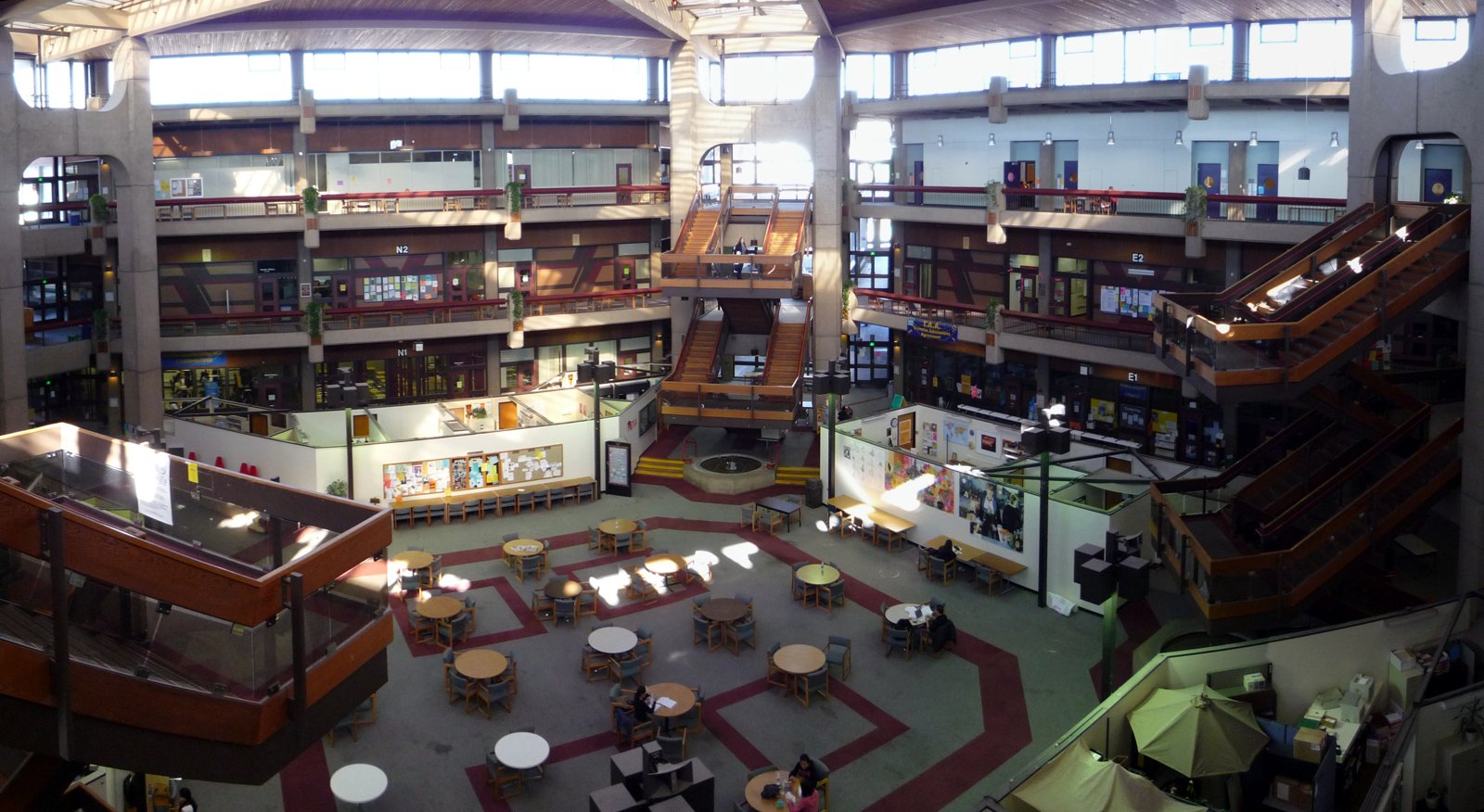 The campus that out-ambitions the office parks next door.