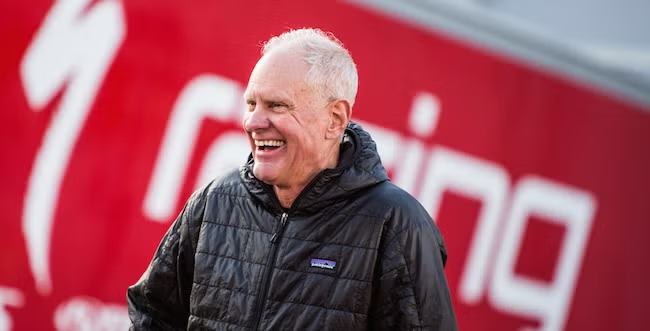
Walk into Specialized's headquarters in Morgan Hill and the parking lot is the giveaway. There are more bike racks than spaces. Mike Sinyard is somewhere on the campus, probably on two wheels, possibly in lycra, definitely talking to a rider about why their new helmet fits the way it does. He stepped out of the CEO chair in 2022 and immediately invented a new title for himself - Chief Rider Advocate - because he had no intention of stepping out of the building.
The company he founded turned fifty in 2024. Its founder, by his own accounting, has more energy now than he did in 1974. The math should not work. It does because Sinyard built a company around an idea he believed before anyone else did: that the bicycle is not a toy, not a piece of equipment, not a hobby. It is a tool. It moves people. It changes them.
His current obsession is Outride, the philanthropic arm born from the Specialized Foundation in 2015. Through a program called Riding for Focus, it gets bikes under middle schoolers and studies what happens. The data goes one direction: kids who ride show up to school differently. Sinyard talks about this with the same volume he uses when describing carbon layup schedules.
That volume - that almost religious certainty about the bicycle - is the through-line of every chapter of his life. It is why he sold the van in 1973. It is why he chartered a flight to Italy to meet the Cinelli family in person rather than fax them. It is why he showed up at dealer shops on a 10-speed with stems strapped to the frame because he could not afford a car. It is why he greenlit a fat-tired bike in 1981 that the entire industry told him no one would buy.
The fat-tired bike was the Stumpjumper. The first batch weighed 29 pounds and retailed at $750. Five or six dealers took it. The rest told Sinyard he was selling a big kid's BMX. The next year U.S. mountain bike sales hit 5,000 units. The year after that, 50,000. By 1986 mountain bikes were 60 percent of every bike sold at specialty shops. Sinyard had not predicted a category. He had created one.
The Stumpjumper is currently in the Smithsonian National Museum of American History. It has been there since 1994. The bike's father has not slowed down enough to notice.
What Sinyard is best at is not engineering. He has plenty of engineers. He is best at a particular kind of stubbornness. The stubbornness of staying inside a single category for fifty years while everyone else in his generation diversified, pivoted, exited. He has been offered exits. He sold a 49 percent minority stake to Taiwan's Merida in 2001 and that is the closest he has come to leaving the building. The other 51 percent is his. The company is, by industry standards, weirdly private. Weirdly founder-shaped.
The Innovate or Die motto is part company doctrine, part personal anthem. It shows up in employee onboarding, on shop walls, in the third principle of the official Specialized brand book, sandwiched between "the rider is the boss" and "seek to understand." Sinyard says it the way a coach says a play call. The phrase is not branding. It is a warning to himself.
By 2022 he was 48 years into being the CEO. Forty-eight. To put that in perspective, the second-longest founder-CEO tenures in the cycling industry don't approach it. He named Scott Maguire, a former Dyson executive, as his successor and immediately handed Maguire the operational levers. Then he gave himself the title Chief Rider Advocate. He still shows up. He still tests bikes. He still has opinions, which he expresses freely, occasionally to the apparent surprise of new hires.
The transition has not been free of bumps. In January 2023, Specialized announced layoffs of about 8 percent of its global workforce as part of a restructuring Maguire called a "shift for the future." The cycling industry was working through a brutal post-pandemic inventory hangover, and Specialized was not exempt. Sinyard, true to form, kept showing up - meeting with dealers, riding with employees, talking to riders at events. The chairman role, in his hands, has not been a ceremonial chair.
Sinyard's relationship with the cycling community is, more than anything, communal. He is a founding member of the International Mountain Bicycling Association. He is a founding member of the National Interscholastic Cycling Association, the league that puts high schoolers on race teams. He launched Outride. The pattern is consistent: the bike is the thing, and anything that gets more people on it is worth funding.
The personal style is unfashionable in a way that has aged into being its own thing. He is tall, lean, weathered, with the calves of a man who has been pedaling for half a century. He is unceremonial. He is fluent in the small details of bike geometry and the smaller details of dealer-shop economics and the smallest details of why a 14-year-old will or will not pedal home from school instead of taking the bus. He has been described, in interviews, as both relentlessly polite and almost evangelically intense. Both descriptions are accurate.
What he is not is a self-mythologizer. The story he tells about himself is consistent and unembellished: he sold the van, he went to Europe, he met a Swiss woman who introduced him to Cinelli, he came home with parts, he sold them out of a trailer, he hired engineers when he could afford engineers, he made the Stumpjumper because someone had to, the dealers laughed, the dealers stopped laughing. He does not edit the part about the laughing dealers.
There is no romance in his telling. The romance was the Europe trip. Everything after that has been work.