Founder File · New York
Michael Foley
He spent a career making molecules by hand. Now he is teaching robots to do the chemistry - and betting the wall between discovery and manufacturing was never supposed to exist.
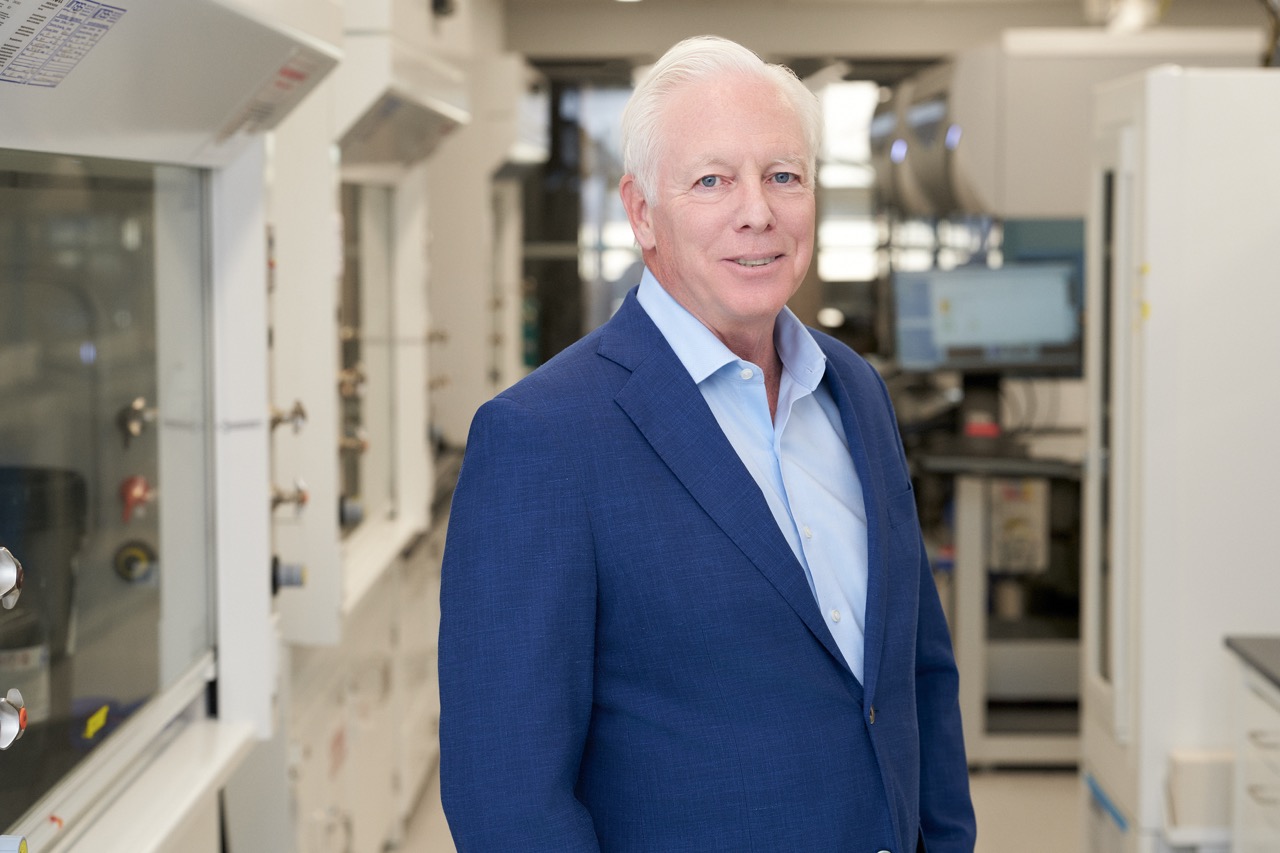
He spent a career making molecules by hand. Now he is teaching robots to do the chemistry - and betting the wall between discovery and manufacturing was never supposed to exist.
Ask Michael Foley what is wrong with drug discovery and he will not start with budgets or pipelines. He starts with a person walking away from a lab bench. The moment that happens, he says, "everything stops - science stops, healthcare stops." A century into modern medicinal chemistry, the most advanced molecule on Earth still waits for a human hand to make it. Foley has decided that is the bug, not the feature.
That is the wager behind Excelsior Sciences, the New York company he co-founded and now runs as CEO. The one-line version fits on a sticker: chemistry that machines can do. The longer version is a reordering of how small-molecule drugs come into existence. Instead of expert chemists improvising routes one flask at a time, Excelsior builds with what it calls smart bloccs - modular chemical building blocks designed so that automated systems, not people, can assemble them through iterative carbon-carbon bond formation. AI designs. Robots build. The loop closes and learns.
The point is not novelty for its own sake. The point is that the same chemistry can run at the scale of discovery and the scale of manufacturing. "From day one," Foley says, scalability "was part of the deal." Most platforms bolt scale on later, after the science works in miniature. Excelsior was drawn the other way around - manufacturing-grade from the first molecule. The promised output is concrete and unglamorous in the best way: not a paper, not a slide, but "a drug molecule, something that is ready to go into animal testing."
Drug discovery and manufacturing are at a crossroads in the West. To stay competitive, we must discover and develop better medicines - faster.
Foley did not arrive at machine chemistry by accident. He has been industrializing chemistry his whole career. As a young medicinal chemist at Bristol-Myers Squibb and then Glaxo Wellcome, he built Glaxo's first high-throughput chemical synthesis platform - the kind of infrastructure that turns a craft into a system. The instinct never left: find the bottleneck, then build the machine that removes it.
At the Broad Institute of MIT and Harvard, that instinct ran at institutional scale. As director of its Chemical Biology Platform he oversaw more than 100 staff and over 150 academic collaborations worth north of $100 million. It was, in effect, drug discovery operated like public infrastructure - shared, networked, and far larger than any single lab.
Then came a different kind of experiment. From 2014 to 2018 Foley was founding CEO and Sanders Director of the Tri-Institutional Therapeutics Discovery Institute, a rare alliance of Rockefeller University, Memorial Sloan Kettering Cancer Center and Weill Cornell Medicine, with Takeda as a pharma partner. The job was to braid three famously independent research powerhouses into one discovery engine. Later, as CEO of Deerfield Discovery & Development, he kept refining the same idea: pair academic researchers with industry discipline and let neither slow the other down. His Excelsior co-founder Jana Jensen was building alongside him there.
Long before Excelsior, Foley had a habit of starting companies. He co-founded a string of biotechs - CombinatoRx, Infinity Pharmaceuticals, Forma Therapeutics and KDAC Therapeutics among them - ventures that collectively raised billions. Excelsior, he suggests, is the one he could only build now, because the AI and automation finally caught up to the chemistry he wanted to automate.
He brought serious company. Excelsior's co-founders read like a chemistry-meets-AI dream team: Marty Burke, the chemist whose work on modular building blocks helped make automated synthesis thinkable; Bartosz Grzybowski, a pioneer of computer-planned synthesis; and Jana Jensen, his longtime operating partner. The funding matched the ambition. New York State put in $25 million through Empire State Development, matched by Deerfield Management, and a $70 million Series A arrived co-led by Deerfield, Khosla Ventures and Sofinnova Partners, with Cornucopian Capital, Eli Lilly, Illinois Ventures and MIT also on the cap table - $95 million in all, announced in December 2025.
Excelsior set up in the Cure building in Midtown Manhattan, a lab full of scientists, software engineers and automation specialists rather than the Boston or Bay Area defaults. The geography is part of the thesis. Foley sits on the Governor of New York's Life Sciences Advisory Board, and the company's launch doubles as an argument that serious therapeutics can be discovered - and made - in the West, on home soil. The reshoring of pharmaceutical supply chains is not a footnote to the pitch. It is a reason for the pitch.
What makes Foley interesting is not that he runs another biotech. It is that he keeps building the same thing at higher and higher resolution: systems that let chemistry happen without waiting on any one person to be in the room. Glaxo's platform automated a step. The Broad networked a field. Excelsior wants to close the loop entirely. If it works, the strangest part will be how ordinary it looks - a quiet Midtown lab where the molecules get made whether or not anyone is watching.
He still keeps a tie to where it started. Foley earned his B.S. in chemistry at St. Norbert College in Wisconsin, picked up a master's at Utah State and a Ph.D. at Harvard - and now sits on St. Norbert's board of trustees. The arc runs from a small Midwestern chemistry department to a company trying to hand chemistry over to machines. He is, by every public account, mid-stride.
Modular building blocks designed as a chemical language machines can read and assemble.
AI designs molecules; automated synthesis builds them; results feed the next round.
The same chemistry serves discovery and manufacturing - no rebuild for scale-up.
"Everything stops - science stops, healthcare stops."
"The output is a drug molecule, something that is ready to go into animal testing."
"From day one, scalability was part of the deal."
"To stay competitive, we must discover and develop better medicines - faster."