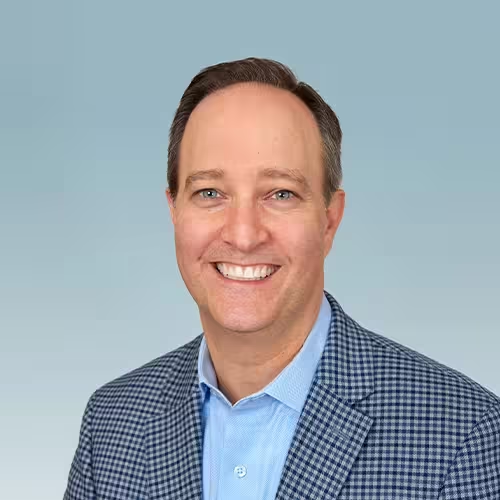
An engineer who decided the most interesting molecule was the deal.
Start with the title and you will miss him. Chief Business Officer reads like a line on an org chart. But watch what the job actually demands at a company like Solu Therapeutics, and a different picture emerges: someone fluent enough in cell biology to explain why a target nobody could drug is suddenly worth a partnership, and pragmatic enough to get that partnership signed. Michael Boretti lives in that overlap. He is the translator between the lab and the boardroom, and at Solu, the translation is the product.
Solu Therapeutics launched in 2023 in Boston around a deceptively simple idea with a hard name: CyTaC, short for Cytotoxicity Targeting Chimera. The platform - in-licensed from GSK - is built to eliminate the specific cells that drive disease, reaching cell-surface targets that antibodies have historically found intractable. It marries the precision of biologics with the vast target space of small molecules. That is a beautiful sentence to a scientist and an abstract one to an investor. Boretti's job, since March 2024, has been to make it land with both.
Solu's innovative approach to unlocking previously inaccessible targets with the CyTaC platform presents a new modality to efficiently remove the cells that drive disease across a wide range of indications.
- Michael Boretti, on joining Solu Therapeutics, March 2024The platform, in three moves
Strip the jargon and CyTaC is a hunting strategy. It finds a flag on a bad cell, grabs onto it, and triggers the cell's removal. Here is the shape of it.
Find the Target
Reach cell-surface targets antibodies could never engage - the "antibody-intractable" ones.
Bind & Bridge
A bifunctional molecule links the disease-driving cell to the body's own cell-killing machinery.
Remove the Cell
Efficiently eliminate the cells that drive cancer and immune-mediated disease.
Boretti's contribution is not the chemistry. It is the conviction. Strategic financing, alliance management, business development - the things that decide whether a platform gets the runway to prove itself. As Solu's CEO Philip Vickers put it on the day of the hire, the timing was deliberate.
His ability to drive strategic collaborations and financing activities will be an asset during this pivotal period of growth. As an accomplished, collaborative corporate strategist, Mike is an ideal addition to the Solu leadership team.
- Philip J. Vickers, Ph.D., President & CEO, Solu TherapeuticsFrom a Penn lab bench to the deal table.
Boretti did not arrive in biotech through the usual MBA side door. He came in as an engineer - twice. An undergraduate degree in engineering science from the University of Virginia, then a Ph.D. in bioengineering from the University of Pennsylvania. The doctorate matters less for what it taught him about pipettes and more for what it taught him about credibility. When he sits across from a chief scientific officer, he has been in the room where the science actually happens.
His first job out of the lab was not in a lab at all. He went into life-science consulting at L.E.K., the firm that trains people to see a company as a portfolio of bets. That instinct - reading assets, stages and structures the way other people read sentences - became his trade. From there, the resume reads like a tour of the Boston biotech ecosystem, each stop a company trying to build something from scratch.
AVEO, and a deal worth an award
At AVEO Oncology, Boretti rose to Vice President of Corporate Development and Alliance Management. He drove the formation of partnerships around AVEO's clinical and discovery-stage programs, including significant transactions with Novartis, Janssen and Astellas. One of them earned the kind of recognition that is rare for any single transaction: AVEO's co-development and co-commercialization alliance with Astellas was named Scrip's 2011 Licensing Deal of the Year. In an industry where most deals are forgotten the week after they close, that is a line that follows a person around.
Epizyme and Celsius
At Epizyme, as Vice President of Business Development, Boretti owned the full arc of a deal - planning, sourcing, structuring, negotiating and securing strategic alliances for clinical pipelines, discovery programs and platforms. Then came Celsius Therapeutics, where he stepped up to Chief Business Officer and broadened his remit well past business development: alliance management, finance, communications, legal, even IT. It was, in effect, a dress rehearsal for the breadth a small company demands of its senior people - the kind of role where the title on the door is the smallest part of the job.
"I am excited to become a part of the passionate Solu team to advance the development of novel medicines to positively impact patients' lives."
- Michael Boretti"We are delighted to welcome Mike to Solu's executive team... an ideal addition to the Solu leadership team."
- Philip Vickers, CEOThe quiet half of biotech that decides who survives.
Drug discovery gets the headlines. Drug financing gets the company to the next headline. Platform biotechs like Solu live or die on a narrow ledge: enough capital and enough partners to fund years of preclinical and IND-enabling work before a single patient is dosed. The person who manages that ledge is not the one in the white coat. It is the one who can sit with a pharma partner and make a case that the science deserves a bet.
That is the throughline of Boretti's career. AVEO, Epizyme, Celsius, Solu - four companies, four attempts to turn novel biology into durable enterprises. He has worked across deal structures, asset stages and therapeutic areas, which is corporate shorthand for: he has seen a lot of ways for a biotech to win and a lot of ways for one to stall, and he has learned to tell the difference early.
Solu is the latest test, and arguably the boldest. A modality that did not exist a few years ago, a platform handed over by a pharma giant, a pipeline aimed at oncology and immune-mediated diseases. The science is the bet. Boretti is the one making sure the bet stays funded long enough to be proven right.
It is a strangely human role inside a deeply technical field. The molecules cannot advocate for themselves. Someone has to walk into the room and argue that removing the cells that drive disease is not a slide deck but a future. For now, at Solu Therapeutics, that someone is Michael Boretti - engineer first, negotiator second, and patient about the order.
By The NumbersA platform is only as strong as its runway.
Solu did not arrive quietly. The company debuted in August 2023 with $31 million in seed funding and a pointed mission statement: unlock antibody-intractable cell-surface targets. By the time Boretti joined the following spring, the company had a CEO in Philip Vickers - a biopharma veteran of more than three decades, with stints at Merck, Pfizer and beyond - and a growing investor base that has come to include names like Longwood Fund, Sante Ventures, DCVC Bio, Pappas Capital, Eli Lilly and Alexandria Venture Investments. Total funding has since climbed toward $72 million across a Series A round.
Those numbers are not vanity. For a preclinical platform company, capital is oxygen. Every dollar raised buys months of IND-enabling studies, target validation and the slow, expensive work of turning a mechanism into a candidate. This is exactly the terrain a Chief Business Officer is hired to manage: pairing the right partners with the right programs, structuring the financings that keep the lights on, and managing the alliances once the ink dries. It is the difference between a promising platform and a forgotten one.
Boretti has done this dance before, on both sides of the table. He has sold programs and bought them, partnered platforms and licensed assets. That fluency across deal structures is the reason a company at Solu's stage reaches for someone like him rather than a first-timer. When the science is novel and the modality is unproven, the people doing the explaining need to be unimpeachable. A two-decade record and a bioengineering doctorate are not credentials he wears - they are the vocabulary he negotiates in.
There is a tidy symmetry to where he has landed. The CyTaC platform itself is a bifunctional thing - one end finds the target, the other end does the work. Boretti's career has the same shape. One end is the scientist who understands what the molecule is trying to do. The other is the operator who makes the world pay attention. At Solu Therapeutics, both ends are pointed at the same target: cells that drive disease, and a company built to remove them.