Co-founder and CEO of MetaNovas, the AI biotech betting that the next generation of skincare and medicine gets computed, not extracted.
Meijie Wang spends his days teaching machines to invent peptides - short chains of amino acids that can calm acne, smooth wrinkles, or shuttle a drug to where it needs to go. At MetaNovas, the company he co-founded in 2021 and now runs as CEO, the pitch is blunt: the rainforest took millions of years to brew its chemistry, and the lab has spent decades copying it. He thinks a knowledge graph and a fermentation tank can do it faster.
The platform reads like a software stack with a biology accent - MetaNLP, MetaKG, MetaPep, MetaOmics. It maps raw-material formulas, biological mechanisms, and molecular design across a billion-node knowledge graph, then proposes new bioactive ingredients and screens them before anyone touches a pipette. The promise is to compress a development cycle that historically ran longer than a decade into something a brand manager can actually plan around.
It is a strange place for a former game developer to end up. Wang's resume zigzags: a VR studio called Studio Qfun, a stint building an app, R&D engineering at Olympus, then AI infrastructure at NVIDIA, then AI applications work tied to Stanford's School of Medicine. Somewhere in that arc, the tools he was building stopped being the point and the molecules became the product.
MetaNovas was born on two continents at once. Since early 2021 it has run dual offices in Silicon Valley and Shanghai, a setup that lets it sit close to both the AI talent of the Bay Area and the manufacturing gravity of China's ingredient industry. Wang himself shows up in records as San Francisco one day and Shanghai the next - the company is built to live in both time zones.
The process can be accelerated through the AI method.
MetaNovas does not name its technology like a biotech. It names it like a developer tools company. Four platforms do the heavy lifting, and each one sounds like something you would import at the top of a file.
The flagship trick is MetaPep, which pairs deep learning with molecular simulation to design bioactive peptides from scratch. One of its outputs, an acne-targeting peptide the company calls MetaAMP33, is built to regulate excess sebum, push back on P. acnes bacteria, and quiet the inflammation that turns a pore into a problem. The molecules are made by precision fermentation - no heavy solvents, no animal-tissue extraction - which is both a cost story and an environmental one.
A bachelor's program built for students who refuse to pick a single lane - the seed of a career spent between engineering and biology.
A master's in Computer Software and Media Applications. The graphics-and-systems training that would later run VR studios and GPU clusters.
Studied Technology and Engineering Management - then left to build MetaNovas. The classic Valley footnote: the startup won the schedule.
A 12-person startup does not usually get to drop these logos. MetaNovas does. The Big Bang win came with a seat across the table from L'Oreal's global CEO, Nicolas Hieronimus, to talk through how computed chemistry changes cosmetics R&D.
Took the Beauty Technology Challenge, the start of a working relationship with the world's largest cosmetics group.
Peer-reviewed publications, plus stages at IFSCC, MIT ILP and the Society of Cosmetic Chemists.
A patent portfolio spanning the United States and China for AI-designed bioactive ingredients.
Named among the 250 Most Promising Early-stage Digital Health Ventures.
Led by GL Ventures and Baoding Venture Capital, with Ruoyuchen co-investing.
A contributor whose code is archived in a Svalbard mine for the next thousand years.
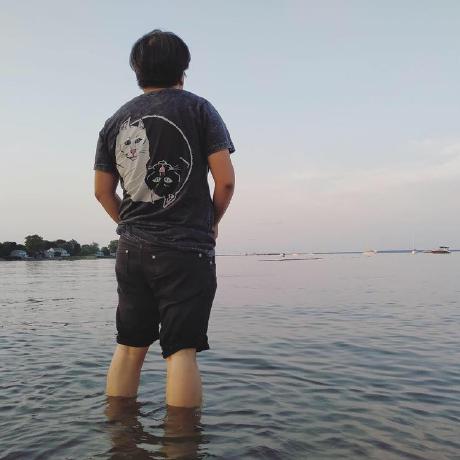
The most honest thing about Meijie Wang might be his profile photo. Most founders pick the clean studio headshot. His - the one on his GitHub, handle wmjpillow - shows him standing knee-deep in flat, glassy water, back turned, in a t-shirt with two cats on it. It is the opposite of a power pose, and somehow more memorable for it.
The GitHub bio is just as plain: “Working on AI + Biotech startup. Worked on AI application @Stanford School of Medicine. Worked on AI Infrastructure @NVIDIA.” No buzzwords. Seventy-seven repos, a pinned GPU data-science project, and a quiet Arctic Code Vault badge. The CEO still reads like an engineer because he is one.
Before peptides, there were polygons. Wang's first company, Studio Qfun, built VR and games. The throughline from rendering pixels to simulating molecules is the same instinct: model a world in software, then make it do something useful.