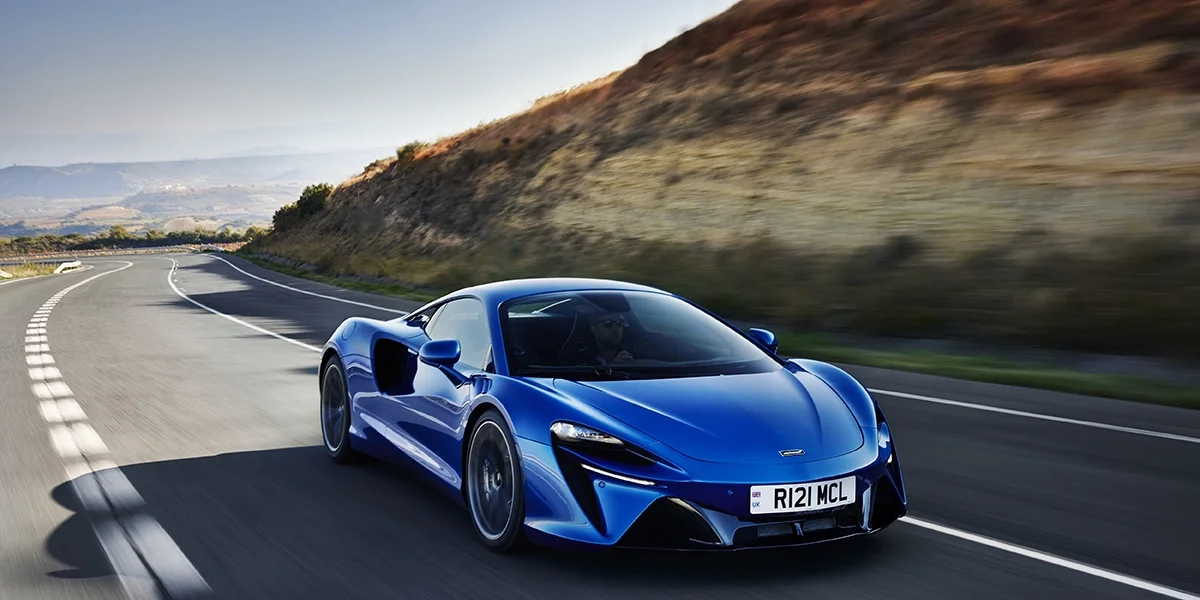
Why McLaren Chose to Break Its Own Rules
Every supercar manufacturer eventually faces the same uncomfortable dinner party question: what happens when the world stops wanting V8s? McLaren answered not with a press release, but with a clean sheet of carbon fibre and a degree of engineering audacity that would make most accountants weep.
The Artura, announced in November 2020 and revealed in February 2021, is named for a collision of two words - art and future. It sounds like something a branding agency charged six figures to invent at 3am. But the name sticks because the car underneath actually earns it.
This is McLaren's third hybrid after the P1 and Speedtail, but the first designed for series production. More importantly, it is the first McLaren built on the MCLA platform - McLaren Carbon Lightweight Architecture - a carbon fibre monocoque manufactured entirely in-house at the company's new Composites Technology Centre in Sheffield. The tub weighs 82kg. Eighty-two. That is roughly the same as a well-fed Labrador, except this Labrador can survive a crash at speeds that would redecorate a motorway.
Then there is the engine. Not the familiar 4.0-litre twin-turbo V8 that powered every McLaren road car since 2011. Instead, an all-new 3.0-litre V6 with a 120-degree bank angle - a world first for a production V6. Why 120 degrees? Because it creates space for a hot-vee turbo layout, placing the turbos inside the cylinder banks where they can spool faster and breathe easier. Only a handful of bolts carried over from previous engines. The rest is new metal, new thinking, new noise.
Paired with that V6 is an axial flux electric motor producing 95PS and 225Nm, sandwiched between engine and gearbox. A 7.4kWh lithium-ion battery pack lives behind the seats. The gearbox is an all-new 8-speed dual-clutch unit, and here is the clever part: there is no reverse gear. Reverse is handled entirely by the electric motor. McLaren found space for an extra ratio by deleting a function the e-motor could perform anyway. It is the kind of elegant solution that makes other engineers jealous.
The DriveWhat 691bhp Actually Feels Like
The numbers are easy to memorize and hard to believe. Zero to 62mph in three seconds flat. Zero to 124mph in 8.3 seconds. A quarter mile in 10.7 seconds. Top speed of 205mph. But numbers on a page are like reading a restaurant menu and calling it dinner. The Artura's real trick is how it delivers that performance.
Because the electric motor fills in the torque gap while the turbos wake up, there is no lag. No hesitation. No moment of doubt before the acceleration arrives. You press the throttle and the car simply goes, as if the road itself has tilted downhill. Top Gear described the powertrain response as deeply fast but not explosive - more surgeon's scalpel than sledgehammer. The Ferrari 296 GTB, its closest rival, feels more violent. The Artura feels more precise.
McLaren also made a deliberate and controversial choice: no regenerative braking. In a world where every hybrid harvests energy through the brake pedal, McLaren refused. They wanted pure, uncorrupted brake feel. The front end is as analogue as possible - hydraulic steering, double wishbone suspension, adaptive dampers. The result is a car that communicates with the driver in complete sentences rather than text messages.
This is McLaren integrating the technology and doing so very slickly... a very easy supercar to get on with. Maybe not as vibrant, explosive and alert as a Ferrari 296 GTB, but a better thought through daily driver.
- Top Gear, 2024There is an electronic differential, a first for a modern McLaren road car. Previous models used an open differential and managed torque distribution through the brakes. The Artura's multi-link rear suspension increases toe stiffness by 75%. On a track, the car rotates with composure that belies its complexity. On a road, it covers ground with the professionalism of a barrister who also happens to box on weekends.
Living With ItThe Cabin: Finally, a McLaren That Understands pockets
McLaren interiors have historically been divisive - striking to look at, occasionally baffling to operate. The Artura represents a genuine course correction. The cabin is more luxurious than the old Sports Series, better insulated, wrapped in materials that actually reward touch rather than merely tolerating it.
The instrument screen is all-new and mounted to the steering column rather than the dashboard, so it moves with the wheel and stays visible regardless of your driving position. Above it sit toggle controls for powertrain and chassis modes, positioned where you can prod them without taking your eyes from the road. McLaren's one-piece gearshift paddle survives, still one of the most satisfying pieces of metal to pull in the entire automotive industry.
Storage, long a McLaren weakness, has been thoughtfully addressed. There is no glovebox, but the door pockets are large and designed to retain their contents even when the dihedral doors swing skyward. The centre console is slim but clever, with channels on either side where a phone sits securely. A wireless charging pouch grips your device firmly enough that, according to McLaren, it will not become airborne no matter how fast you drive. This is a specific claim born from specific experience.
The MIS II infotainment system runs on an 8.0-inch portrait screen that prioritizes lightness and processing speed over sheer size. Apple CarPlay is standard, now available wirelessly following the 2024 updates. The factory navigation remains slightly unintuitive to program but perfectly adequate once set. Bowers & Wilkins offers a 12-speaker premium audio system with genuine clarity rather than mere volume.
The 2024 UpdateMcLaren Listened. Then They Added 20bhp.
After early customer and media feedback, McLaren treated the Artura to a significant mid-life upgrade in autumn 2024 - even though the car was barely two years old. The V6 received a remap liberating an extra 20bhp, bringing total output to 691bhp. The power delivery was tweaked to give the engine a zippier, more exciting character near the 8,500rpm redline, complete with a hard rev-limit cut-out that feels properly theatrical.
Both standard and optional sports exhausts were revised to extract more noise from the V6. New engine mounts - the old ones were carryover items designed for V8s and were too good at isolating vibration - now transmit more of the engine's personality into the cabin. The nose-lift system, powered by a new steering pump, reaches full height in four seconds instead of ten. Brake cooling has been improved using lessons from McLaren's Formula One programme. A wireless charger that your phone cannot escape from, no matter how fast you drive, was also added.
The Artura Spider arrived alongside these updates, with a retractable hardtop that opens or closes in eleven seconds at speeds up to 30mph. It weighs only 62kg more than the coupe and retains the same structural rigidity, thanks to the inherent stiffness of the carbon tub.
Three Angles. One Obsession.


Top: IAA Munich 2021 debut. Bottom left: Road car profile. Bottom right: Artura GT4 in competition at Watkins Glen.
The Details That Matter
120-Degree V6
No production V6 has ever used a 120-degree bank angle. McLaren chose it specifically to accommodate a hot-vee turbo layout, placing the turbos inside the cylinder banks for faster spool and tighter packaging.
MCLA Carbon Tub
Manufactured at McLaren's Sheffield composites centre. Weighs 82kg. Offers greater rigidity than previous platforms while being produced entirely under McLaren's own roof for the first time.
E-Reverse Gear
The electric motor handles reverse, deleting the mechanical reverse gear from the transmission entirely. This saved enough packaging space for an extra ratio - eight speeds instead of seven.
No Regenerative Braking
McLaren deliberately omitted brake regeneration to preserve pedal feel. In a hybrid world, this is either stubbornness or brilliance. The steering remains hydraulic. The suspension is double wishbone. The front end is defiantly analogue.
Electronic Differential
Previous McLarens used open differentials and brake-based torque vectoring. The Artura's e-diff is faster, more precise, and allows the multi-link rear suspension to operate without compromise.
MIS II + OTA
New ethernet-based electrical architecture reduces wiring weight by 10% and cable count by 25%. Over-the-air updates are now possible, with wireless phone mirroring added via software update.
Things You Did Not Know
- The name Artura was announced on 23 November 2020 and is a deliberate mashup of "art" and "future." McLaren claims no consultants were harmed in its creation. We have our doubts.
- The 120-degree V6 bank angle is not just unusual - it is genuinely unprecedented in series production. Ferrari's 296 uses a similar layout, but McLaren got there first.
- The wiring loom weighs 10% less than previous models thanks to the new ethernet architecture. When you are counting grams in a supercar, even the wires go on a diet.
- The Artura appeared in Season 3 of Netflix's Emily in Paris, arguably its most culturally significant moment since launch. Supercar purists wept.
- At 1,498kg, the Artura weighs roughly the same as a non-hybrid Lotus Emira. Hybrid technology used to mean obesity. McLaren proved it does not have to.
- The nose-lift system, upgraded in 2024, now reaches full height in four seconds instead of ten. Speed bumps no longer require a tea break.
Who Is This Actually For?
The McLaren Artura is for the buyer who wants hybrid technology without hybrid apologies. It is for the 570S owner ready to upgrade but unwilling to accept weight gain as the cost of progress. It is for the enthusiast who tracks their car occasionally but also needs to drive to the office without arriving deafened and dishevelled.
It is not for the Ferrari loyalist who craves theatre above all else. The 296 GTB is more explosive, more emotionally volatile, more Italian. The Artura is more considered, more precise, more daily usable. Top Gear called it a better thought-through daily driver, and that is exactly right. This is the supercar you could actually own for three years without developing lower back problems or a hatred of infotainment systems.
The Artura is evidence of McLaren's continuing maturity as a company and sends the firm into the hybrid era with confidence and capability. Shame you'll be hard pushed to spot it.
- Top Gear, 2024The only genuine criticism is visual. The Artura looks like a mildly facelifted 570S with 750S headlights. For a car that represents such a radical mechanical departure, the styling is disappointingly familiar. Existing McLaren owners considering an upgrade face the awkward task of explaining to neighbours that yes, this really is the new one. In a world where supercars are half transport and half statement, that matters.
But underneath the familiar skin lies something genuinely new. A carbon tub born in Sheffield. A V6 with an angle nobody else dared. An electric motor that does reverse. And a kerb weight that suggests McLaren's engineers have been sneaking into physics lectures and taking notes.
The Artura will not shout about what it has achieved. It does not need to. The stopwatch does the talking.