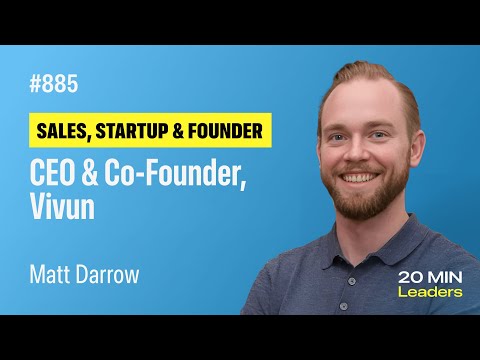
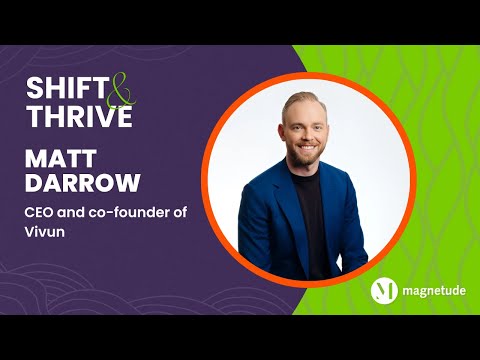
The aerobatic pilot who landed $131 million by building software for the salespeople everyone forgot about.
The list had eight or nine ideas on it. Matthew Darrow pulled it out somewhere near Lake Wanaka, in a $3,000 campervan he and his wife Dominique had bought to drive the length of New Zealand. They were on sabbatical - Darrow had just spent four years at Zuora watching it sprint from $7 million to $200 million ARR and ring a Nasdaq bell. He needed to think. Dominique, a seven-year Google engineer, went through the list item by item and crossed things out. Then she hit the one about building dedicated software for sales engineers. "Tell me more about this one," she said. "It seems like it has legs."
That conversation became Vivun. Today the Oakland-based company has raised $131 million from Salesforce Ventures, Tiger Global, Accel, Menlo Ventures, and Unusual Ventures - and its platform serves enterprise customers including Snowflake, Seismic, Autodesk, ADP, and Coupa. But the insight was almost absurdly simple: for every software tool aimed at sales reps, marketers, and customer success teams, there was nothing - zero - built specifically for sales engineers, the technical specialists who live at the exact moment a prospect decides to buy.
Darrow would know. He spent more than 15 years as one. He started at Deloitte deploying SAP and enterprise software for state governments, then discovered presales at Big Machines (acquired by Oracle), then built Zuora's global sales engineering function from scratch. He watched the IPO happen, then walked away to code from campsite Airbnbs because he was convinced the presales role was the most important function in B2B sales that nobody had bothered to instrument.
He was right. Gartner research showed that sales engineers are the buyer's preferred point of contact - more trusted than account executives, more technically credible than marketing. Yet there was no software measuring their impact, tracking product feedback, or connecting their work to revenue outcomes. "Why don't sales engineers have any dedicated software?" is the question Darrow kept asking. Nobody had a satisfying answer. So he wrote the first version himself, from New Zealand, before he even had a co-founder.
Back in the US, Darrow recruited John Bruce - a longtime Zuora colleague and former early Pandora engineer - with a three-page pitch delivered inside a blue folder over dinner. Bruce's wife Claire watched from the other room and, alarmed by what she described as a suspiciously MLM-style recruitment setup, started yelling about pineapples to distract her husband. She didn't stop John from signing on. She later joined as COO. The four co-founders - two married couples - brought together software architecture, customer success, legal operations, and 25 combined years of presales experience. The company has never had external tension over founder alignment. It's hard to argue about equity distribution at the dinner table.
The seed round nearly didn't happen. Darrow bootstrapped for nine months while pitching the wrong investors - late-stage VCs who had zero interest in seed-stage companies and zero framework for thinking about presales software. "We were wasting months," he later admitted. The pivot to seed-stage specialists, combined with strategic angels including Godard Abel (G2 CEO), Tyler Sloat (Freshworks CFO), and Shailesh Rao (ex-Google Enterprise), finally provided the credibility to close. Getting that first term sheet, Darrow said, "was huge validation."
Since then, Vivun has navigated COVID (the company was remote-first by design, predating the trend by years), the 2022 Russia-Ukraine crisis that affected Ukrainian engineers on the team, the Silicon Valley Bank collapse, and the generative AI disruption - each one handled without layoffs and with what former team members describe as unusual operational composure for a company its size. The first time Vivun held an all-hands in person was in Chamonix, France, more than three years after founding. It felt, Darrow said, like the company finally existed in three dimensions.
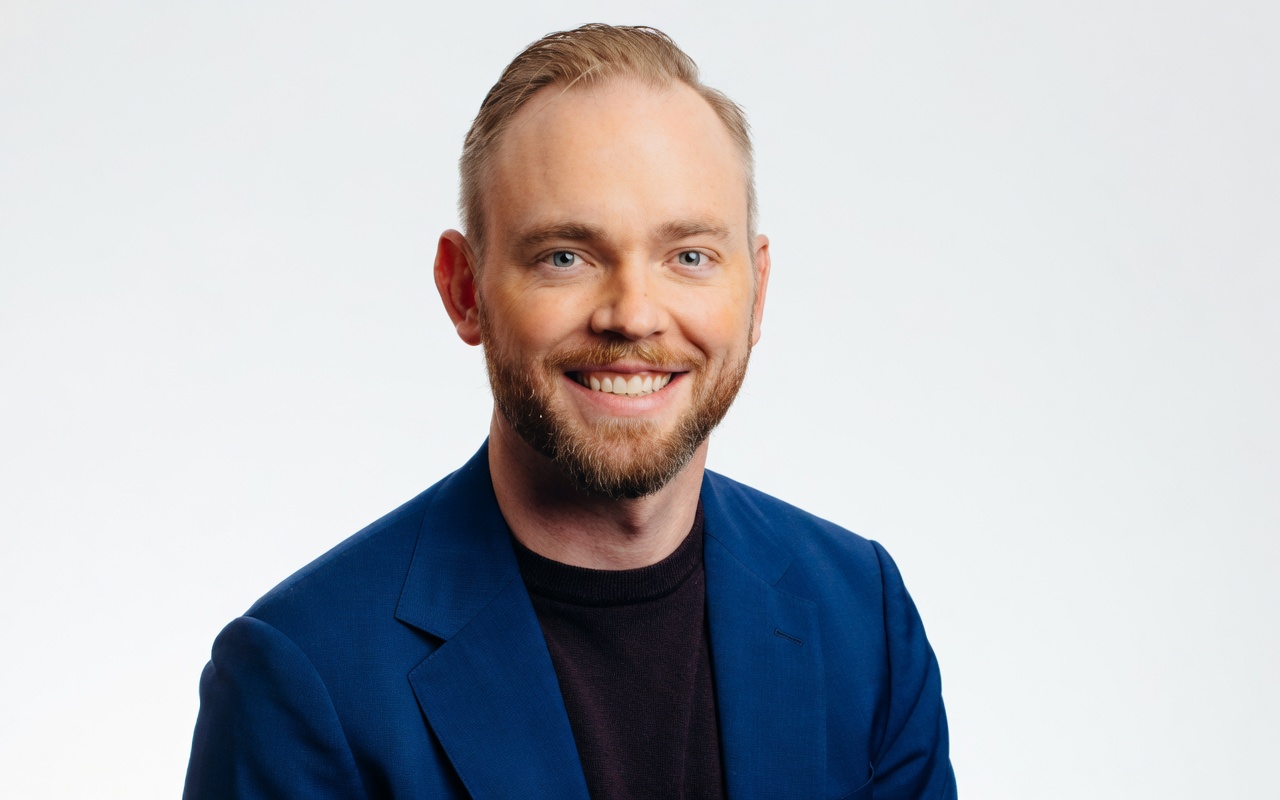
"Between my co-founder John Bruce and I, we have 25 collective years of doing the job - we know exactly what needs to be built and why."- Matthew Darrow, CEO of Vivun
Darrow grew up moving - Ohio to Japan to Pennsylvania to California. That kind of early mobility builds a specific tolerance for ambiguity that most people don't encounter until their thirties. He credits it as foundational to entrepreneurship.
He studied mechanical engineering because of a childhood obsession with roller coasters - the physics of velocity, force, and structural limits. He earned his master's at UCLA, then discovered relatively quickly that sitting alone at a desk writing code wasn't how he wanted to spend his time. Deloitte and SAP deployments for state governments got him into rooms where enterprise decisions happened. Big Machines got him into presales. And presales, it turned out, was where his instincts lived.
He spent a decade-plus as a practitioner - not a theorist, not an analyst, but someone doing the actual work of translating complex software into customer outcomes. At Zuora he rose to VP of Sales Engineering and VP of Product, watching the company scale from Series B to IPO. The gap he identified wasn't abstract. He'd lived it every day: no software measuring utilization, win rates, product gaps, or forecast accuracy for the presales team. "Why don't we have anything?" wasn't a pitch. It was a genuine question he'd been asking for years.
Creating a software category from scratch is one of the hardest things a founder can do. There's no analyst coverage to cite, no budget line already earmarked, no conversation already happening in the CIO's conference room. Darrow spent years explaining what presales software even was before he could pitch why Vivun was the best version of it.
His original 45-slide Deloitte-style investor deck was a tell - the instinct to prove everything with data before asking for trust. Investor feedback compressed it to two slides. The first established deep personal experience with the problem and a unique market insight. The second quantified the market: for every three sales reps globally, there's roughly one sales engineer. Salesforce alone claims 70 million salespeople. That's potentially 23 million presales professionals - a market nobody had software for.
VivunOne eventually became a unified platform covering presales operations, product-field alignment, demo automation, and AI-powered analytics. The most recent addition is Ava - an AI sales engineer agent that handles the 80% of presales work that's repetitive: generating proposals, running standard demos, mapping technical requirements, handling objections from a knowledge base. It's the version of Vivun that Darrow probably pictured from the back of that campervan.
When Darrow arrived at John Bruce's house with a blue folder and three handwritten pages to pitch his startup idea, Claire Bruce watched from across the room and grew alarmed - it looked, from her vantage point, unmistakably like an MLM recruitment scene. She started yelling about pineapples to break her husband's attention. It didn't work. John signed on. Claire later became Vivun's COO.
"I questioned why I was commuting three hours a day or why I had to live in the backyard of where my office space is."- Matthew Darrow, on the sabbatical that sparked Vivun
Founded Vivun in 2019 and created an entirely new software category - presales operations - before Gartner or Forrester had a name for it.
Raised $131M across four rounds in four years. Lead investors include Salesforce Ventures, Tiger Global, Accel, and Menlo Ventures.
Scaled Zuora from Series B through Nasdaq IPO as VP of Sales Engineering - witnessing $7M to $200M ARR before founding his own company.
Vivun's platform delivers 37% higher technical win rates, 31% shorter sales cycles, and 95% faster pipeline insights for enterprise customers.
Hired Joe Miller, former AI programming lead at Bridgewater Associates, as Chief Data Scientist. The resulting AI architecture is patented and production-grade.
Forbes Business Council official member since March 2021. Licensed aerobatic pilot certified for unlimited aerobatic maneuvers - because apparently building a unicorn wasn't enough.
"Getting that first term sheet was a big milestone because it was huge validation. Up until that point, we were bootstrapping the company."
"Startup building is all consuming and I don't think we would have the success that we have right now as a company if both partners weren't fully committed."
"When Dominique looked at the list, she quickly identified items that weren't realistic, but when she got to this one, she asked me to tell her more about it because it seemed like it had legs."
The presales function - also called sales engineering, technical sales, or solutions consulting - exists in every major B2B software company. These are the engineers who run technical demos, answer hard product questions, write custom proposals, and sit in rooms with a customer's CTO to prove that a piece of software does what the salesperson promised it does.
Before Vivun, they had no software of their own. They were tracked in Salesforce fields designed for account executives. Their win rates were guesses. Their time allocation was invisible. Product teams had no structured channel for the field intelligence that sales engineers collected every day on customer objections, feature gaps, and competitor weaknesses.
VivunOne addresses this across four modules: presales operations (measuring and scaling the SE function), product-field alignment (routing field intelligence to product teams), demo automation (handling the routine 80% of demonstration work), and Ava (the AI sales engineer agent for autonomous deal progression). The company's Chief AI Officer is Joseph Miller, whose earlier work at Bridgewater Associates gave Vivun's AI architecture a foundation that's unusual for a 90-person startup.
Darrow's public ambition is a publicly traded company. His framework for getting there involves three layers: formal category recognition from Gartner and Forrester (so presales software has its own quadrant, not just a footnote inside CRM), revenue scale that forces that recognition, and an AI product layer that extends Vivun's value beyond human-staffed presales teams to fully autonomous deal execution.
Ava is the first version of that autonomous layer. The goal is an AI sales engineer that handles initial technical qualification, standard demonstrations, proposal generation, and objection handling - freeing human sales engineers for the complex, relationship-intensive work that still requires judgment. The framing Darrow uses: "automate the 80%, amplify the 20%."
His view on AI in enterprise sales is pointedly skeptical of hype. On the Ascend Podcast in late 2024, he made a clear distinction between AI tools that generate activity (gimmicks) and AI tools that generate outcomes (gold). Vivun's bet is on structured domain knowledge - knowledge graphs, not generic LLM outputs - as the foundation for reliable AI sales behavior in complex enterprise environments.
Vivun's Chief Data Scientist, Joseph Miller, previously led AI programming at Bridgewater Associates - the world's largest hedge fund, famous for its systematic approach to decision-making. That background is embedded in how Vivun thinks about AI architecture: rules-based, explainable, auditable. Not a chatbot. A reasoning model.