A vet you can text, before you've finished panicking
It is 2am and the dog has eaten something he should not have. Most people open a browser and fall into a spiral of contradictory advice written by strangers. Marc Atiyeh built the alternative: open an app, and within minutes a licensed vet is on the line by text, call, or video. No appointment. No clipboard. A flat fee, and a $3,000 emergency fund sitting behind it in case the news is bad.
That is Pawp, the company Atiyeh co-founded in 2019 and runs as CEO. It now counts as one of the largest digital pet telehealth clinics in the United States. But the origin is smaller and more human than the scale suggests. Atiyeh wanted a pet question answered by someone who actually knew the answer. "I wanted to talk to someone I could trust: a vet," he has said. The internet gave him anecdotes. He wanted a clinician.
Here is the part that complicates the pitch, and the part Atiyeh likes to say out loud anyway. Pets cannot describe their symptoms. "Unlike in human telehealth, there's no silver bullet for pet telehealth," he told Sacra. "We can't diagnose virtually. Pets can't talk." A lesser founder would have buried that. Atiyeh built the whole product around it - triage, reassurance, and a clear hand-off to physical care when the screen reaches its limit.
Digital healthcare isn't going to replace physical healthcare, but the best outcomes happen when digital and physical work hand in hand.
Marc AtiyehBeirut to Cambridge, by way of a brother
Atiyeh grew up in Beirut and went to school at College Notre-Dame de Jamhour before landing at Harvard, where he studied electrical engineering and computer science and graduated in 2014. He is fluent in English, French and Arabic, with enough Spanish and Italian to get by. He credits his brother Karim and his family's sacrifices for the path that got him there, and he does not soften the gratitude: "I'm a living example of how Harvard can change lives."
The engineering training is not a footnote. Asked how he learned to build a company through trial and error, he answered plainly: "I absolutely learned how to do those things at SEAS." While still a student he started Help Me Get In, an admissions advisory aimed at students from developing countries who were trying to do exactly what he had done.
The fintech years, where the playbook was written
Before pets, there was money. Atiyeh was Head of Growth at Paribus, the price-tracking startup later acquired by Capital One, where he grew the user base from 10,000 to nearly a million in a single year. Then he was Chief Strategy Officer at Clarity Money, the personal finance app Goldman Sachs swallowed. Two acquisitions, two crash courses in scaling consumer products fast and cheap. He carried the habit into Pawp, which now grows roughly 95% organically - a deliberate move to what he calls "CAC-less growth," leaning on content and distribution instead of buying every customer.
One side effect: Pawp's library of plain-spoken pet content quietly dominates search. The guide for the query "My dog ate weed" ranked number one. It is not glamorous. It is exactly the moment a panicked owner needs a calm, trustworthy voice - which is the entire thesis, delivered as SEO.
There just aren't enough vets to care for all the pets in the U.S.
Marc Atiyeh, on the shortage that built his marketThe pivot that made the company
Pawp did not start as a clinic. It started as an e-commerce idea in 2019, co-founded with fellow Harvard SEAS alumni Andrew Malek and Cody Simons. Then 2020 arrived, pet adoptions surged, vet clinics shut their doors, and the gap between owners and care widened overnight. Atiyeh pivoted the company into a digital health clinic and launched in September 2020. The timing was not luck so much as attention - he saw the shortage and the surrender problem at the same moment, and pointed the company straight at them.
The surrender problem is the one he returns to most. Too many pets get given up or put down simply because the bill is more than the household can carry. Pawp's flat $19-a-month plan covers up to six cats or dogs regardless of age, breed or preexisting condition, with a $3,000 annual emergency fund attached. The model deflected an estimated $10 million in unnecessary vet visits across its first stretch, while still routing the real emergencies to clinics.
Money in, money not made
By 2021 the model had attracted capital. A $13M Series A led by Lux Capital came in oversubscribed roughly threefold, with a roster of backers that reads like a consumer-startup hall of fame: the founders of Warby Parker, Harry's, Allbirds, Ramp, Better and Deel, plus Ro, ZocDoc and Eight Sleep. Across rounds the company has raised more than $27 million.
Atiyeh is unusually blunt about where Pawp does not earn its keep. On the pharmacy - the obvious place a pet company would mark up margins - he is flat: "We don't make money off the pharmacy. This is not our business model." The discounts get passed through. The business is the membership. He is just as candid about competitors, noting that vets "absolutely hate Chewy," and that the trust of clinicians, not the size of a catalog, is what lets a company actually move into telemedicine.
Where this is going
In 2022, Atiyeh and Malek made the Forbes 30 Under 30 list for Consumer Technology. Atiyeh has since taken the story to Jim Cramer on CNBC's Mad Money and to Fox Business, arguing the same line each time - that pet care can be both good and affordable, and that the two are not enemies. In May 2024 the argument got its biggest stage yet: a national partnership putting Pawp's telehealth service inside Walmart's membership program, the "phygital" model he had described for years finally riding someone else's footprint into towns where vets are scarce.
The Walmart move is the clearest expression of a vision Atiyeh had been describing for years. He never wanted to operate a hundred clinics himself. The plan was always to replicate the "phygital" model - digital triage paired with physical care - by riding the footprint of a major retailer or veterinary chain, and to aim it at the underserved markets outside big cities where the vet shortage bites hardest. The order of operations matters to him. As he puts it, the physical visit should follow from the digital one, not the other way around: "it's because we can do it virtually that we're going to have to do physically."
He does not run the company alone, and he does not pretend to. Pawp was built with two fellow Harvard SEAS alumni, Andrew Malek and Cody Simons, and it was Atiyeh and Malek who shared the Forbes honor in 2022. Outside Pawp, Atiyeh keeps a hand in the wider startup world as an advisor to Nuvocargo, the cross-border logistics company, and Cushion.ai, a consumer fintech tool - a tell that the growth operator from the Paribus and Clarity Money years never fully left the building.
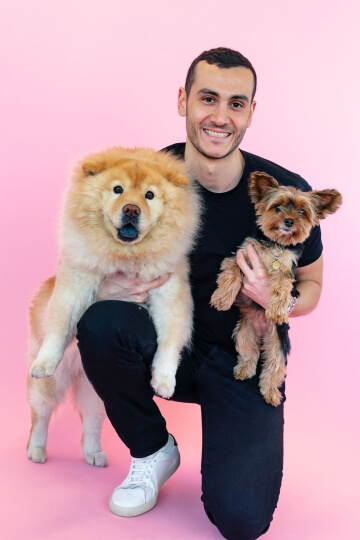
He still has two dogs, Chelsea and Fluf. Chelsea, a Yorkie, has more than 250,000 TikTok followers - a reminder that the man optimizing veterinary access at national scale started, like everyone else, as someone who just loved his dog and wanted to keep her well. "We founded Pawp to democratize pet care," he says. The line could be a slogan. Coming from someone who searched for a vet he could trust and ended up building one for everyone, it reads more like a receipt.
Eight lines that explain the man
"We founded Pawp to democratize pet care."
On the mission"I wanted to talk to someone I could trust: a vet."
On why he started"We can't diagnose virtually. Pets can't talk."
On the hard limit"We don't make money off the pharmacy. This is not our business model."
On the economics"Our mission is to make pet care accessible and affordable for everybody."
On the goal"I'm a living example of how Harvard can change lives."
On gratitude