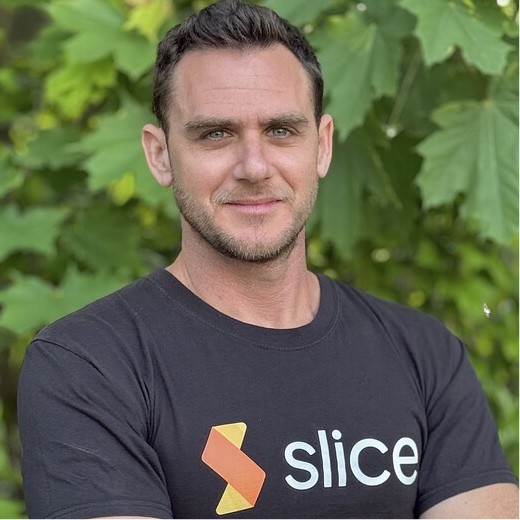
Maor Levran runs a company most founders would never think to start. Slice, the New York and Israel-based business he co-founded and leads as CEO, sells software for one of the least glamorous problems in modern work: making sure that when a company hands an employee stock options or restricted shares, it does so without breaking the tax and securities laws of whatever country that employee happens to live in. It is unglamorous. It is also, as Levran discovered over a long career in law, a problem that quietly costs companies and their people enormous amounts of money.
Today Slice manages equity for more than 70,000 employees across roughly 60 countries, for customers whose combined enterprise value tops $100 billion. Names on the roster include the cloud-security company Wiz, the self-driving startup Wayve, and the medical-imaging firm Aidoc. In January 2026 the company raised a $25 million Series A led by Insight Partners, bringing its total funding to $32 million. For a business built around cross-border compliance paperwork, that is a striking amount of investor conviction.
The pitch is direct. Slice is an AI-powered platform that lets finance and legal teams create, issue, track, and monitor equity awards while staying compliant with the rules of each jurisdiction. The company says it cuts legal consulting costs by roughly 80% and shortens equity operational cycles by about 60%. Those two numbers are the entire argument, and Levran has spent years earning the right to make it.
The lawyer's education
Before Slice, Levran was a corporate attorney, and not an anonymous one. He was repeatedly ranked a Top Tech Attorney by The Legal 500, the industry guide that tracks the practitioners companies actually call when the stakes are high. His path there started young. He studied law and business administration - with a finance major - at Reichman University in Israel, graduating in 2009 with a foot in both worlds at once. That combination turned out to be the whole story.
His first serious exposure to employee equity came even before law. As a supervisor in the ESOP department at Tamir Fishman, he watched how option plans were built and administered from the inside. From there he moved into private practice - first as an associate at GKH Law Offices, then across roughly eight years at H-F & Co. Law Offices, where he rose to partner. The work was equity, options, and the fine print of how companies compensate people. He saw the same failure repeat itself in country after country.
What he noticed was that the tools didn't exist. Payroll had software. Cap tables had software. But the messy middle - the part where a grant collides with the tax code of a specific country and a specific employee - was handled by lawyers, spreadsheets, and hope. And when it went wrong, it went expensive.
The $200,000 problem
Levran has pointed to real cases where individual employees faced fines exceeding $200,000 because of equity compliance mistakes. Not the company - the employee. A person who accepted stock options as part of their pay, moved between countries, and ended up on the wrong side of a rule nobody explained to them. For Levran, that was the kind of detail that separates a nuisance from a mission. Equity is supposed to make employees wealthier. Handled badly, it does the opposite.
So in 2022 he stopped billing hours. He co-founded Slice with a team built to attack the problem from more than one direction. Yoel Amir, an AI product manager who had worked at Google and Salesforce, came on as chief product officer. The founding group paired Levran's deep legal fluency with the kind of product and engineering muscle that turns domain knowledge into a working system. The bet was that the hardest part - understanding the rules - was the part Levran already knew cold.
That is the quiet advantage of a lawyer-founder in a field like this. Most legal-tech companies are built by engineers who have to go learn the law. Levran spent 15 years living inside it. He knows which regulation trips up which grant type in which country, because he was the person clients called when it happened. You can hire that knowledge. It is much harder to hire the instinct for where the landmines are buried.
Building the boring moat
Global equity compliance does not trend. It is not the kind of company that gets breathless coverage on tech social media. And that, in a sense, is the point. Levran chose a problem that is genuinely hard, genuinely painful, and genuinely ignored - the combination that keeps competitors away and customers loyal. When the alternative to your product is a small army of lawyers in 60 countries, the value proposition writes itself.
Slice emerged from stealth in February 2024 with a $7 million seed round led by TLV Partners, with participation from R-Squared Ventures, Jibe Ventures, and the law firms Wilson Sonsini and Fenwick & West. At launch it covered around two dozen countries and set a target of 100-plus. By the time Insight Partners led the Series A in early 2026, the coverage had expanded to roughly 60 countries, the customer base had grown into the hundreds, and the platform was managing equity for tens of thousands of employees.
The Series A investor list is telling. Alongside Insight Partners sat Fenwick and Cooley - two of the most prominent law firms in technology - plus returning backers TLV Partners, R-Squared Ventures, and Jibe Ventures. When the law firms whose business Slice partly automates are also writing checks into it, that is a strong signal about where the work is heading.
What comes next
Levran's stated ambition is to push Slice toward becoming the default infrastructure layer for cross-border equity - the thing companies simply plug into when they want to grant options to people scattered across the map, without having to reinvent compliance every time. That means widening country coverage toward 100-plus, deepening the AI that watches for regulatory changes, and turning a category that used to run on legal opinions into one that runs on software.
It is a specific, unfashionable, durable bet. And it fits the person making it. Levran did not stumble into equity from the outside looking for a market. He spent his whole career at the exact intersection of law and finance where the problem lives, watched it hurt real people, and decided the honest response was to build the tool that should have existed all along.
Slice appears on the NASPP Equity Expert podcast and in the trade press as the company translating a lawyer's frustration into product. Behind it is a founder who knows the material well enough to make it look simple - which, for anyone who has ever tried to grant equity across borders, is the highest compliment the work can earn.