YesPress // Profile
Manan & the Math
He is not running a tutoring company. He is running a twenty-year argument with how the world teaches numbers.
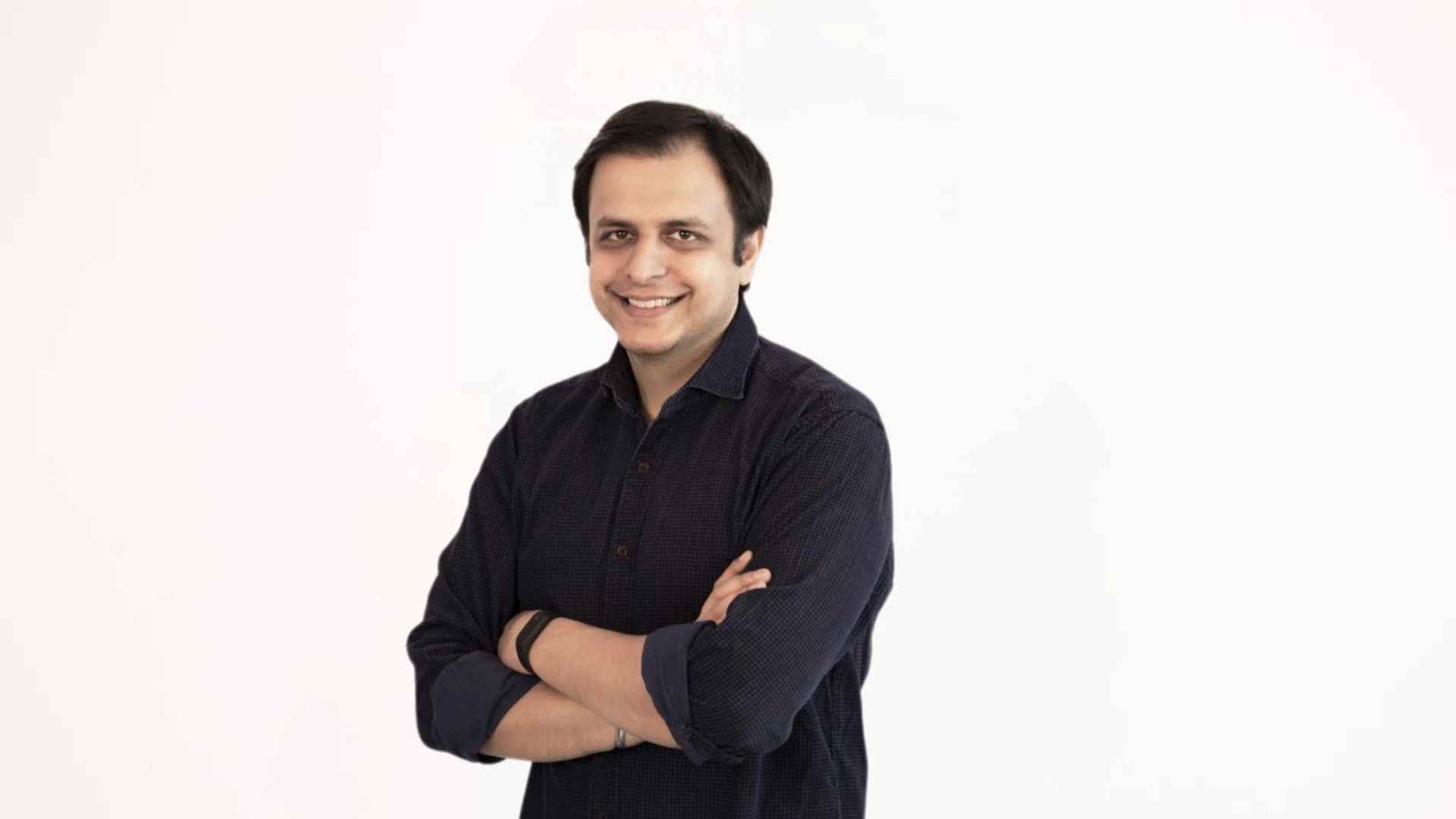 Exhibit A — the founder, mid-thesis
He is not running a tutoring company. He is running a twenty-year argument with how the world teaches numbers.
Exhibit A — the founder, mid-thesis
The bio on his Instagram does not say founder. It does not say CEO. It says learn with Manan, the handle of a man who would rather post a fractions problem than a selfie. This is the tell. Manan Khurma sits at the top of an organization with 2,500 employees, a tutor bench of four thousand, and a hundred-and-twenty-four million dollars on the books, and his preferred output is still a worksheet.
Cuemath, which he founded in 2013 from a coworking desk in Bengaluru, now teaches K-8 math to children in more than eighty countries through live 1-on-1 classes. The growth is not the interesting part. The interesting part is that he has been doing the exact same thing - sitting beside a kid, watching where their reasoning breaks - since he was nineteen, in a JEE coaching room in Delhi, before he had a degree to coach with.
Khurma grew up in Amritsar, in the shadow of the Golden Temple, in a house that ran on lectures. His father taught chemistry. His mother taught biology. Both were university professors, both kept the right books on the right shelves, and both raised a son who admits, openly and without embarrassment, that he fell in love with mathematics the way other children fall in love with cricket.
He went to IIT Delhi to read Electronics and Communication Engineering and graduated in 2007. By then he had already started a small JEE prep brand named Locus Education out of a real, brick-and-mortar room. He was teaching calculus to seventeen-year-olds while in his second year, and by the time he walked off the IIT campus he had a business, a payroll, and a hypothesis that would take him the next two decades to settle.
The hypothesis was this. Most students who failed the JEE did not fail because they could not understand calculus. They failed because they could not understand fractions. They had reached the eleventh grade with a load-bearing crack in their foundation, and by then the building was already too tall to retrofit. He had ten thousand data points to confirm it. So in 2013, with about forty lakh rupees of his own money, he stopped working on the symptom and went after the root. He left the JEE business and started Cuemath, aimed at the kindergarten-through-eighth-grade window where the cracks first appear.
The first version of Cuemath ran out of suburban living rooms. Teachers - almost all of them women, many returning to work after a break - were trained, certified, and given a curriculum, and parents sent their children to learn next door. It was a thin-margin, hands-on, deeply local business. It was also, charmingly, the exact business model a math professor's son might design - tutors in the neighbourhood, worksheets on the table, no rote.
Sequoia Capital India led the Series A in 2016. CapitalG, Google's growth fund, led the Series B a year later. Then the pandemic arrived and broke the living-room model overnight. Cuemath flipped to live online classes and discovered that the format scaled in a way the franchise never had. By 2022 the company was operating in more than seventy countries; Alpha Wave Global led a $57M round and doubled the valuation. By 2023 the student count had crossed two hundred thousand and Khurma turned up on the Fortune India 40 Under 40 list.
The cliche about Indian edtech is that it eats founders. The category has chewed through hype cycles, valuations, accounting scandals, and entire business models. Khurma has lived inside it for ten years, raised three institutional rounds, and - this is the strange part - did the whole thing as a solo founder. No co-founder, no flashy second-in-command on the deck. One man, one thesis, one decade.
Ask him what he is actually trying to do and the answer is not "build a unicorn." It is a phrase he says often enough that it now hashtags itself: One Billion MathMinds. A billion children worldwide who think mathematically as a default reflex. He treats this as a real number, not a slogan. In an LLM-saturated 2026, he argues, the human edge is not knowing facts - the models will always know more - but the ability to reason. Mathematics, he insists, is the only general-purpose reasoning gym we have invented for children. The marketing copy on Cuemath's website sells classes. The founder is selling something stranger: a worldview.
If you want a single object that captures Manan Khurma, it is this. A photo he posted in early 2023, taken outside a small house in Lincolnshire, England - Woolsthorpe Manor, where Isaac Newton spent the plague year of 1665 and invented calculus and a theory of gravity at the same time. The caption was three lines of unguarded fan-mail. There is no PR distance in it. He is, as he has always been, a math nerd taking a selfie with his hero. The founder is incidental. The teacher is permanent.
Across two decades, three companies, four investors and eighty countries, that has been the constant. Cuemath is the wrapper. The math is the message. And the man behind it still grades the worksheets.
Starts teaching JEE math to high-schoolers while still in his second year at IIT Delhi.
Graduates with a B.Tech in Electronics. Formally founds Locus Education, a JEE prep brand.
Closes Locus and launches Cuemath with ~Rs 40 lakh. Hires neighbourhood teachers, mostly women, to run home-based math centres.
Sequoia Capital India leads the Series A.
CapitalG (Google's growth fund) leads the Series B.
Pandemic forces a pivot from living-room franchises to live 1-on-1 online classes. Format scales.
Cuemath raises $57M led by Alpha Wave Global. Valuation doubles. Operating in 70+ countries.
Fortune India 40 Under 40. Cuemath turns ten. Student base crosses 200,000.
Funding rounds disclosed publicly. Bars scaled to round size.
Solo founder. Three institutional rounds. A tutor network larger than most school districts. A pivot from brick-and-mortar franchises to live 1-on-1 online classes executed during a pandemic that nuked the original model.
Hand-marks problem sets in his head while reviewing curriculum decks. Speaks about math the way music critics speak about Coltrane. Considers rote learning a kind of theft from a child's future.
In early 2023 he flew to Lincolnshire and photographed himself outside Woolsthorpe Manor, the farmhouse where Newton spent a plague-year inventing calculus. His caption read like a teenager meeting a band. The CEO posture vanishes entirely around dead mathematicians.
Cuemath's recruitment quietly built one of India's largest networks of certified female educators, many of them returning to work after raising children. The PR rarely leads with this. The bench is the moat.
Father in chemistry. Mother in biology. He picked the third base of the scientific table - mathematics - which, in retrospect, looks less like rebellion than completing the set.
Instagram says @learn_with_manan. Not follow. Not watch. Learn. Notice the verb the founder has chosen for himself.