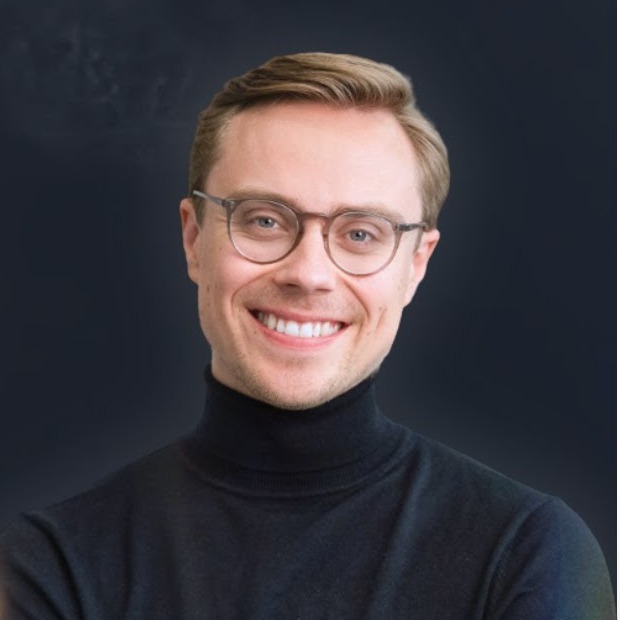
A voice company that learned to listen
In January 2026, Parloa was worth three billion dollars. Eight months earlier it had been worth one. Kosub runs the company from two continents - a Berlin headquarters and a New York office he opened in 2024 - and spends his days convincing some of the largest brands on earth that the right way to answer a customer call is to let an AI agent pick up. Allianz did. So did Booking.com, IKEA, SAP, Swiss Life and HealthEquity.
The pitch is deceptively simple. Most contact-center software automates the boring parts and hands the hard parts to a human. Parloa wants to flip that: build AI agents good enough to handle the whole conversation - on the phone, on the website, inside the app - and make each one feel less like a phone tree and more like a person who already knows you. Kosub calls the underlying market “one of the biggest opportunities that has ever existed in software.” He also notes, with some satisfaction, that the field is thinning out: “the number of competitors is decreasing significantly.”
What makes this interesting is not the funding. It is that Parloa spent roughly seven years as a business before it took a cent of institutional money. The growth that looks meteoric on a chart was, up close, a long and unglamorous slog through a consulting business, a rebrand, and a near-death stretch where the team almost walked.
If other people aren't telling you you're crazy, you're not thinking big enough.
The agent that answers before you finish the sentence
Strip away the funding headlines and Parloa is a piece of plumbing for conversations. Its platform - Parloa calls it an AI Agent Management Platform - lets a company design, test and run AI agents that handle real customer interactions end to end. Not a chatbot that deflects you to a form, and not a script that breaks the moment you go off-menu. The goal is an agent that can take a phone call from an insurance customer, understand the claim, check the policy, and resolve it without a human ever joining the line.
That is harder than it sounds, which is the whole point. Enterprise customer service is a graveyard of half-working automation. Companies like Allianz and Swiss Life do not buy software that occasionally hangs up on a paying customer. Parloa's wager is that the latest generation of language models has finally made these agents reliable enough for regulated, high-stakes industries - insurance, travel, financial services - where a wrong answer is expensive. The company says it crossed $50 million in annual recurring revenue, a number that only happens when large organizations trust you with their phone lines.
Kosub frames the next chapter as a move from automation to personalization. The vision he describes in interviews is not a single corporate help-desk bot but a personal AI agent for every customer - one that remembers context across the phone, the website and the app, and behaves less like a switchboard and more like a concierge who already knows your account. The Series D money is earmarked for exactly that: contextual, multi-model experiences, and continued expansion across the United States and Europe.
Shipping, song lyrics, and a school music contest
Kosub grew up in Hamburg, a port city, and the obvious career for an ambitious kid there is shipping. He nearly went. Instead, in the 11th grade, he founded a nationwide music competition - an NGO that grew to about 50 volunteers and partnerships with more than 250 schools. That is an unusual thing for a teenager to build, and it tells you most of what you need to know: he likes organizing people around something larger than himself.
The next venture had better trivia. His e-commerce startup, Wandnotiz, was the first to license rights from Universal Music and Sony to print song lyrics onto physical products. Securing a catalog deal with two major labels is hard for a record company; he did it as a student selling prints. He sold the business.
Then came the insight that mattered. Around 2016 he noticed that speech-to-text had quietly crossed a line - machine transcription was approaching human quality, and fast. If computers could finally hear properly, he reasoned, the entire way companies talk to customers was about to change. In 2017 he co-founded Future of Voice, one of Europe's first conversational-AI agencies, and started advising Red Bull, Vodafone and Deutsche Bahn on how to talk to machines.
The agency was the trojan horse. While consulting paid the bills, Kosub and co-founder Stefan Ostwald were quietly building software on the side - a platform they spun out as Parloa in 2018. For four more years the two businesses ran in parallel. In 2022 they sold the consulting arm, raised their first institutional round, and bet everything on the software.
The organizer
Founds a national school music contest as a student. 50 volunteers, 250+ schools.
The dealmaker
Wandnotiz licenses lyrics from Universal and Sony to print on products. Later sold.
The bet
Founds Future of Voice as speech-to-text crosses into human-quality territory.
The funding ladder
Resilience over genius
Ask Kosub what it takes and he does not reach for the word brilliant. He reaches for resilient. You face challenges every single day, he says, and if you are not built to absorb them you will not last long enough for the good part. The early years of Parloa included a stretch where the team nearly emptied out and he was putting his own money in to keep the lights on. He talks about that period plainly, the way founders only do once the outcome is no longer in doubt.
The other recurring theme is narrative. Kosub believes a founder's real job is telling a grand story - big enough that reasonable people think you have lost the plot. His stated ambition is not to build a nice German software company. It is to build a $100 billion company out of Germany, and to prove that world-leading technology companies can be built in Europe rather than only consumed there. It is the kind of sentence that gets you funded or laughed at, and he seems comfortable with either.
He is also, by his own telling, a family operation as much as a corporate one. His brother joined the company early and stayed. His partner, who comes from an entrepreneurial background, is the reason the punishing hours have not ended the relationship. “Life,” he likes to say, “is about the people you meet and the things you create with them.”
For founders trying to break into AI, his advice is unsentimental and slightly contrarian. Use the tools obsessively yourself rather than reading about them. Follow the people actually shipping, not the ones narrating. Work hard, because the field is crowded and talented. Keep learning, because the ground shifts monthly. And if you are early in your career, join an AI-first company rather than bolting AI onto an old one. None of it is glamorous. All of it is the kind of thing people only say after they have done it the hard way.
A European company with American ambitions
There is a quiet argument running underneath everything Kosub says, and it is about geography. The prevailing wisdom holds that defining technology companies come from Silicon Valley, that Europe builds solid businesses but cedes the giants to the United States. Kosub finds this both wrong and a little insulting. Parloa keeps its headquarters in Berlin on purpose. It hires across Berlin and Munich. And it opened in New York in 2024 not to relocate the company's soul but to win the largest market in the world on its own turf.
The investor roster reads like a vote on that thesis. EQT Ventures backed the Series A and has stayed in through every round since. Altimeter Capital led the Series B. The 2026 Series D was led by General Catalyst, with Altimeter, EQT Ventures, Durable Capital Partners and Mosaic Ventures all returning. That is a lot of repeat capital, and repeat capital is the clearest signal in venture - it means the people closest to the numbers like what they see enough to do it again.
Whether Kosub gets to his hundred-billion-dollar company is unknowable and, frankly, beside the point. What he has already done is take a customer-service category that everyone assumed was solved and boring, attach it to the most consequential technology shift in a generation, and build it from a continent that was supposed to sit this one out. He waited seven years for the first round. The next seven look like they will be louder.