She told her cataract patients they would need glasses forever. Then she decided to stop telling them that — and spent twenty years building a lens that thinks like the eye you were born with.
// Liane Clamen. Harvard MD, four kids, three patents, one very patient idea.
Inside a Newton, Massachusetts lab, a soft, flexible polymer is being coaxed to do something the eye stops doing somewhere around age forty: flex on command. When the ciliary muscle tightens, the lens should bulge to pull near objects into focus. When it relaxes, the lens should flatten for the horizon. This is what a young human lens does thousands of times a day without being asked. Liane Clamen wants to put that talent back inside an aging eye, manufactured.
The company is Adaptilens, and Clamen is its founder and CEO. The product is an accommodating intraocular lens, the artificial replacement surgeons implant after they remove a cataract. The ones in use today have a single fixed power. They restore one distance and leave the rest to reading glasses. Clamen calls the surgery itself elegant. The lens is the part that disappointed her.
So she set out to copy the original. Not improve on nature, imitate it. She coined the word she uses for the approach: biomimetic. The lens is engineered to respond to the eye's own muscle the way the natural lens once did, delivering near, intermediate, and distance vision without glasses or contacts.
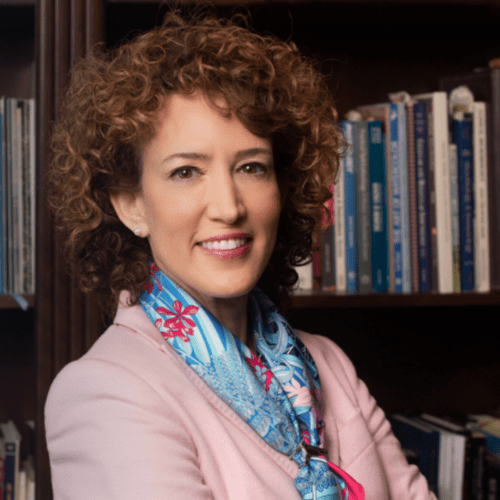
"Even 20 years ago, I thought, let's just imitate nature."
// Liane Clamen, on the origin of AdaptilensOne prototype flexed four times past target.
Clamen did not arrive at ophthalmology in a straight line. At Harvard she studied English and American Literature. After graduating she taught high school students at the Tibetan Children's Village in Dharamsala, India, a year that she credits with pointing her toward her real work. Medicine came next, also at Harvard, then a residency at the Harvard Ophthalmology Residency Program at Massachusetts Eye and Ear.
The writing degree turned out to be useful. Early in her training she co-authored textbook chapters on cataract surgery with the chair of the hospital's cornea department. In the late 1990s she wrote a chapter on the history of intraocular lenses. Reading the whole arc of the field's past, she noticed the future was missing a piece. Nobody had built a lens that accommodated like the real thing.
She filed her patent application in 2011. The Patent Office said no, repeatedly, for the better part of a decade. In 2019 it finally said yes. That same year she formed the company. The idea had been incubating since roughly 2002. Few founders can say their product predates the iPod.
"Cataract surgery is a beautiful, elegant surgery to perform. The disappointing part is that we remove the cataract and implant an artificial lens with one power."
// On the gap she set out to closeThe lens leans on bottlebrush polymer chemistry, developed in partnership with Duke's Matt Becker. Soft, flexible, biocompatible, and clear — built to bend with the eye rather than sit still inside it.
Eight years of rejection letters from the patent office. She kept refiling. The grant landed in 2019, the same year she finally turned the idea into a company.
"I look forward to having our game-changing lenses implanted in my eyes when I need cataract surgery." A founder volunteering to test the product on herself is a particular kind of conviction.
She credits MassChallenge with opening the door: "Being accepted into the program gave us an immediate stamp of approval." It helped her decode FDA regulatory pathways and fundraising.
Mother of two daughters and two sons. Asked about her greatest accomplishment, she points to her children before her patents.
The target was 5 diopters of accommodation. A prototype delivered 20. In a field where a single fixed power is the norm, that is a wide margin to play with.
Between 2022 and 2024 Adaptilens ran computer simulations and animal trials, the groundwork for the milestone that matters most: the first in-human clinical trial. The $17.5 million Series A, on top of an earlier $1.6 million seed from Pillar VC and Accanto Partners, exists to get the device there. Total funding reported sits near $20.7 million.
The market she is aiming at is not small. Roughly 94 million people are blind from cataracts worldwide, and tens of millions more live with uncorrected refractive error. Cataract surgery is one of the most common operations on earth. A lens that restores full-range vision, rather than one focal point, would change the default outcome of a procedure performed millions of times a year.
Her advice for the road, gathered across interviews: surround yourself with hard-working, honest, motivated people, lean into strengths rather than fixate on weaknesses, and treat creativity as the engine of progress. Twenty-some years in, the idea she first sketched is closer than ever to looking back at the world through someone's eye.