A Yespress Story · Deep Tech
The Man Who Would Lift Cities From the Sea
Laurence Allen has a magnet in his finger, a robot named Prometheus, and a plan to keep Miami above water using nothing more extravagant than the woodpile.
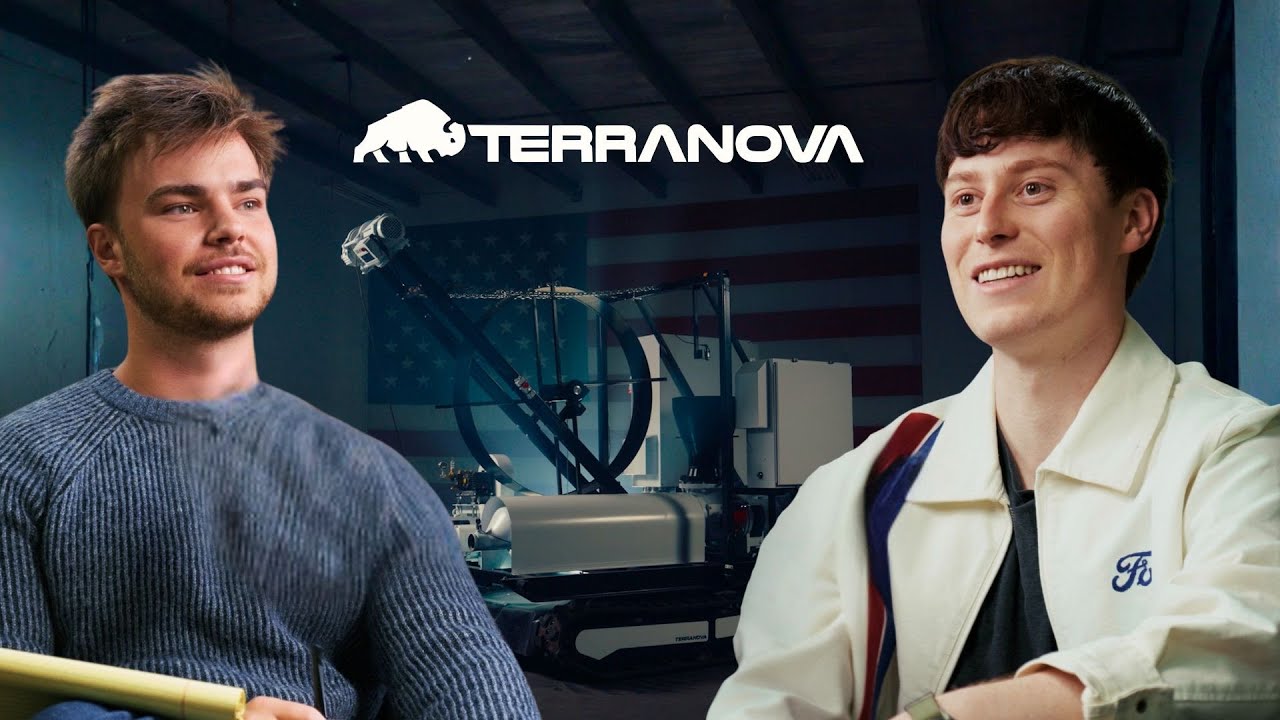
Laurence Allen has a magnet in his finger, a robot named Prometheus, and a plan to keep Miami above water using nothing more extravagant than the woodpile.
There is a particular kind of madness that wears a clean shirt and speaks in cost-per-linear-foot. It is the madness of the engineer who has looked at a drowning city, consulted the brochures of available remedies—the seawall, the levee, the heroic act of demolishing and rebuilding an entire town a few feet higher—and concluded, with the serene confidence of the young, that the whole industry has been holding the problem upside down. Laurence Allen is that engineer. His proposition is so disarmingly simple that he himself struggles to believe nobody arrived first.
"It's like we're playing Minecraft and we're mixing earth with wood," he says, "and if you put it together you have a solution for global flooding, and somehow no one had ever done that. I can't even believe that we were the first hand in the cookie jar."
The company is called Terranova, and its ambition is to lift sinking land back out of the water—not with walls that hold the sea at bay, but by pumping a slurry of waste wood chips deep beneath our feet and inflating the ground like a slow, deliberate lung. To grasp why this is clever rather than merely eccentric, one must first appreciate how impoverished the alternatives are.
Allen is generous on this point, which is to say he is merciless. The municipal toolbox for flooding, he explains, contains almost nothing worth owning. There is the seawall—"really expensive," priced by the foot, and quoted to his own hometown of San Rafael at a frankly comedic five to nine hundred million dollars for a city of sixty thousand souls. There is the earthen levee, perpetually under siege; he notes that the leaders of the Bay Area's architecture and engineering establishment convene monthly for the express purpose of defending their levees against gophers, whose patient chewing threatens a cascading collapse the region prices at roughly a trillion dollars.
"A gopher can literally take out a city by just chewing through an earthen levee. They're worried about a collapse that cascades—a domino effect—and the predicted damage is about a trillion dollars."
— Laurence AllenAnd when the wall is too dear and the levee too treacherous, what remains is the nuclear option: tear the city down, truck in dirt, spend a year and a half compacting it, and rebuild the whole thing on stilts of compressed earth. The result, Allen observes drily, is the Palisades—the same precarious situation as before, only more expensive and a year and a half older. Cities, he argues, behave toward flooding precisely as they behave toward wildfire: a bout of denial, a king tide, a brief and operatic panic, and then a swift return to burying the head in the sand until the next billion-dollar reckoning.
The idea is not entirely without ancestry. In the Venice of the 1970s, Allen recounts, engineers lifted an entire island—buildings and all—by injecting a cementitious mud beneath it, a technique with the wonderfully unglamorous name of mudjacking. It worked beautifully. It was also so ruinously expensive—the cement, the giant research team—that the study is now nearly impossible to find online, and the world looked upon the miracle and decided, sensibly, never to repeat it.
"They really just never did it again because it's so expensive," Allen says. "Everyone looked at that and went, okay, that's not scalable." Terranova's entire conceit is the dismantling of those two costs. The expensive cement is replaced with wood chips—"free, delivered, and abundant." The expensive research team is replaced with robots and AI planning software. What remains is the miracle, minus the ruin.
"We solved the cement-being-super-expensive problem with wood chips, which are free, delivered, and abundant. And we solved the giant research team with robots that do the injection for us."
— Laurence AllenThe choice of filler was, Allen insists, almost embarrassingly obvious. At the volumes a sinking city demands, only two materials exist in sufficient quantity—dirt and wood—and wood, astonishingly, is the cheaper of the two. It is a waste product the modern world cannot give away. San Rafael ships eight semi-truck loads of chips to the Central Valley every single day, Sundays included, to be incinerated in subsidized biomass plants—an arrangement so unlovely that a Terranova intern reportedly developed asthma from the very Stockton plant in question. The city pays roughly a thousand dollars a truckload simply to make the wood disappear.
A single Central Valley farmer told them she had burned fifty thousand tons of agricultural wood waste in a year—illegally, no less. Add the urban tree-trimmings, the sawmill leavings, and the vast harvest of California's new fire-prevention clearing laws, and the supply becomes effectively bottomless. The crowning calculation, the one Allen returns to like a refrain, concerns Florida:
"We did the math. Florida has enough waste wood on a yearly basis to lift the entire city of Miami by the whole amount it needs in one year."
— Laurence AllenIt helps that Florida's trees grow three times as fast and that the state, by some happy accident of bureaucracy, already pre-separates its wood waste. And there is the matter of permanence—the objection any sensible person raises first. Does the wood not simply rot? It does not. Buried beneath thirty feet of consolidated earth, deprived of oxygen, the chips become inert; Alaska built much of its highway system on wood-chip fill precisely because, once anaerobic, it does not decompose. Under all that compaction the slurry sets into something closer to particle board than soil—a substance Allen quietly suspects will outperform ordinary dirt in an earthquake.
Cement also flows poorly underground, demanding injection wells roughly every 10 ft; the buoyant wood slurry can travel from wells spaced as far as ~1,000 ft apart. Terranova bills land-lifting as "less than an order of magnitude" of what seawalls cost.
It would be a mistake, Allen is careful to say, to file Terranova under sea-level-rise alarmism. The deeper villain is subsidence—land that sinks of its own accord. California's Central Valley has dropped some twenty feet from groundwater extraction. Jakarta is preparing to abandon itself. Tehran sinks twenty-five centimeters a year. Mexico City has descended perhaps a hundred feet. Long Beach earned the nickname "the sinking city" from petroleum extraction, and now quietly injects seawater underground to hold itself in place—a band-aid that, were the pumps ever switched off, would let the city resume its descent.
"It's turtles all the way down. You can really sink your city as much as you want. We are basically the anti-subsidence—and I think the right solution to fix that at scale."
— Laurence AllenFor a man selling mud, Allen has an unmistakable flair for nomenclature. The injection rover—the unit that actually drives the wood into the earth—is Prometheus. The twenty-foot shipping container that mixes the slurry and commands the operation is the Arc. The well-drilling robot is Vulcan; the drill mast, Atlas. One Arc can feed up to three Prometheus rovers, and that modular trio can lift an acre by a foot in a single day. The first Prometheus was, charmingly, a hacked concrete pump nicknamed "Old Faithful," even though, Allen admits, "it wasn't all that faithful"—its little ball valves clogged on every two-inch chip until the team learned to let the machine, rather than a tired human at midnight, control the slurry.
Non-permanent bores—often easier to permit—are sunk across the site, by Terranova or a local contractor.
Wood, water and a viscosifying additive are pumped like a milkshake, up to 220 ft from the mother ship, lifting the land toward a planned topography.
The hardware withdraws to an open well bore—no buried gear, nothing for a water board or the EPA to fret over.
Beneath all of it runs the part Allen calls the real enabler: an AI trained on roughly nine hundred thousand California geocores, repurposing algorithms borrowed from the robotics world to model the entire underground geology of the state. Most cost estimates can be produced without any on-site work at all—there is even a public tool, plan.terranova.inc, where the curious may model their own flood risk and underground injections. Autonomy is not a luxury here; it is load-bearing. "You can't casually hand this off to a contractor" without it, he says. "They can't just manually control these pumps. We tried. You clog it every single time."
To understand the tempo of Terranova, one must visit Hawthorne and Boca Chica. Allen interned at SpaceX—on Dragon's thermal protection systems, the heat shielding that carries astronauts to the station and home, "a zero-failure game"—before a production crisis flung him to Starbase to wrestle with Raptor engines and booster. He speaks of the place the way veterans speak of a hard campaign: with a grin and a flinch.
"I'd compare it to fraternity hazing. You know what you're getting into, and you walk in preparing to have your engineering elevated."
— Laurence Allen, on SpaceXHis favorite legend is a welder named Bulldog, indisputably the best on site, who therefore did as he pleased, whipped an ATV around the yard, and worked one-hundred-and-twenty-hour weeks because no one dares tell their finest welder no. His own defining memory is a cancelled Thanksgiving flight, a borrowed seat on Elon Musk's personal jet, and a midnight return to seven emails commanding everyone back to the floor—Musk himself reportedly welding among them—followed by Allen working until seven in the morning fixing a robotic welding arm and hand-sanding the inner wall of a rocket engine, convinced it would somehow make all the difference for launch. He left, by his own audited account, having saved the company some fifteen million dollars. "You wouldn't feel that way at the end of your time at Lockheed Martin," he says. It is the intensity, and the responsibility handed to the young, that he has tried to bottle and carry into Terranova.
The origin runs deeper than any internship. Allen's father showed him square roots in kindergarten and baking-soda volcanoes before that. In seventh or eighth grade his father simply direct-messaged the engineer Ben Naka on YouTube, and the boy flew to Boston for a fortnight of building nuclear fusors, supercritical-CO₂ caffeine extractors, chocolate 3D printers, and assorted things that explode. He ran an electric-skateboard business—one model hit thirty-two miles an hour, a figure he knows only because that was the last speed it recorded before depositing him in a bush and breaking the small bone in his wrist. He won his school district's raffle-ticket sales five years running, roughly thirty-five hundred dollars a time, and very nearly converted the proceeds into Bitcoin before a child's inability to navigate an old white iMac saved—or cost—him a fortune.
He arrived at Berkeley a bioengineer, haunted by a babysitter who died of a protein-misfolding disorder that seemed, maddeningly, solvable. He worked on CRISPR, concluded the cure simply lacked a market, and—in a flourish only a true tinkerer could love—sliced open a finger to implant a magnet, the better to sense magnetic fields. The magnet is still there. When SpaceX called, he was, improbably, still a bioengineer; he switched to mechanical engineering only on his return, to build the company now trying to keep the world's cities above water.
"My Prius barely even made it 60,000 miles in high school. Human ingenuity is so amazing."
— Laurence AllenTerranova's plan is not to hoard the miracle. Rather than vertically integrate until no city can lift a square foot without them, Allen intends to license the technology to local contractors—people who already understand the permitting in Jakarta, in Phnom Penh, in places he cheerfully admits he does not. An Indonesian minister is, as he speaks, pitching Jakarta on the whole city; he is due to meet Cambodia's prime minister in January. He would, he says, sooner have a desperate nation steal the technology than wait on a startup. The patents, issued across the United States and Europe, are insurance, not strategy. "They're going to work with us because we are by far the cheapest."
He is honest about the present scale. Ten production Prometheus units this year; enough for hundred-acre projects, not yet the entire Ninth Ward. The customers who find him—land developers, wetland restorers, the occasional parking lot—keep offering projects of six hundred acres precisely because nothing else can supply that much fill. The municipalities, with their glacial urgency, are the hardest of all to move. And the man himself pays the private cost of moving fast: a two-and-a-half-year relationship lost to an office he never left, ninety-hour weeks through an entire fundraise, four all-nighters out of five before a launch.
"If we're doing your highway, you're driving over it. If we're doing your runway, you're flying over it. If we're doing your house, you'll continue to live in it."
— Laurence AllenIt is the line that best captures the strange grace of the thing. No evacuation, no demolition, no year-and-a-half of compaction—merely the slow, two-millimeter ascent of the ground beneath an ordinary life that never thinks to look down. The Venetians proved it possible half a century ago and then, appalled by the bill, pretended they hadn't. Laurence Allen, magnet in his finger and Prometheus on the trailer behind his Cybertruck, simply declined to look away. Whether the cities of the world will let him lift them is, as ever, a question of urgency. He has plenty to spare. "Your destiny," he says, "is in your own hands."
Laurence Allen walks through Terranova's robots, the wood-chip slurry, and the plan to lift cities out of the flood zone.