Ocean Tech / Founder Dossier
Kortney Opshaug
She can track a spacecraft and a crab pot with the same toolkit. These days she points the math at the sea - and the gear that keeps getting lost in it.
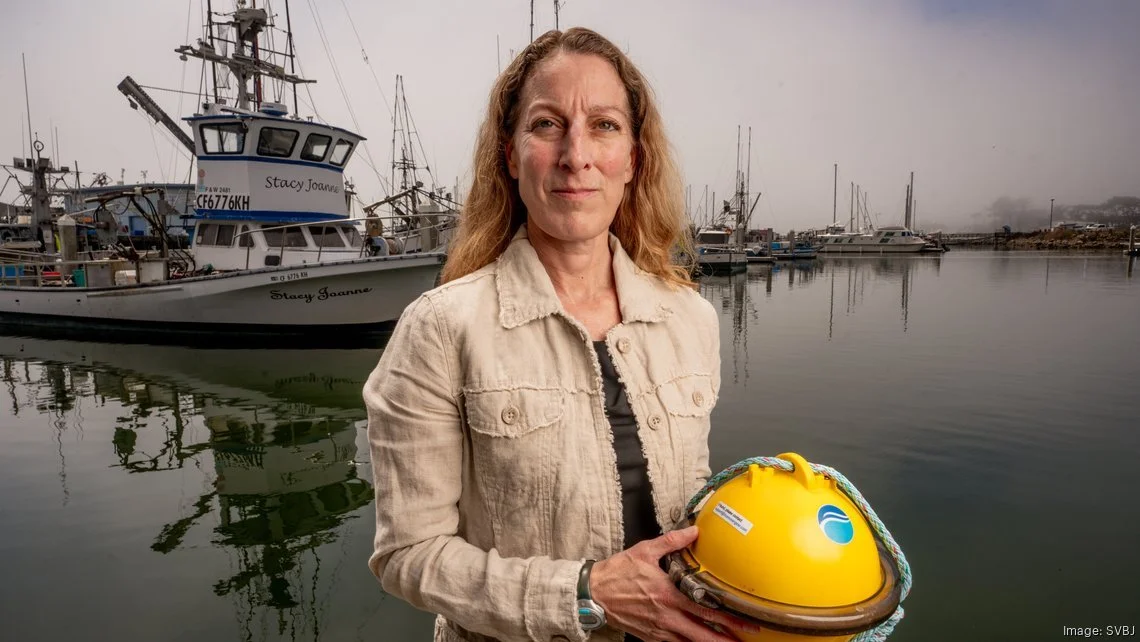
She can track a spacecraft and a crab pot with the same toolkit. These days she points the math at the sea - and the gear that keeps getting lost in it.
Pull a Blue Ocean Gear Smart Buoy out of the water and it looks almost too simple: orange and yellow, palm-sized, stamped with a number like a varsity sweater. Inside is a GPS device not so different from the one in a phone. The hard part was never the chip. It was making the thing survive a fishing season - the salt, the slamming, the months adrift - and making fishers actually want to clip it to their gear.
Kortney Opshaug runs the company that builds it. Her resume is the kind that makes people do a double take: a Ph.D. in aerospace from Stanford, a bachelor's and a master's in aeronautics and astronautics from MIT, and early career stops doing dynamics and controls at Lockheed Martin and mission operations on a NASA airborne observatory. The natural next move was more spacecraft. She went the other direction, down to the docks.
The problem she picked is enormous and largely invisible. Roughly 640,000 metric tons of fishing gear is lost in the world's oceans every year. Lost traps and nets don't stop working when nobody is holding the line - they keep catching. Whatever they catch dies, becomes bait, and catches more. Opshaug calls it "a horrible cycle." It is also a brutal line item: fishers pay to replace gear, and lose the harvest the gear would have brought in.
Her answer was not to lecture the industry. It was to listen to it. "We spent years with fishermen just learning how they operate and listening to what they need," she has said. "They really came up with the design." The buoy that resulted is built around what a working captain on a bad-visibility morning actually needs: to know exactly where the gear is, when it surfaces, and whether it has wandered.
That field-first instinct is the through-line of the whole company. Blue Ocean Gear, founded in 2015 and based near the San Francisco Bay in Sausalito, sells into three markets at once - wild-capture fisheries, aquaculture, and ocean research - on the same idea: put a connected sensor on gear, and the ocean stops being a black box.
At its core, the buoy is a GPS tracking device. We spent years with fishermen learning how they operate - they really came up with the design. - Kortney Opshaug, founder, Blue Ocean Gear
Dynamics, controls, navigation, signal processing - the discipline that keeps a spacecraft on course also tells you where a buoy will drift. Opshaug carried aerospace rigor straight into seawater.
Before the buoy, she was Director of Engineering at Deep Ocean Engineering and ran mission operations on NASA's SOFIA program. Underwater robotics, then airborne astronomy, then back to the water.
The pitch isn't charity. Lost gear costs fishers real money. Find it, and you protect the ocean and the margin in the same move. That overlap is the whole business.
Every Smart Buoy doubles as an ocean instrument. It doesn't just say "here" - it logs the water around it.
Multiply that by a fleet, season after season, and a single rescue tool quietly becomes a real-time data platform for the ocean.
Plenty of ocean startups arrive with a slick demo and a theory about how fishers should behave. Opshaug's company arrived with years of sea time and a willingness to be told it was wrong. The buoys are field-tested with the people who use them - through fog, through bad weather, through the unglamorous reality of a fixed-gear operation.
That patience is why the numbers fishers quote are not marketing copy. Five hours saved on a big day. Five thousand dollars saved per trip when you know exactly when and where your gear resurfaces. In an industry of thin margins and brutal hours, those are not abstractions.
The federal validation followed the field validation. NOAA's Small Business Innovation Research program funded a tougher, sensor-rich version of the buoy built for open-ocean conditions, then extended the relationship - the kind of slow, earned credibility that doesn't trend but does compound.
Opshaug's longer game is bigger than recovery. She has talked about the "power of real-time, persistent data from the oceans." Every buoy that goes overboard is another node. The endgame is an internet connection for the world's fishing fleet, where sustainability and profit are reported on the same dashboard. For a list of where Blue Ocean Gear's buoys are working and what they're learning, the company's site and YouTube channel keep a running log.
Most climate and ocean technology lives on a screen. Opshaug's lives in the surf. That choice matters, because the failure she set out to solve is one almost nobody sees. Gear that goes missing doesn't make headlines; it just keeps working in the dark, hauling in animals that never reach a market and depleting the very stocks the fishery depends on. The damage compounds quietly, season after season, until it shows up as a smaller catch and a bigger replacement bill.
Tackling that meant accepting an unglamorous truth: the hard engineering wasn't the software, it was the survival. A buoy that fails after three weeks is worse than useless. So the work became material science, sealing, buoyancy, antenna placement, battery life, and the dozen small indignities the open ocean inflicts on anything that floats. The orange-and-yellow shell that looks almost toy-like is the product of exactly that grind - shaped to be seen in fog, to take a beating, and to come back next year.
There is a quiet feminism to the story, too. Opshaug works in two industries - deep-sea commercial fishing and hardware engineering - where female founders are scarce, and she's tagged her own posts with the obvious hashtag and moved on. The work makes the argument. She isn't asking the fishing world to imagine a different kind of leader; she's handing captains a tool that saves them five hours and five thousand dollars and letting the result speak.
What she is really building, underneath the rescue narrative, is infrastructure. A single buoy finds a lost trap. A fleet of buoys, reporting for years, becomes a living map of how the ocean actually behaves where the work happens - the currents that drag gear, the temperatures that move fish, the conflict zones between vessels. That is the version of Blue Ocean Gear that keeps Opshaug talking about "persistent data" rather than just recovery. The buoy is the wedge. The data is the company.
Three of the most demanding engineering degrees in the country - a Stanford aerospace PhD plus a BS and MS from MIT - now aimed at fishing buoys.
Her earlier career touched both extremes of the planet: controls work at Lockheed Martin and mission ops on NASA's airborne SOFIA telescope.
Blue Ocean Gear is co-founded with Kevin Johnson and headquartered near the San Francisco Bay, a stone's throw from the boats it serves.
The buoys are numbered like jerseys and built in highly visible orange and yellow - engineered to survive a full season at sea.
Each buoy is secretly a scientific instrument, logging water temperature, currents, velocity and acceleration alongside its location.
She's partnered with marine-mammal-focused small businesses on whale-safe and ropeless gear monitoring - tech meant to keep gear off whales.