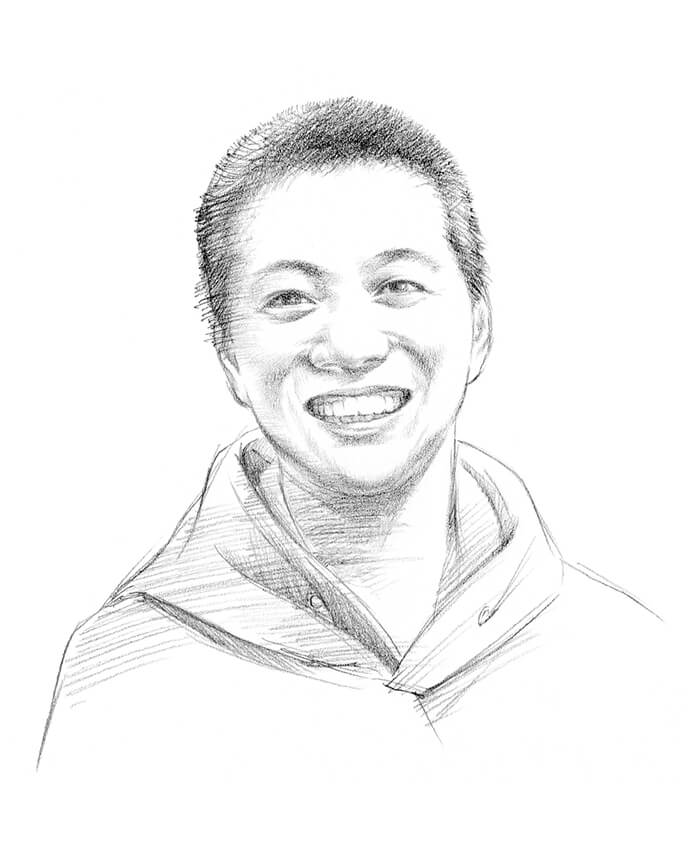
A cell factory that fits in your hand
Most biotech founders chase a single drug. Koji Tanabe is chasing a supply chain - the unglamorous, decisive problem of how you make a living medicine cheaply, cleanly, and at scale.
At I Peace, the headline product is not a pill. It is a process: an automated, closed, modular device - roughly the size of your palm - that grows clinical-grade induced pluripotent stem cells without a human hand ever touching them. Many donors, in parallel, no cross-contamination. That last detail is the whole game. iPS cells have been Nobel-famous since 2012. Turning them into therapy has been stuck on a far more boring question: can you manufacture them reliably enough, and affordably enough, that an ordinary patient could ever receive them?
Tanabe spent the better part of eight years answering the first half of that question by hand. He concluded the bottleneck had moved. The science worked. The factory did not exist. So he built one.
I Peace runs on two coasts of the Pacific: a Palo Alto headquarters and a manufacturing engine - "Peace Engine Kyoto" - in the very city where iPSC science was born. The Kyoto facility earned approval from Japan's Ministry of Health, Labour and Welfare to manufacture cell-based products, and is operated to cGMP standards. The company name reads like a wish, and it is one. "I Peace" is the idea that your own cells, banked and kept in reserve, are a kind of personal peace of mind - stem cells for life.
We aim to bring the power of iPS cell technology to everyone - so people can take charge of their own longevity and unlock a healthier, longer life.— Koji Tanabe, Founder & CEO, I Peace
The lab where it started
Rewind to 2006. A young researcher named Koji Tanabe joins the Kyoto University laboratory of Shinya Yamanaka. The lab is about to do something that sounds like science fiction: take an ordinary adult cell and coax it backward, into a state of near-infinite possibility - a cell that can become almost any tissue in the body. They call the result an induced pluripotent stem cell.
When the world's first paper reporting human iPS cells was published, Tanabe's name sat in the second-author slot. In 2012, Yamanaka shared the Nobel Prize in Physiology or Medicine for that line of work. Tanabe is not a Nobel laureate, and he is careful never to claim otherwise. But he was in the room, at the bench, for one of the defining biological discoveries of the century. That is a rare credential to carry into a startup.
He earned his PhD in Medical Science from Kyoto in 2013 and crossed the ocean to Stanford, joining the laboratory of Marius Wernig at the Institute for Stem Cell Biology and Regenerative Medicine. There the work turned even stranger: direct reprogramming, the trick of converting one mature cell type straight into another - skin to neuron - without first rewinding all the way back to an embryonic state. He held a Japan Society for the Promotion of Science fellowship and stayed on at Stanford as a visiting researcher even as his attention drifted toward a different kind of problem.
From bench to business
The pattern in Tanabe's career is a scientist repeatedly noticing where the real obstacle sits, and moving toward it. Discovery, then direct reprogramming, then - the leap - manufacturing. In 2015 he founded I Peace with a deceptively simple premise: if iPS cells are going to help anyone, someone has to make them at industrial scale and consumer cost. The breakthrough years came around 2020, when the company demonstrated iPSC production inside an automated, closed, compact, modular device - the kind of engineering that promises drastic cost reduction precisely because it removes the most expensive ingredient in cell manufacturing, which is skilled human labor in a clean room.
The recognition followed. World Biz Magazine named him a Top 100 Innovation CEO in 2021. In 2022 he took the Japan Entrepreneur Award in Healthcare. That same year, I Peace announced a partnership with the California Institute for Regenerative Medicine, the state's stem cell agency - a signal that the manufacturing approach was being taken seriously on the policy side, not just the lab side.
The I Peace idea, in five steps
Why "for everyone" is the radical part
Plenty of companies will sell you a stem cell therapy. The unusual move in Tanabe's vision is the word "autologous" - using your own cells, not a donor's. The dream he describes is a world in which everyone would possess their own iPSCs, banked and ready, so that if you ever needed a transplant or a regenerative treatment, the raw material would be you. No immune mismatch. No waiting list of donors. Just a withdrawal from an account you opened years earlier.
That only works if making personal iPS cells is cheap. A bespoke, hand-crafted batch for one person is a luxury good. A standardized, automated batch produced by a machine is infrastructure. The entire bet of I Peace - and the reason the palm-sized cassette matters more than any single therapeutic - is the conviction that cell medicine has to become infrastructure before it can become medicine for the rest of us.
By 2024, the company moved from theory toward the consumer, launching personalized iPS cell services in the United States, framed around longevity. The framing is bold and worth reading skeptically, as all longevity claims should be. But the manufacturing logic underneath is sober and concrete: standardize, automate, lower the unit cost, repeat.
The acceleration of applied research is paving the way for stem cell-based therapeutics to become a common treatment modality in the near future.— Koji Tanabe
The shape of the person
What you notice across Tanabe's interviews and writing is patience. This is a founder building on a biological timescale, not a quarterly one. He talks about modalities becoming "mainstream" and "common" - the vocabulary of someone playing a decade-long game where the win condition is ubiquity, not exclusivity. He spent eight years at the bench before he let himself become an entrepreneur, and the company he built reflects that order of operations: get the science right, then obsess over the boring machine that makes the science repeatable.
It is a quietly contrarian stance in a field addicted to miracle announcements. Tanabe's pitch is closer to plumbing than to magic. The most ambitious thing about him may be that he finds the manufacturing problem more interesting than the discovery problem - and that he is probably right that it is the one that decides whether any of this reaches you.
The economics nobody romanticizes
Here is the part that rarely makes the press release. Producing a single batch of clinical-grade iPS cells the traditional way means trained technicians, hooded clean-room benches, and weeks of meticulous, expensive handwork. Every manual step is a chance for contamination and a line item on an invoice. Tanabe's automated, closed system attacks both at once. Take the human hands out of the loop and you do not just lower the price - you make the output consistent enough to satisfy regulators, which is its own kind of currency in this industry. The modular design also means capacity scales by adding units rather than rebuilding facilities. That is why the company can talk credibly about producing cells from multiple donors simultaneously: the machine, not the workforce, is the constraint, and machines are easier to multiply than expert technicians.
The mission statement I Peace publishes is plain about who this is for - to alleviate the suffering of patients and to help healthy people maintain a high quality of life. Read it next to the manufacturing strategy and the through-line is obvious. You cannot serve "everyone" with a process that only serves the wealthy. Accessibility is not a marketing flourish bolted onto the technology; it is the design specification the technology was built to meet.
A bridge across the Pacific
There is something fitting about a company that lives in both Palo Alto and Kyoto, run by a scientist who did the same. Kyoto gave the world the discovery; Silicon Valley supplies the appetite for scaling it into a product. Tanabe is one of the few people fluent in both dialects - the careful, citation-bound language of the academic bench and the impatient, build-it-now grammar of a startup. He moved from one to the other deliberately, carrying the rigor with him. The result is a business that behaves less like a typical biotech swinging for a single blockbuster and more like an industrial company trying to drive down the cost curve of a brand-new category, one production cycle at a time.
In his own words
A long-form conversation on iPSC discovery, potential, and manufacturing - the science behind I Peace, explained by the scientist who lived it.
▶YouTube Interview Stem Cell Pioneers →