Breaking
KeyMe operates 7,000+ key-copying kiosks nationwide Expected to cut 10M+ keys this year Raised ~$200M across 11 rounds since 2012 Founded by Greg Marsh after a bad lock-change Kiosks inside Kroger, Walmart, IKEA, Menards, Rite Aid Won patent trial vs. Hillman Group in 2021 KeyMe operates 7,000+ key-copying kiosks nationwide Expected to cut 10M+ keys this year Raised ~$200M across 11 rounds since 2012 Founded by Greg Marsh after a bad lock-change Kiosks inside Kroger, Walmart, IKEA, Menards, Rite Aid Won patent trial vs. Hillman Group in 2021
KeyMe Locksmiths key-copying kiosk and services
Company Profile / Robotics & Retail

KeyMe Locksmiths

The New York company that decided the humble spare key deserved a neural network - and built 7,000 robots to prove it.

The Frame A machine in the corner of your grocery store, quietly reading the teeth of a key it has never seen before, then cutting a working copy in the time it takes to buy milk. Ordinary errand, uncanny technology.
Founded 2012 HQ: New York ~160 employees ~$200M raised
7,000+
Kiosks Nationwide
10M+
Keys Per Year
~$200M
Total Raised
$12B
Industry Targeted
The Story

A Robotics Company Wearing a Locksmith's Apron

Here is a fact that should be more surprising than it is: the American locksmith industry is worth something like $12 billion, and until fairly recently almost none of it ran through an app, a screen, or a price you could see before someone showed up at your door. You lost a key, you called a number on the side of a van, and you hoped. This is roughly the market structure of the 1970s, preserved into the smartphone era like an insect in amber.

KeyMe's founder, Greg Marsh, discovered this the way most people discover the locksmith industry - involuntarily. He needed his home's locks changed, the experience was miserable, and instead of simply complaining about it, he did the founder thing and asked whether the whole process could be rebuilt. The answer he arrived at, in 2012, was a machine. Not a person with a truck, but a kiosk: a self-service box that could scan your key, understand its geometry, and cut a copy on the spot.

The technically interesting part is that keys are harder than they look. A house key is a small piece of brass whose value lives entirely in a series of precise cuts, and there are thousands of variants. Rather than build a mechanical library, KeyMe trained neural networks on those key types - using computer vision to look at a key and infer its structure with enough precision to reproduce it. The company says its hardware and software support roughly 50 times more key types than a traditional key-cutting machine. That is the sort of number that sounds like marketing until you remember that the alternative is a human squinting at a blank and a grinding wheel.

Once you have a robot that can read keys, a few things follow almost automatically. You can put it where people already are - so KeyMe kiosks live inside Kroger, Walmart, IKEA, Menards and Rite Aid, among others. You can let people store a digital scan of a key in the cloud through a mobile app, so a lost key becomes a printable file rather than a locksmith call. And you can move beyond brass: KeyMe's kiosks handle car keys, including the ones with transponders that talk to the car, plus RFID fobs, which are the keys that don't look like keys at all.

The kiosks scaled the way good hardware scales when it hides inside someone else's foot traffic. In 2016 the company had around 200 machines and had fabricated its first million keys. By 2025 that number had crossed 7,000 kiosks, and the company expects to cut more than 10 million keys in a single year. Somewhere in there, copying a key at the grocery store stopped feeling like science fiction and started feeling like a chore you could knock out between the produce aisle and checkout.

But a key-copying kiosk has a natural ceiling, which is that people do not lose keys very often. So in 2020 KeyMe did the sensible expansionist thing and put humans back into the loop - not the old van-and-a-number humans, but a nationwide dispatch network of professional locksmiths for the jobs a machine can't do: lockouts at midnight, re-keying a new apartment, installing and repairing locks for homes, businesses and cars. The pitch is a tidy division of labor. Robots handle the routine and predictable; people handle the emergencies and the judgment. The customer, ideally, never has to know which one they're getting until it shows up.

"KeyMe wants to bring trust and convenience to a $12 billion industry that time, more or less, forgot."

Then there is the part of the business that is either a clever second act or a sign that every hardware company eventually discovers advertising. Each KeyMe kiosk has a screen. Screens attract eyeballs. Eyeballs, when counted, become a media network. In 2021 KeyMe launched exactly that - a retail media network that by 2025 was generating more than 2 billion advertising impressions. It is a familiar move: the machine you built to do one useful thing turns out to be, incidentally, a place to sell attention. The keys may be the product, but the screen is real estate.

None of this happened without a fight. In 2021, KeyMe went to trial in Marshall, Texas - the patent-litigation capital of America - against The Hillman Group, whose minute key kiosks are the most direct competitor. A jury found that KeyMe did not infringe Hillman's patents. When you build a physical machine that undercuts an incumbent, litigation is less a risk than a milestone; KeyMe cleared it.

The money followed the machines. KeyMe raised across eleven rounds, from a $300,000 angel check in 2012 to a $35 million Series E in January 2020, with Comcast Ventures, Battery Ventures and, tellingly, 7-Eleven among its backers along the way. Roughly $200 million total has gone into the unglamorous proposition that copying a key should be fast, transparent, and available wherever you happen to be standing. It is not the flashiest thesis in venture capital. It may be one of the more legible ones.
What You Can Actually Do With It

Four Products, One Errand Solved

Self-Service · 2013

KeyMe Kiosks

Walk up to a machine in a store, scan your key, and get a copy in minutes - brass house keys, transponder car keys, and RFID fobs included.

Mobile · 2013

KeyMe App

Digitally scan and store your keys in the cloud. Lose one, and you can print a spare later at any kiosk instead of calling anyone.

Field Service · 2020

24/7 Locksmith Network

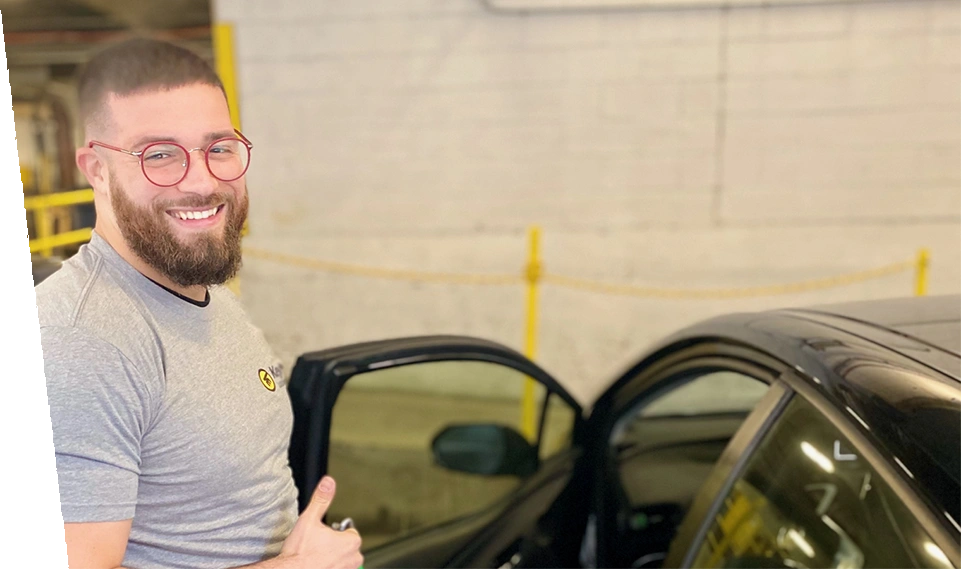
Dispatch a vetted professional for lockouts, re-keying, lock installation and repair - residential, commercial and vehicle.

Advertising · 2021

Retail Media Network

The kiosk screens double as ad inventory, generating 2+ billion impressions a year for brands reaching shoppers in-store.

"The kiosks use computer vision and AI to scan and infer a key's structure with high precision - enabling faster, more accurate duplication."
- On KeyMe's core technology
Follow The Money

Eleven Rounds, One Bet

RoundYearAmountNotable InvestorsScale
Angel2012$300KRavin Gandhi
Seed2013$2.3MBattery Ventures
Series A2014$7.8M-
Series B2016$20MComcast Ventures, 7-Eleven
Series C2017$15M-
Series D2018$25M-
Growth2019$50M-
Series E2020$35M-
The Record

From One Bad Lock-Change to 7,000 Robots

2012

KeyMe is founded

Greg Marsh starts KeyMe in New York after a frustrating lock change; raises $300K in angel funding.

2013

First kiosks and app

Launches self-service key-copying kiosks and a mobile app; raises $2.3M seed from Battery Ventures.

2014

Series A

Raises $7.8M to expand the kiosk footprint and its computer-vision technology.

2016

Series B and scale

$20M round led by Comcast Ventures with 7-Eleven; hits ~200 kiosks and 1M keys made.

2019

$50M growth round

Fuels national expansion of the kiosk and services network.

2020

Series E & full-service

Raises $35M and launches residential, commercial and vehicle locksmith services.

2021

Patent win & ad network

Wins its patent case against Hillman Group and launches a retail media network.

2025

7,000+ kiosks

Operates more than 7,000 kiosks and expects to cut over 10 million keys in the year.

Things That Amuse & Inform

Fun Facts

  • The company exists because Greg Marsh had a miserable time changing his home locks.
  • KeyMe kiosks copy car keys with transponders and RFID fobs - not just brass.
  • Early kiosks used fingerprint authentication before releasing a stored key.
  • Your key can live in the cloud: scan once, print a spare from any kiosk later.
  • The screens that guide you also run ads - a media network hiding in a key machine.
  • KeyMe's first kiosks went live in a handful of New York City 7-Elevens.
Where You'll Find It

Retail Partners

Kroger

Kiosks across grocery locations.

Walmart

Kiosks in stores nationwide.

IKEA

Kiosks in retail showrooms.

Menards

Home-improvement store kiosks.

Rite Aid

Pharmacy retail kiosks.

7-Eleven

Early host & Series B investor.

The Questions People Ask

FAQ

What is KeyMe Locksmiths?

KeyMe is a technology company that copies keys through self-service robotic kiosks and provides 24/7 locksmith services through a nationwide network of professional locksmiths.

What kinds of keys can a KeyMe kiosk copy?

KeyMe kiosks can duplicate standard brass house keys, car keys (including keys with transponders), and RFID key fobs using computer vision.

Where can I find a KeyMe kiosk?

KeyMe kiosks are in over 7,000 retail locations, including Kroger, Walmart, IKEA, Menards and Rite Aid stores across the United States.

Who founded KeyMe and when?

KeyMe was founded in 2012 by Greg Marsh, who created it after a difficult experience getting his home's locks changed; he now serves as president.

Does KeyMe do more than copy keys?

Yes. Since 2020 KeyMe also dispatches professional locksmiths for lockouts, re-keying, lock installation and repair for homes, businesses and vehicles.