For 20 years he chased oncogenes to shut them down. Then he built a company to do the exact opposite - and named it after a 2,500-year-old warning carved into Greek stone.
At 1 Kendall Square, in the densest square mile of biotech on earth, Kevin Marks runs a company built on an idea that sounds like a typo. Most cancer drugs are brakes - they jam an overactive oncogene until the signal goes quiet. Delphia Therapeutics, the company Marks co-founded and now leads as President and CEO, does the reverse. It steps on the gas.
The field has a name now, because Marks gave it one: activation lethality. The premise is that a cancer cell, for all its menace, is a fragile thing tuned to a narrow band of signaling. Push the very pathways it depends on past the redline and the machinery seizes. "Cancers cannot tolerate excessive activation of oncogenes," Marks says, "which is surprising but powerful."
It is also, by his own description, heresy. "What we are doing scientifically is the inverse of these three decades of targeted therapy in precision medicine and oncology," he has said. Three decades of doctrine, run backwards on purpose. That is the kind of sentence that gets a person funded - or laughed out of the room. Marks raised $67 million.
The reason he could is on his resume. Before Delphia there was Novartis, where he ran oncology drug discovery. Before that, more than a decade at Agios Pharmaceuticals, where he rose to VP and Head of Biology and helped push three medicines from a whiteboard idea all the way to FDA approval. People who have done that once are rare. Marks did it three times, then walked away to chase an inversion.
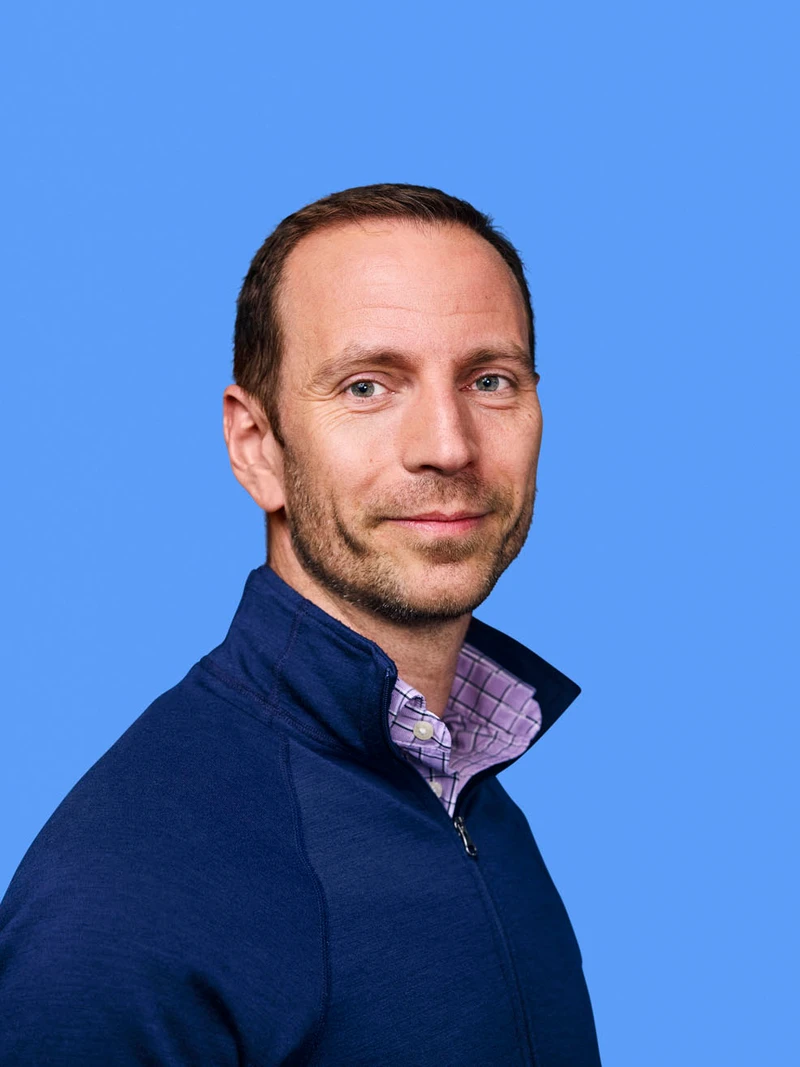
"It turns out that the ancient Greeks considered 'nothing in excess' to be one of the most important concepts about how to live."
Precision medicine spent a generation learning to silence the genes that drive cancer. Delphia asks the unfashionable question: what happens if you shout instead?
Brakes on. Signal goes quiet. Then resistance creeps in and the benefit fades.
Push past the tolerable. The cell can't downshift. Excess becomes the weapon.
Marks frames the whole problem with the maxim carved over the Temple of Delphi. Normal cells, he notes, have many ways to keep signaling in check - "that homeostatic control, the endogenous regulation, is supposed to be important." Cancer cells, racing on a hijacked engine, have fewer. Take away their off-switch and "some levels of activity are too high for the cancer to tolerate."
The origin story has a punchline. Marks had left Novartis and taken a seat at GV as an entrepreneur-in-residence - the corporate equivalent of a blank page, a place to think without a quarterly number breathing down your neck. He had been losing sleep over drug resistance, the way a good problem keeps a scientist company at 3 a.m.
Then Bill Sellers, a cancer biology heavyweight from the Broad Institute, came in for a meeting. Before Marks could lay out the pitch, Sellers asked: "Is this about over-activating oncogenes?" Sellers' own lab had chased the identical idea, independently, from the other direction. Marks just smiled.
That accidental collision became a company. Marks, Sellers, and Mike Dillon - formerly chief scientific officer at IDEAYA - co-founded Delphia. Between the three of them, they have touched more than 15 approved medicines. GV led the round. Nextech Invest, Polaris Innovation Fund, and Alexandria Venture Investments came in beside it.
B.A. in Cell Biology - the first bench, the first questions.
Ph.D. in Molecular Pharmacology, where chemical biology met hard targets.
More than a decade at Agios, rising to VP & Head of Biology. Three FDA approvals: IDHIFA, TIBSOVO, PYRUKYND.
Head of Oncology Drug Discovery at Novartis, leading teams chasing first-in-class medicines.
Joins GV as entrepreneur-in-residence. Founds Delphia.
Delphia launches publicly with a $67M Series A. Activation lethality has a flag in the ground.
Named to BioSpace's NextGen Class of 2025.
Most founders pitch a faster version of what already works. Marks pitched the opposite of what works - and brought the receipts to make it credible.
Curis and Makoto Life Sciences sit earlier on the ledger, the chemical-biology proving grounds before the big approvals. The throughline is constant: take the targets everyone calls undruggable, and find the strange angle in.
"We are the first movers in a whole new field, pursuing some of the biggest oncogenes and thus the biggest patient populations in oncology."
"All too often, the actual benefits to patients are short-lived because tumors are heterogeneous and drug resistance emerges quickly."
"Our activation lethality platform offers the potential for new cancer medicines that are effective on their own while also combating the emergence of resistance."
"We are thrilled to launch Delphia to lead this exciting new area of cancer biology."