The Dispatch
A surgeon who decided the operating room was too small
In South San Francisco, on Oyster Point Boulevard, a company is trying to do something cell therapy has mostly failed at: kill solid tumors. The person running it spent the first chapter of his career inside the human abdomen.
Ken Drazan trained as a liver transplant surgeon. That is not a hobbyist's credential. It is years of holding a person's survival in two gloved hands, of fitting one body's organ into another and willing it to take. He carried faculty appointments at Stanford and UCLA. And then he walked away from the table - not because the work was small, but because he kept noticing that the most interesting problems were no longer cut with a scalpel.
Today he is Chairman, CEO and co-founder of Arsenal Biosciences, known to everyone as ArsenalBio. The pitch is deceptively simple and quietly radical: stop treating a T cell as a blunt weapon and start treating it as programmable hardware. ArsenalBio engineers what amounts to an integrated circuit inside a living cell - synthetic DNA cassettes, multiplex gene edits, logic gates - so the therapy can tell a kidney tumor from a healthy kidney. CAR-T transformed blood cancers. Solid tumors shrugged it off. Drazan's bet is that the difference is not more force. It is more intelligence, written into the cell itself.
”
The model we built is effectively a digital incarnation of the human T cell.
- Ken Drazan, on ArsenalBio's AI foundation model
That line is not marketing froth. ArsenalBio is building an AI foundation model of the T cell, trained with deep learning, aimed at accelerating target discovery, sharpening which patients get which drug, and pointing toward personalized therapy across oncology, autoimmunity, allergy and infection. Drazan talks about it the way a software founder talks about a platform - the cells are the application layer, the model is the thing underneath that makes the next one faster.
The career that refuses to pick a lane
Read his resume backwards and it looks less like a ladder and more like a man assembling a toolkit. Before ArsenalBio, Drazan was President and Chief Business Officer of GRAIL, the early cancer-detection company later acquired by Illumina - a tour through the world of reading cancer before it announces itself. Before that he founded Verb Surgical, a digital-surgery venture that became part of Johnson & Johnson, where he had also led the J&J Innovation Center in California, hunting for science worth betting on.
And before any of the biotech, there was money. In 2006 he co-founded Bertram Capital, a private equity firm that grew to manage roughly $1.9 billion. Earlier still he had founded Arginox, working on nitric-oxide medicines for critical care, and co-founded EnGen Bio in infectious disease and oncology. Surgery, diagnostics, robotics, finance, and now gene-edited immunology. Most founders spend a career learning one of those. Drazan collected them like instruments and then walked into a room that needed all of them at once.
ArsenalBio - the money behind the science
2024 round$325M (Series C)
Why a surgeon was the right CEO
When ArsenalBio's scientific founders described what they wanted in a chief executive, the answer was not a salesman. It was an integrator. Drazan was drawn to the job, by his own account, because of the chance to coordinate many stakeholders and a thicket of complex technologies - which is, when you think about it, exactly what a transplant is. Many specialists, one body, one shot, no room for ego to slow the team.
”
The result is something different than each of the founders originally intended, but more complete and well-equipped to produce a best-in-class therapy than any of them could have developed without the others.
- Ken Drazan, on assembling ArsenalBio
The founders describe him bringing an energy and an appetite to do every part of the process at an extremely high level, and working hard to fuse what could have stayed disparate pieces into one coherent therapy. That is the through-line of his whole career: he is the person who makes the parts add up to more than they were apart.
The AI turn, and the democratization pitch
Drazan is bullish on large language models, but not in the gee-whiz way. His interest is access. He has framed the use of an LLM - focused on diseases where T cells play a major role - as a democratization of scientific research, putting questions that once required a lab full of specialists within reach of more people. It fits the man. Every venture he has built took something locked behind expertise - surgery, early detection, growth capital - and tried to make it scale.
ArsenalBio's collaborators say something too. Bristol Myers Squibb has a multi-program deal that hit a milestone on the AB-4000 series in early 2025. Genentech signed on to help identify the features of T-cell therapies that actually work. When two of the most discerning buyers in oncology put their name on your platform, the science is being taken seriously - and so is the operator selling it.
The honest part of this story is that the clinic is where bets get settled. ArsenalBio has a clinical-stage renal cell carcinoma program and a pipeline built on the premise that a single, smartly engineered dose can move a patient toward cure rather than maintenance. That promise is not proven. Drazan does not pretend it is. What he offers instead is a method - computation, gene editing, logic - and a track record of finishing the things he starts, two of which now belong to Johnson & Johnson and Illumina.
There is a tidy symmetry in all of it. A liver transplant is the ultimate act of integration: take a working part from one source, edit it into another system, and make the whole thing live. Drazan spent years doing that with organs. Now he does it with cells, code and capital - and the patient, once again, is someone who has run out of other options.
Sources: ArsenalBio, Parker Institute for Cancer Immunotherapy, USC Schaeffer Center, Crunchbase, BiotechTV, PMWC. Quotes verbatim from public interviews and company materials.
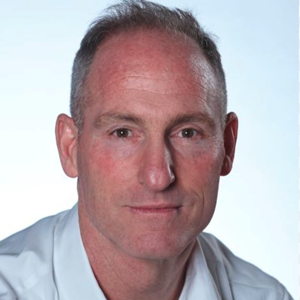 Ken Drazan, in the lobby of a company that treats biology like an engineering problem.