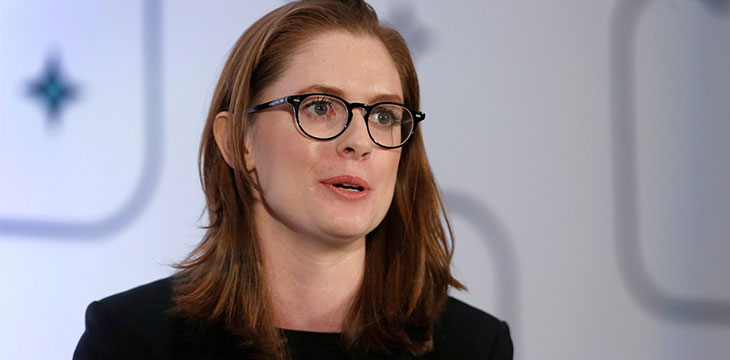
In the summer of 2017, Kathleen Breitman raised $232 million in thirteen days.
Then someone else took the money.
That is the compressed version of the Tezos origin story - and it skips the part
where she got it back, launched the mainnet anyway, and built the blockchain that
has done something no other public chain has: amended itself over a dozen times
without a single hard fork, without the ecosystem fracturing, without the drama
that splits communities into hostile factions arguing about sacred whitepapers.
Breitman grew up in Northern New Jersey, the daughter of a contractor from the
Bronx and an Irish elementary school teacher. She studied economics and mathematics
at Cornell, picked up a Wall Street Journal Bartley Fellowship in 2011, spent a
stint at Bridgewater Associates, then moved into blockchain consulting at a time when
"blockchain consulting" was not yet a punchline. She and her husband Arthur -
a French mathematician with a taste for academic programming languages - wrote
the first Tezos white paper in 2014, using the pseudonym "L.M. Goodman" for
reasons that still generate occasional internet debate.
The blockchain world calls them the "First Couple of Blockchain." Kathleen would
almost certainly roll her eyes at that. She is the kind of founder who describes
her ideal product future as "deeply boring" -
not because she has run out of ambition, but because boring means stable, boring
means infrastructure, boring means it actually works.
During the worst of the Tezos governance crisis - when Johann Gevers, the
president of the Tezos Foundation in Switzerland, was sitting on $820 million
in assets and allegedly angling for a $1.5M self-assigned bonus - Breitman
went to war in public. She called him out. She talked to journalists. She did
not stay quiet. When friends suggested she should handle it discreetly, she
compared that advice to victim-blaming. Gevers was eventually removed with a
$400,000 settlement. The Tezos mainnet launched in September 2018.
Her assessment of the whole affair: "They fucked with the wrong nerds, is my take."
Since the mainnet launch, she has not slowed down. She co-founded Coase - a
software company named after Nobel economist Ronald Coase, whose work on
transaction costs is essentially a cheat code for understanding why Breitman
finds blockchain interesting in the first place. She launched Emergents, a
collectible card game on Tezos co-designed with competitive Magic: The
Gathering champion Zvi Mowshowitz. She became a venture partner at Social
Impact Capital. She writes pointed op-eds for Fortune about why the crypto
industry's woman problem is not a knowledge gap but a culture problem.
She is 35, living in Mountain View with her husband and their dog. She styles
her name "Kaꜩleen" on Twitter - the ꜩ is the official Tezos currency symbol,
slotted in place of "tz" - which is either extremely on-brand or the nerdiest
joke in social media. Probably both.
Breitman's superpower is not the technology. It is the judgment. She called
DeFi yield farming a future embarrassment before the collapse. She called
NFT PFP collections "purely speculative" while the market was melting up. She
called the Ethereum Merge "razzle dazzle" when the rest of the industry was
treating it like a moon landing. She has a tendency to be approximately twelve
to eighteen months ahead of consensus, at which point she is no longer
interesting to the people who ignored her, because they have moved on to being
wrong about the next thing.