The woman who turned "ugly Excel graphs" into the world's most-read public health newsletter - and made the rest of us feel like we actually understand what's happening to our bodies.
Before anyone was calling her a "leading science communicator," Katelyn Jetelina was a violence epidemiologist researching child abuse, human trafficking, and police trauma in the hospitals and townships few researchers bother with. She had done a stint at the World Health Organization in Geneva. She had spent time in the townships of South Africa. She had a tenure-track position, a research lab, and a very clear academic career ahead of her.
Then a pandemic happened. Her dean sent a request: could she please update the faculty and students on this new coronavirus? So she did - a few sentences, some charts she'd be the first to describe as "ugly Excel graphs," sent by internal email. Her students, somewhat understandably, said: can we please share this outside the building?
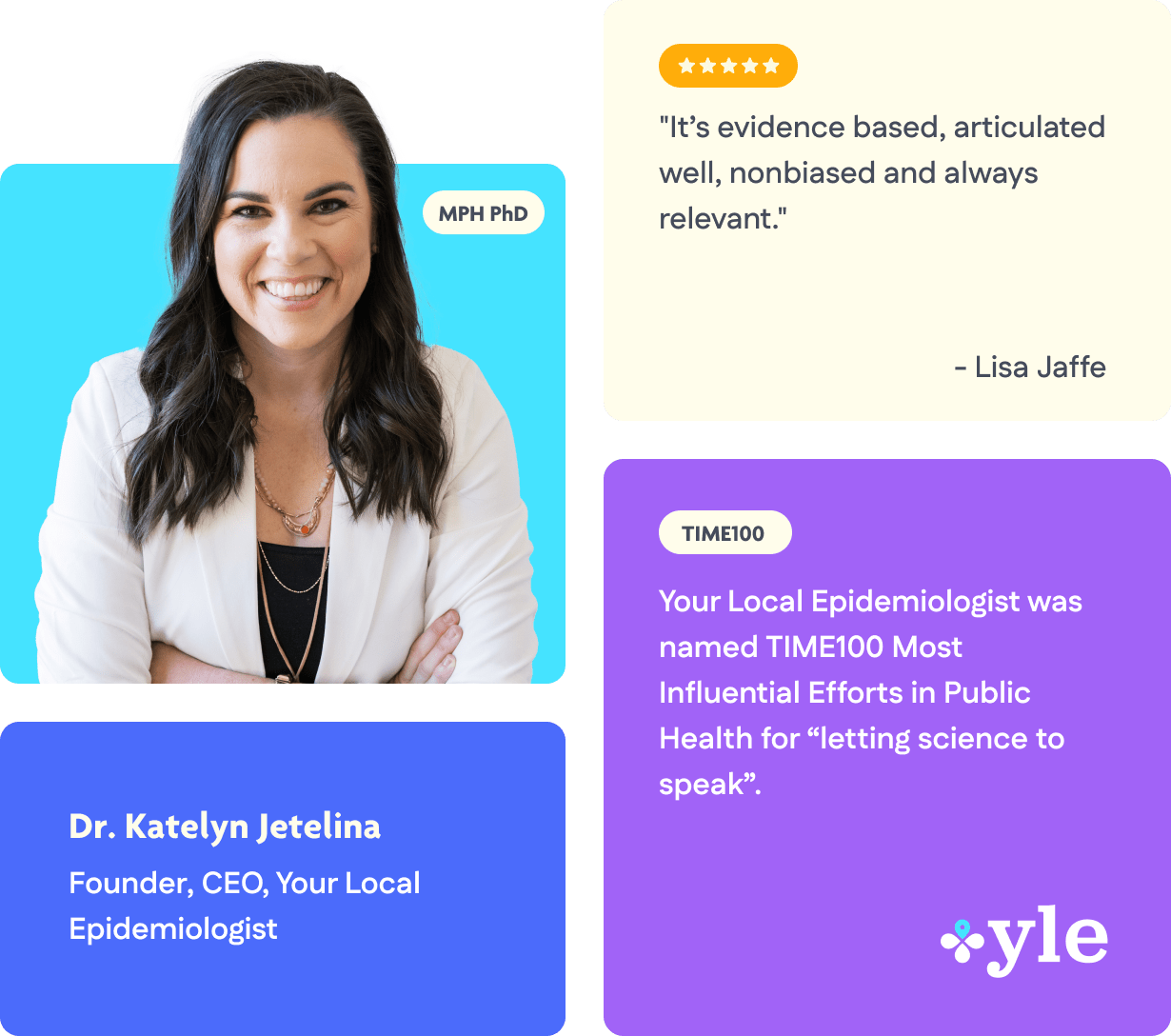
What followed is either a remarkable accident or an inevitable consequence of putting the right person in the right moment. Your Local Epidemiologist (YLE) now reaches 365,000 subscribers across 133 countries, has accumulated more than 500 million total views, and publishes twice a week without fail. It covers everything from vaccine science to bird flu to the politics of federal health policy - always evidence-based, always readable, never condescending.
Jetelina has been named a TIME100 Most Influential Person in Health. She served as Senior Advisor to the White House and the CDC. She teaches at Yale. She runs 0.05 Findings, the company behind YLE, the Evidence Collective, and Project Stethoscope - a deliberate infrastructure to support other scientist-communicators and to make science communication a real, funded profession rather than something academics do in their spare time out of guilt.
She also has two daughters, has visited more than 50 countries with her husband, and once had her entire Facebook audience of 400,000 people vanish overnight when her page was hacked. She rebuilt. That's the pattern: setback, then rebuild, but larger.
What makes Jetelina unusual isn't her credentials - there are plenty of epidemiologists with PhDs and MPHs. It's that she understands communication as a discipline in its own right. She has said publicly that the pandemic's failure wasn't just about the science - it was that science kept talking at people instead of with them. Her newsletter is what that principle looks like in practice: evidence-based but never preachy, rigorous but never inaccessible, opinionated but always honest about uncertainty.
She is, by any measure, the local epidemiologist America didn't know it needed - until it did.
"Communication is a two-way street. Throughout the pandemic, we have been doing a lot of 'telling' without a lot of 'listening.'"- Katelyn Jetelina, PhD, MPH
Nobody plans a newsletter with 365,000 subscribers. Especially not when it starts as an internal university email.
In March 2020, Katelyn Jetelina was teaching at the University of Texas Health Science Center. People were frightened and confused about COVID-19. Her dean asked her to send daily updates to the school community - students, faculty, staff. She did. Just a few sentences and some data visualizations she would later describe, with characteristic self-deprecation, as "ugly Excel graphs."
Her students noticed the updates were useful. They asked if she could share them publicly - on social media, somewhere they could forward to their parents and neighbors. She started a Facebook page. It was called "Your Local Epidemiologist." Within weeks, it had grown beyond anyone's expectations.
Then in 2021, the Facebook page was hacked. Overnight, more than 400,000 followers were gone. Another person might have called it a sign to stop. Instead, she moved to Substack and rebuilt - and grew back larger than before. The audience that shows up after a crisis is more engaged, more loyal, and more diverse than the one that came first.
The newsletter has since expanded well beyond COVID-19. It now covers vaccines, nutrition, mental health, gun violence, wildfires, bird flu, and the ongoing drama of federal health policy. The premise is always the same: translate the science so people can actually use it.
What Jetelina figured out - and what almost no one else in public health has managed to execute at this scale - is that science communication isn't a soft skill you add on to research. It is the job. The research matters only if it reaches the people who need it. Her career, in a meaningful sense, is an argument made by example.
"Communication is a two-way street. We hear this with marriage, but the same is true for science. Throughout the pandemic, we have been doing a lot of 'telling' without a lot of 'listening.'"
"Public health is everywhere. It touches every aspect of our lives."
"My goal has always been to make the largest possible positive impact."
"People were desperate for information about this novel coronavirus. It was usually just a couple sentences and a few ugly Excel graphs."
"To break down complex public health science into relatable, evidence-based insights so YOU can make informed decisions."
"My goal has always been to make the largest possible positive impact."- Dr. Katelyn Jetelina