Founder · Edtech · byteXL
Karun
Tadepalli
Advertisement
The co-founder rebuilding how India trains its engineers - one college at a time.
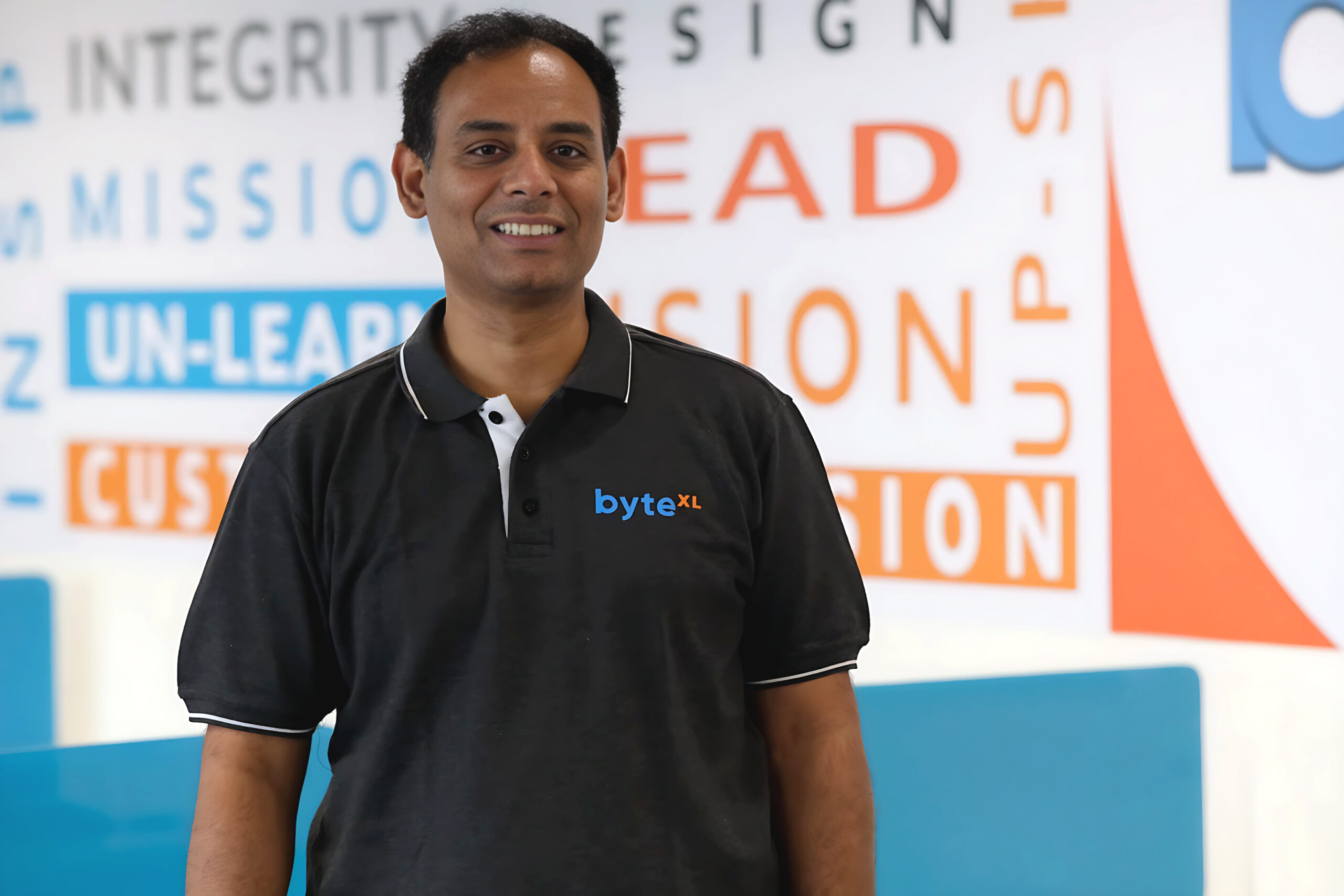
Karun Tadepalli runs byteXL, an edtech company that walks into engineering colleges across India and quietly rewires how they teach. It does not sell courses to students the way most learning apps do. It partners with the institution itself, updating the curriculum, supplying industry-grade content, upskilling the faculty, and running hands-on coding training so that graduates leave able to do the work the tech industry actually asks of them. Today that model reaches more than 100,000 students, and in 2024 it drew a marquee partner: Microsoft.
That is where Tadepalli spends his days now - closing the distance between a college syllabus and a job offer. It is a narrow, stubborn problem, and he has staked a company on it. byteXL's own framing is blunt: its mission is to transform engineering colleges in India and create a pathway of opportunity for students who might otherwise graduate with a degree and few marketable skills.
The bet is specific. India produces an enormous number of engineering graduates every year, but a persistent share of them struggle to get hired into real technology roles. The gap, as Tadepalli reads it, is not the students. It is the system training them: curricula that lag the industry, faculty who have not touched the newest tools, and assessments that reward memorization over building. byteXL is his attempt to fix the pipe rather than filter what comes out of it.
In September 2024, byteXL announced a partnership with Microsoft to launch a B.Tech in Computer Science with a specialization in Artificial Intelligence and Machine Learning at a group of universities across India, among them Lovely Professional University, Parul University, Chandigarh University, GLA University and Rayat Bahra University. Under the arrangement, byteXL acts as the executing agency, deploying Microsoft-certified trainers to deliver the syllabus on campus. Students earn Microsoft certificates folded directly into their regular coursework, and the program is designed around paid internships and placement support.
For a company that started by selling subscriptions to individual learners, landing a tech giant as a knowledge partner is a meaningful marker. It signals that the institutional model - harder to sell, slower to build - has found traction where it counts, inside the universities themselves.
byteXL did not arrive at this model fully formed. Founded in 2020, it first set out to prepare students for tech careers through affordable subscriptions and industry-led training aimed at individual learners. By late 2022 the company changed course. Instead of reaching students one at a time, it decided to transform entire colleges - taking on the outdated curricula and faculty skill gaps that a consumer subscription could never touch. It was the harder path, and Tadepalli chose it because it addressed the root cause rather than the symptom.
The early numbers reflected a company finding its footing. byteXL raised roughly a million dollars in a seed round backed by angel investors, grew its team from a founding handful to well over a hundred, and set aggressive growth targets. "byteXL is witnessing exponential response from the engineering institutes and we are emerging as the preferred skilling partner," Tadepalli said as the company expanded its footprint across Andhra Pradesh, Telangana and beyond.
Tadepalli did not come up through the startup circuit. He spent close to two decades in the United States working for established technology companies - among them Accenture, Health Management Systems and AT&T - building enterprise applications and leading teams. He earned a Master of Arts from Gannon University in Pennsylvania and an MBA from The University of Texas at Dallas. By the time he founded byteXL he was a first-generation entrepreneur starting a company after a full corporate career, not before one.
That background shows up in how byteXL is run. The company treats education less as content to be published and more as a system to be re-engineered - curriculum, delivery, assessment and outcomes all wired together. His stated aim, repeated across interviews, is to "bridge the huge academia-industry skills gap," and to help Indian students compete with the world's best tech talent rather than settle for whatever their local job market offers.
Inside a partner college, byteXL's approach is layered. Students get a cloud-based coding environment where they can practice against real challenges rather than toy exercises. The content is broken into short, digestible micro-videos and annotated walkthroughs, and progress is tracked through assessments and analytics that give both the student and the institution a read on where the gaps are. Faculty, often the quietest part of the equation, get upskilling of their own, so the improvements outlast any single cohort.
The subject matter leans into where the jobs are moving: cloud computing, DevOps, cybersecurity, full-stack development, and increasingly artificial intelligence and machine learning. That focus is deliberate. Tadepalli has consistently framed employability, not enrollment, as the metric that matters - a graduate who can actually build, deploy and reason about modern software.
The delivery is engineered to be dense. A single 45-hour subject on the platform is built from around 150 micro-videos and roughly 1,500 shorter annotated clips, the kind of granularity that lets a student replay exactly the two minutes they did not understand. It is a design choice that reflects how Tadepalli thinks about learning: confidence comes from repetition against real problems, not from sitting through a lecture once and hoping it lands.
Choosing to sell into institutions rather than to individuals was not the obvious commercial move. Consumer edtech is faster to scale and easier to market; you can acquire a student with an ad and a discount. Selling to a college means longer sales cycles, procurement committees, and the slow work of changing a syllabus that has not moved in years. Tadepalli took it on because the consumer version, in his reading, never touched the thing that was actually broken. A motivated student can always find a course online. The students byteXL is built for are the ones whose entire environment - curriculum, faculty, assessment - is set up to produce a degree without producing a skill.
That framing also explains the company's language around "hope." byteXL talks about creating a pathway of opportunity for students, and the phrasing is not incidental. A large share of India's engineering graduates come from colleges far from the metros and the marquee campuses, places where the brand name on the degree does little for the job hunt. Fixing the institution, rather than skimming its best students, is a bet that the biggest gains are at the middle and the bottom of the distribution, not the top.
byteXL's trajectory has been steep for a company selling into a slow-moving sector. In its earlier phase it partnered with dozens of engineering colleges across states including Andhra Pradesh, Telangana, Maharashtra, Delhi NCR and Punjab, and set out to upskill students by the tens of thousands. Revenue targets were ambitious - the company spoke publicly about aiming for a multi-fold jump year over year - and it backed those targets by roughly quadrupling its headcount in a short span. The funding followed the traction: an early seed round led by angel investors, and later a Series A that gave the company the balance sheet to chase the institutional model at scale.
Tadepalli's story runs between Hyderabad and Dallas, Texas, and he has built byteXL as a transnational venture rather than a purely local one. The co-founding team is family-connected: Sricharan Tadepalli serves as the company's chief strategy officer, and the leadership bench pulls from IIT, IIM and other strong pedigrees. The result is a company with one foot in India's engineering colleges and another in the global technology market it is trying to prepare its students for.
What comes next is scale. byteXL has spoken about widening its geographic reach across more Indian states and exploring markets beyond, while deepening the institutional partnerships that now define it. The Microsoft collaboration gives it a template - a way to bring globally recognized certifications into a standard four-year degree - and Tadepalli has made clear he sees that template repeating. For a founder who left a comfortable career to work on a problem most people accept as permanent, the ambition is consistent with the choice: fix the system that trains India's engineers, and do it at the level of the institution, where the change actually sticks.