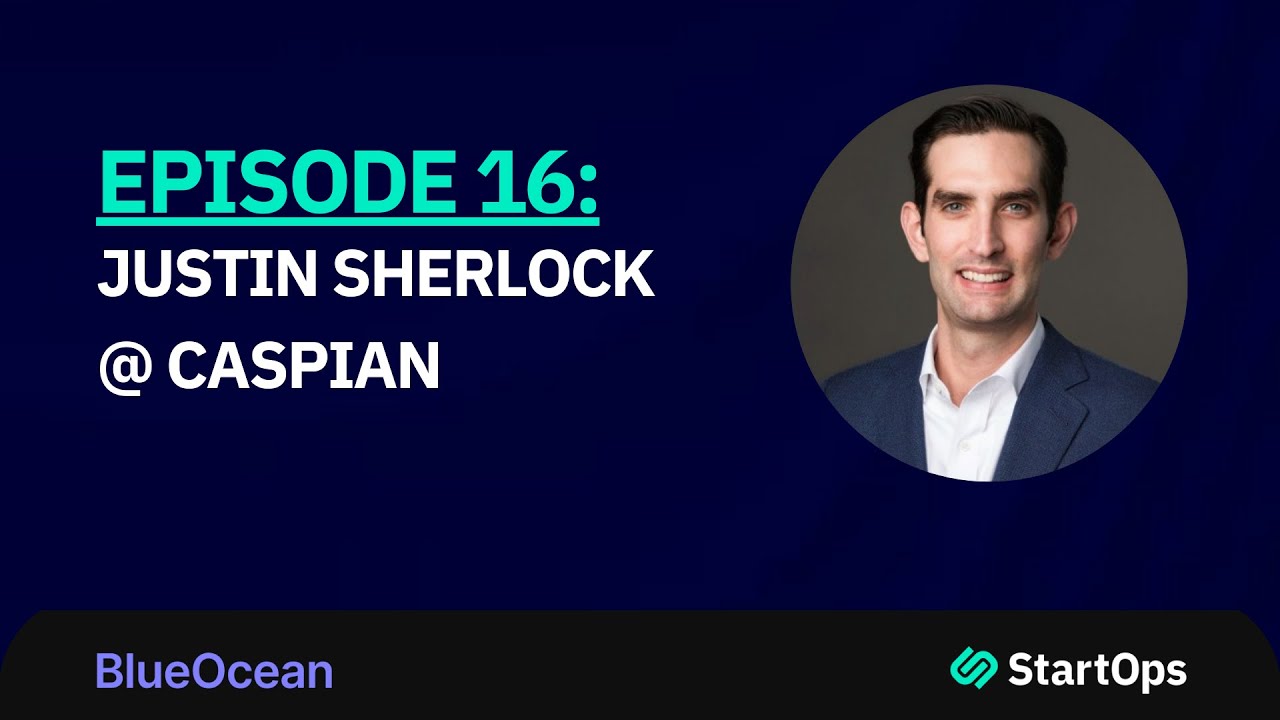
$5.4M Seed Round - Primary Venture Partners leads Caspian's launch $130 Billion in unclaimed duty refunds - Caspian is after every dollar Licensed Customs Broker + AI Platform - rare combo in trade compliance Caspian cuts 12-month drawback timelines to weeks 80+ system integrations - Caspian connects your supply chain Harvard Economics + Wharton MBA + Customs License = Justin Sherlock Flexport Capital 10x revenue growth in 3 years under Sherlock's leadership Cass + Caspian partnership: tariff cost management at scale $5.4M Seed Round - Primary Venture Partners leads Caspian's launch $130 Billion in unclaimed duty refunds - Caspian is after every dollar Licensed Customs Broker + AI Platform - rare combo in trade compliance Caspian cuts 12-month drawback timelines to weeks 80+ system integrations - Caspian connects your supply chain Harvard Economics + Wharton MBA + Customs License = Justin Sherlock Flexport Capital 10x revenue growth in 3 years under Sherlock's leadership Cass + Caspian partnership: tariff cost management at scale
Justin Sherlock, Co-Founder & CEO of Caspian
YesPress Profile  /  Founder  /  San Francisco

Justin
Sherlock

The man who scaled a billion-dollar logistics finance arm quit to get his customs broker license - then built the AI that makes the license almost unnecessary.

Co-Founder & CEO Caspian Licensed Customs Broker Harvard · Wharton San Francisco
$130B
Unclaimed duty refunds targeted
$5.4M
Seed funding raised (2025)
10x
Flexport Capital revenue growth under Sherlock
80+
Supply chain system integrations
3x
Faster than traditional brokers

He Saw the Money Nobody Was Claiming

There is a specific kind of professional frustration that comes from watching a problem sit unsolved for years while everyone around you shrugs. Justin Sherlock spent five years at Flexport watching it happen. Companies shipping goods internationally were routinely leaving duty refunds unclaimed - legal money owed back to them by U.S. Customs - because the process to recover it was so convoluted, so paper-intensive, and so slow that most importers simply gave up. The brokers who could help charged a premium. The timeline stretched 6 to 12 months. The average importer had no visibility into what they were owed.

Sherlock noticed. Then he left Flexport in late 2023 and started Caspian.

Before writing a line of code or pitching a single investor, he did something unusual: he sat for the Licensed Customs Broker exam. It is one of the harder credentials in U.S. trade law - only a fraction of candidates pass each cycle, and fewer than 12,000 people hold it in the country. Sherlock passed it. The credential is not a marketing detail. It signals that he understood the problem well enough to master the legal and procedural framework governing it before building a business around automating that framework away.

That orientation - go deep before going fast - traces back to his academic formation. Sherlock graduated cum laude from Harvard with high honors in economics and a minor in Classics, then went to Wharton for his MBA. The combination is less surprising than it seems: rigorous quantitative analysis meets a habit of reading primary sources carefully. He spent two years as an investment banking analyst at Barclays in the Power and Utilities Group, moved to TA Associates for private equity exposure, and eventually found his way to Flexport - the logistics unicorn that was, at the time, reinventing freight forwarding from first principles.

"There's approximately $130 billion in unclaimed trade refunds sitting in global supply chains due to complex, paper-intensive legacy processes." - Justin Sherlock, Co-Founder & CEO, Caspian

At Flexport, Sherlock ran capital. He joined in April 2019 working in corporate development and investor relations, then moved into Flexport Capital - the company's trade finance arm. In three years as its Director and then Senior Director, he grew monthly revenues 10x while keeping the business profitable. He expanded the division to 20+ countries and managed a team of more than 20 direct reports across three continents. By the time he left in November 2023, Flexport Capital was a business that had crossed $1 billion in financing volume.

It was also the vantage point from which he saw duty drawback being systematically ignored. Importers paying duties on goods they later exported - or on goods manufactured with imported inputs - are legally eligible to claim back up to 99% of those duties. The mechanism is called duty drawback, and the U.S. Customs and Border Protection has administered it since 1789. In theory, it is one of the oldest trade incentives on the books. In practice, most eligible companies never file. The documentation requirements are labyrinthine. The filing process requires cross-referencing import records, export records, manufacturing records, and inventory data - often from incompatible systems.

Caspian connects to more than 80 supply chain and ERP systems to assemble that data automatically. It analyzes shipment and inventory records to identify eligible refunds, builds the documentation package, and files directly with CBP as an ABI (Automated Broker Interface) software vendor - the same status held by the major customs brokerage firms. Claims that historically took 6 to 12 months are completed in weeks. The company's pitch to CFOs is direct: there is money you are owed, you are not getting it, and we can fix that without adding headcount.

A $130 Billion Blind Spot in Global Trade

Duty Drawback: The Numbers
$130B
In unclaimed annual duty refunds
99%
Max refund rate on eligible duties
1789
Year duty drawback was established by Congress
20+
Countries in Caspian's service footprint
Traditional Broker
6-12 months
Caspian
Weeks
Speed Advantage
3x Faster

Duty drawback is not new. The mechanism has existed since the founding of the U.S. customs system, designed specifically to encourage re-export of imported goods and support domestic manufacturers. What is new is the data infrastructure to claim it efficiently. Historically, filing a drawback required correlating paper manifests, customs forms, and manufacturing records across years of transactions - a task so tedious that most companies outsourced it to specialized brokers, paid a significant cut of any recovery, and waited up to a year to see a check.

Caspian's bet is that the digitization of supply chains - ERP systems, logistics platforms, customs portals - has created enough structured data to automate what brokers do manually. The 80+ integrations are the infrastructure play: once Caspian is plugged into a company's systems, it can identify eligible transactions continuously, not just on a one-time audit basis. The CBP-approved status means it files directly; no third-party broker is in the chain. The speed improvement is structural, not a matter of working faster.

The $5.4 million seed round, led by Primary Venture Partners with participation from Blank Ventures, was announced simultaneously with Caspian's public launch in July 2025 - a sign that the team had been building in confidence before going to market. By February 2026, Caspian had announced a partnership with Cass Information Systems, one of the larger enterprise freight audit and payment companies, to deliver a tariff cost management solution. Enterprise distribution channels this early in a startup's life are not common.

From Barclays to Boardrooms to Customs Forms

Sherlock's career reads like someone who kept picking the harder problem. Investment banking at Barclays (Power and Utilities Group) taught him infrastructure and capital structures. Private equity at TA Associates taught him how to evaluate businesses at depth. On Deck gave him a taste of the startup ecosystem. Flexport put him at the center of the global logistics revolution happening in the 2019-2023 window.

The pivot from Flexport Capital to founding Caspian is the move that defines his professional identity: he saw a specific, solvable, high-value problem that incumbents were too slow or too comfortable to address properly. He spent a year learning the domain from the inside before building a product to disrupt it.

2013
Investment Banking Analyst, Barclays Corporate & Investment Bank - Power and Utilities Group
2015
Private equity at TA Associates; later joined On Deck
2019
Joined Flexport in Corporate Development & Investor Relations (April)
2020
Senior Portfolio Manager, Flexport Capital - began scaling the division
2021
Director and Head of Flexport Capital - grew monthly revenues 10x in 3 years
2023
Senior Director, Head of Flexport Capital; crossed $1B in financing volume; departed in November
2024
Co-founded Caspian (March); obtained Licensed Customs Broker credential
2025
Caspian launched from stealth + closed $5.4M seed round led by Primary Venture Partners (July)
2026
Caspian-Cass Information Systems partnership announced (February) for enterprise tariff cost management

The Record

Grew Flexport Capital's monthly revenues 10x in three years while maintaining profitability
Scaled Flexport's financing arm past $1 billion in volume across 20+ countries
Obtained the Licensed Customs Broker credential before founding Caspian
Raised $5.4M seed round led by Primary Venture Partners for Caspian (July 2025)
Built Caspian as a CBP-approved technology company and ABI software vendor - a rare dual status
Graduated cum laude with high honors from Harvard University in Economics
Secured Cass Information Systems as an enterprise partner within 18 months of founding
Led teams of 20+ direct reports across three continents at age under 35

The Company He Built

Caspian
AI-native trade advisory platform for international supply chains
Founded March 2024
Headquarters San Francisco, CA
Seed Funding $5.4M (July 2025)
Lead Investor Primary Venture Partners
Co-Founder Matt Ebeweber
CBP Status CBP-Approved + ABI Vendor
Integrations 80+ systems
Website meetcaspian.com

Caspian sits at the intersection of regulatory knowledge and supply chain data infrastructure. The core use case is duty drawback - a U.S. trade mechanism that allows importers to recover up to 99% of duties paid on goods that are subsequently exported or used in manufacturing for export. Filing for drawback is legally straightforward but operationally brutal: it requires matching import entries to export records, accounting for manufacturing transformations, proving inventory lots, and filing within strict timelines. Most companies leave it on the table not because they are ineligible but because doing it manually is expensive and slow.

Caspian's technical approach is to connect to the source systems where this data already lives - freight management systems, ERP platforms, customs portals, warehousing software - and build the documentation automatically. The 80+ integrations are both a moat and a flywheel: more integrations mean more customers can onboard without custom work, and each new integration makes the next onboarding easier.

The CBP-approved and ABI software vendor status is not window dressing. The ABI (Automated Broker Interface) is the system through which customs brokers file electronically with U.S. Customs. Holding ABI vendor status means Caspian's software can submit filings directly to CBP on behalf of its clients - which is how it achieves the speed advantage over traditional brokers, who typically queue work and file in batches on manual schedules.

The Cass Information Systems partnership, announced in February 2026, adds a distribution angle: Cass is a major enterprise freight audit and payment company with deep relationships in the Fortune 500 supply chain world. Accessing that channel within less than two years of founding is a signal that Caspian's product is credible at enterprise scale, not just a tool for smaller shippers.

Five Things Worth Knowing

Sherlock holds the Licensed Customs Broker credential - fewer than 12,000 people in the U.S. hold it - even though he built software to automate what brokers do manually.
Harvard economics with a minor in Classics. The Classics minor is for someone who believes in reading the source material. The customs broker exam is for someone who takes that belief literally.
Caspian launched publicly and announced its seed round on the same day in July 2025. No quiet beta. No soft launch. Full stealth, then full go.
Before founding Caspian, he managed a team across three continents and helped Flexport expand a financial services product to 20+ countries - all while keeping the division profitable.
Duty drawback has existed since 1789, making it one of the oldest trade incentives in U.S. history. Sherlock is building the first AI-native infrastructure to claim it at scale.

In His Own Words

Sherlock has appeared on several podcasts and in trade and executive publications discussing the mechanics of duty recovery and how AI changes the calculus for CFOs and supply chain leaders. His public comments are notably operational - he explains the regulatory framework, the data requirements, and the timeline compression, not just the market size.

On The Freight Pod (Episode 63 - "Tariff Talk"), Sherlock joined a roundtable with Matt Silver of Cargado and Emil Stefanutti of Gaia Dynamics to discuss navigating tariff volatility. The conversation reflects his broader view: tariff complexity, which has accelerated sharply since 2018, creates both risk and opportunity for importers who understand the mechanisms and have the infrastructure to respond quickly.

In executive publications like the C-Suite Brief and Randlesham, he has written about how CFOs can use duty recovery to optimize margins without adding operational cost - essentially framing trade compliance not as a legal obligation but as an untapped revenue line.

"AI can turn black box trade data into clear refund insights." - Justin Sherlock, C-Suite Brief

The Coffee with a Founder podcast appearance and his Flexport blog presence give additional texture to his thinking on supply chain finance and trade infrastructure - worth reading for anyone trying to understand how Caspian's product thesis was shaped by years of watching logistics companies handle (and mishandle) capital flows.

Links & Profiles

Share Justin Sherlock's Profile