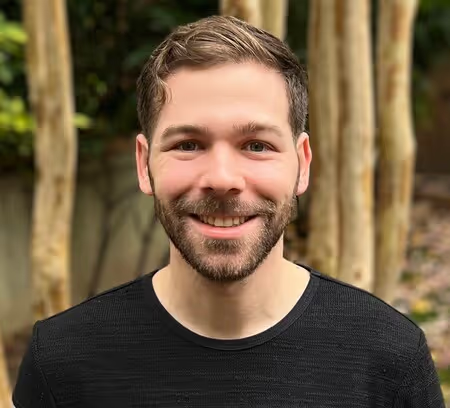
A medicinal chemist fixes the solubility of a promising molecule and watches its toxicity climb. They fix the toxicity and the permeability collapses. Fix that, and the metabolism goes wrong. Thousands of molecules, years of bench work, and tens of millions of dollars later, most candidates still fail. Josh Haimson decided this was a software problem hiding inside a chemistry problem.
That conviction became Inductive Bio, the New York company he co-founded in 2024 with Ben Birnbaum. Its Compass platform predicts a small molecule's ADMET behavior - absorption, distribution, metabolism, excretion and toxicity - before anyone synthesizes it. The pitch is brutally simple: stop guessing at the bench, start ranking candidates on a screen. By 2025 the platform had supported dozens of active drug programs and explored more than a million molecule designs.
Haimson did not arrive here from a chemistry lab. He arrived from cancer data. At Flatiron Health he was Director of Product for the machine learning and data curation teams, building systems that turned the messy clinical records of more than two million active cancer patients into real-world evidence that researchers in pharma, academia and government could actually use. Roche acquired Flatiron in 2018. Birnbaum had built out the ML organization there alongside him. The two had already learned the hardest lesson in applied machine learning: the model is the easy part, the data is the moat.
So when they looked at drug discovery, they saw the same shape of problem. Every pharmaceutical company runs the same ADMET assays, generates the same kinds of measurements, and locks every byte of it behind competitive walls. The science is shared. The data is hoarded. Inductive's wager is that a model trained across a consortium of those walled gardens beats any single company's private model - and that competitors will share if you build the vault carefully enough.
That vault is the part people underestimate. Inductive runs a pre-competitive data consortium: rival drug makers contribute anonymized data into secure environments, and everyone's models get better for it. Persuading fierce competitors to feed the same machine is less a technical feat than a trust feat, and it is the quiet center of the whole company. The revenue does not come from making drugs. It comes from software licenses and scientific collaborations, with an AI-native contract research organization on the roadmap.
The proof points are arriving. Inductive's Beacon-1 model won first place in the inaugural Polaris ADMET competition, beating 37 other entrants. The company published a drug optimization collaboration with Nested Therapeutics in ACS Medicinal Chemistry Letters. In May 2025 the work attracted a $25M Series A led by Obvious Ventures, with Andreessen Horowitz Bio + Health, Lux Capital, S32, Character and Amino Collective joining, alongside angels including Oren Etzioni, Jeff Hammerbacher, Malay Gandhi and Jakob Uszkoreit. Total funding reached $29.3M.
Ask Haimson about the fundraising and he flips the order of operations. Value first, capital second. He frames it as a discipline: prove the platform changes how real chemists make real decisions, and the rest follows. It is the same instinct that ran through his Flatiron years - that the point of all this machinery is not a clever model but a better decision made by a human who needs one.
When they fix one issue with a molecule, two other issues pop up.
Josh Haimson, on the chemist's dilemma
There is a through-line from a college project to a Series A. As an MIT computer science student, Haimson worked with researchers at Massachusetts General Hospital, using machine learning and natural language processing to read clinical notes and predict which cardiac patients would respond to resynchronization therapy. Reading messy human text to forecast a biological outcome - that is, in miniature, exactly what Inductive does at industrial scale today. The substrate changed from hospital notes to molecular structures. The instinct did not.
What makes the bet interesting is its modesty about AI. Haimson is not promising a machine that invents drugs while chemists sleep. He is promising a chemist-in-the-loop tool that kills bad ideas early and surfaces good ones faster - a co-pilot, not an autopilot. In an industry fluent in hype, that restraint reads as a strategy. The goal he repeats is unglamorous and enormous at once: become the default. The standard tool. The thing every scientist opens before they pick up a pipette.
Off the clock, Haimson keeps it local. He lives near Prospect Park in Brooklyn and turns up at Celebrate Brooklyn concerts, a short walk from the lab benches his software is trying to make faster. It is a fitting picture for someone whose whole company is about compressing distance - between idea and molecule, between rivals and shared progress, between a frustrated chemist and the next good drug.