Lyzr AI · Chief Business Officer
Joel Kandy.
He spent twenty years selling to the people paid to assume the worst. Now he's handing them AI agents.
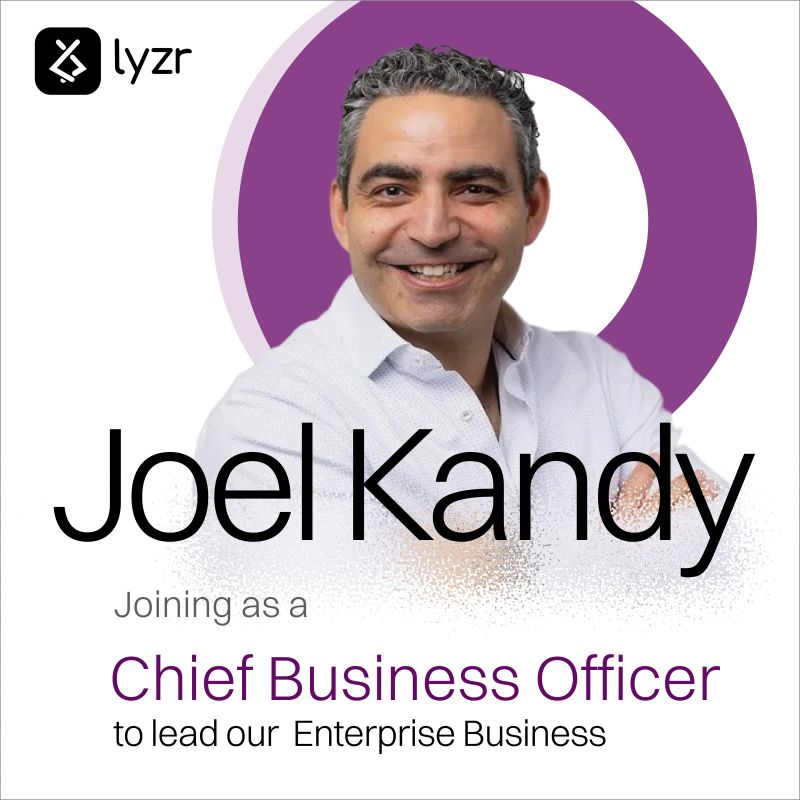
He spent twenty years selling to the people paid to assume the worst. Now he's handing them AI agents.
The job posting for Joel Kandy's career might read: must sell software to fraud teams, threat hunters, compliance officers, and bank CIOs - the four buyer types trained to say no. He has now done it for two decades, and in late 2025 he took the title of Chief Business Officer at Lyzr AI, a Jersey City company that builds AI agents enterprises can actually put into production.
Lyzr is a low-code platform for spinning up autonomous agents - customer support, underwriting, claims, RFP scouting - with the guardrails that let a regulated company sign off on them. Kandy runs the commercial engine: global enterprise sales, go-to-market, and the unglamorous work of getting an agent past a bank's risk committee. The product is new. The buyer is not. He has been selling to that buyer his entire life.
What makes him interesting is the inversion. Kandy trained as a computer scientist at Columbia, then walked away from the keyboard and into the room where the deal gets done. He is the engineer who chose to carry the bag - and who keeps gravitating back to the hardest, most distrustful corners of the software market.
"Banks are stalled by operating discipline, not AI models."
— Joel Kandy, on LinkedInAt Lyzr, Kandy's mandate is to move agentic AI from impressive demo to production system - the kind that survives an audit and a procurement cycle.
He is expanding Lyzr across financial services, healthcare, e-commerce, and large-scale enterprise - the markets where "move fast and break things" is a fireable offense.
Building the scalable sales frameworks that connect what an AI agent can do with what a regulated buyer is actually allowed to deploy.
Every logo on his resume points the same way: buyers who are paid to be skeptical. The through-line of Joel Kandy's career is trust, sold into rooms that don't grant it cheaply.
Illustrative emphasis based on his stated focus areas at Lyzr and prior roles.
Read the list and a pattern surfaces. Anti-fraud. Threat intelligence. Crypto compliance. Account security. Each one a market where the product only works if the buyer believes it - and the buyer's whole job is to not believe things.
Kandy started where a Columbia computer-science graduate is supposed to start, on a Vice President's seat at Credit Suisse, surrounded by trading technology. He left the safe path for the startup grind, and kept choosing the version of the grind with the steepest trust curve.
THE TELL The engineer who became a seller, then spent fifteen years specializing in the one thing engineering alone can't deliver: a buyer's confidence.
On LinkedIn, Kandy keeps publishing what amounts to a free field manual for bank executives trying to ship AI - less hype, more checklist.
"Banks are stalled by operating discipline, not AI models." The frontier model isn't the constraint. The org's ability to own and operate it is.
His playbook reduces AI governance to three nouns a risk officer can act on: ownership, thresholds, escalation. Who owns it, when does it stop, who gets the call.
Trained as a computer scientist, then spent his whole career on the commercial side. He can read the codebase and close the contract.
Was inside CipherTrace when Mastercard bought it - a rare clean exit in the volatile world of crypto compliance.
His resume is a greatest-hits of distrustful buyers: fraud teams, threat analysts, compliance officers, and now bank risk committees.
Scheduled to demo Lyzr's agents on a Finovate stage - returning the kid from the Credit Suisse desk to a room full of bankers, now selling them the future.
The bet: that the winner in enterprise AI won't be the team with the cleverest model, but the team that makes a governed agent boring enough to deploy.
— Joel Kandy's working thesis at Lyzr AI