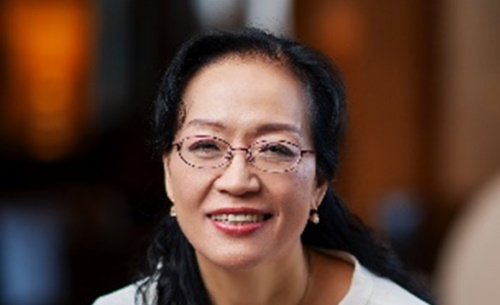
Joan Huaqiong Shen runs NeuShen Therapeutics from two places at once. The clinical-stage biotech she founded keeps research centers in Shanghai and Boston, a deliberate split that lets it draw on talent and science across the Pacific. The company works on treatments for psychiatric and neurodegenerative diseases - schizophrenia, agitation in Alzheimer's, and other conditions where the list of approved options is short and the record of failed trials is long.
In January 2026 NeuShen closed a Series A+ financing round led by Lilly Asia Ventures, with Pivotal bioVenture Partners, Shanghai Healthcare Capital, Lapam Capital and TTM Capital joining. Around the same time, the company's lead compound, NS-136, moved into Phase 2 clinical development. For Shen, the milestone is a familiar kind of moment. She has spent decades moving drug candidates through the stages where most of them stall.
"We will accelerate the progress of our current pipeline, advance candidates with breakthrough potential into clinical development, and deliver transformative treatment options for patients around the world," she said when the round was announced. It is the kind of plainly stated ambition that has followed her across companies and continents.
From a Nasdaq bell to a fresh start
Before NeuShen, Shen was head of R&D and then CEO of I-Mab Biopharma. During her tenure the company completed a Nasdaq listing and struck a global collaboration with AbbVie around lemzoparlimab, a CD47 antibody. Taking a Chinese biotech public in the United States and negotiating a partnership with a large multinational are each hard on their own. Doing both put Shen among a small group of executives who have operated at that level on both sides of the Pacific.
She did not stop there. Rather than settle into the role of a public-company chief executive, she left to build something of her own. The name NeuShen folds her own surname into the field she has spent her life in - neuroscience. It is a small tell about how personal this chapter is.
The long apprenticeship
Shen's path to founder ran through some of the biggest names in the industry. Her pharmaceutical career began at Eli Lilly, and she went on to hold roles at Wyeth and Pfizer in the United States, working on central-nervous-system programs. She later returned to China, where she became chief medical officer at Jiangsu Hengrui Medicine and built what has been described as the largest clinical team among Chinese domestic drug companies.
At Johnson & Johnson's Janssen unit in China, she served as head of development and led multiple successful regulatory approvals with the country's National Medical Products Administration. Each stop added another vantage point. "All these different experiences exposed me to different institutions in both the US and China, broadening my view of the overall industry," she has said.
The reverse move - from a long American training to the Chinese market - was not seamless. Reflecting on returning, she once admitted: "I actually felt that I knew nothing about China!" It is a striking thing for a leader to say, and characteristic of how she frames learning as ongoing rather than finished.
A scientist first
Shen is a physician-scientist by training, not a manager who arrived at biotech through finance. She earned her MD from Southeast University Medical College in China, a master's in anatomy from West China University of Medical Sciences, and a PhD in neuroscience from Indiana University School of Medicine, where she also completed a clinical residency and three postdoctoral fellowships. She is board certified by the American Board of Psychiatry and Neurology, and has held academic appointments as a guest professor at Beijing University and an adjunct professor at Indiana University School of Medicine.
That grounding shapes how she talks about strategy. On building drug programs for different markets, she has cautioned against shortcuts: "Fundamentally, we need to keep an open mind about learning from existing models, yet should avoid simply copying and pasting what has worked in other countries or what worked previously in China." The through-line is a refusal to treat any playbook as settled.
Building people, not just pipelines
In 2022, the industry network Bay-Helix named Shen its "Woman Leader of the Year," citing her leadership in both drug development and people development. The framing matters. Colleagues and the award itself point to a record of mentoring junior scientists into drug-discovery careers, a form of legacy that does not show up in a pipeline chart.
Her instinct to support the broader field extends outside her own company. In 2023 NeuShen funded amyotrophic lateral sclerosis research at UMass Chan Medical School - backing science it does not own, in an area where progress is slow and badly needed.
The recognitions have piled up alongside the work. In 2021 Endpoints News named her one of 20 Women in Biopharma R&D, and Forbes listed her among the Top 50 Women in Tech in China. For Shen, the lists are a byproduct. The point, as she puts it, is downstream: "The end game is delivering our products to patients, so we have to look at where the patients are." It explains, in a sentence, why NeuShen sits in two cities instead of one.
Asked what she would tell those coming up behind her, she has offered something close to a personal creed: "There are no limits to where your aspirations can lead you! Do not limit yourselves." Coming from someone who moved between countries, industries and roles to end up running her own company, it reads less like advice and more like a description of what she actually did.