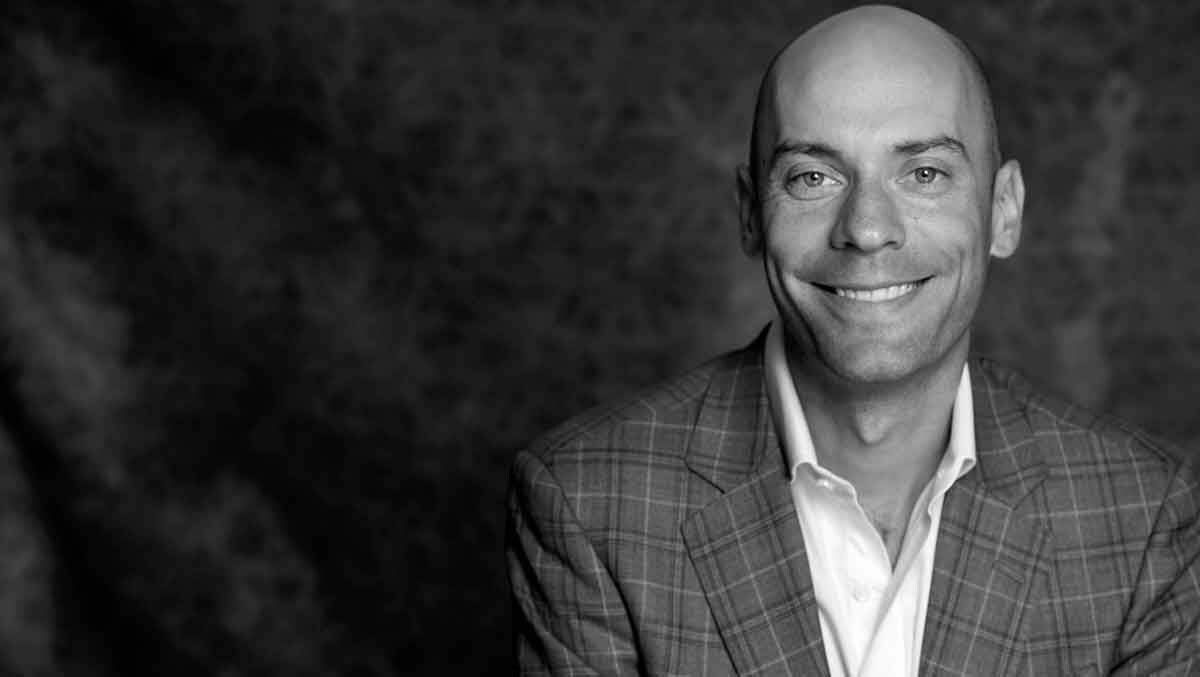
The operator who came back for the comment section
On April 1, 2025, Jim Daily walked into OpenWeb as its new chief executive. No April Fools. The company that runs the conversation layer for thousands of digital publishers had just parted ways with its founder, raised hundreds of millions, and needed someone who had already done the hard part somewhere else: turn a clever idea about advertising into a business with real revenue and real customers.
Daily had. Twice. And both times he started with almost nothing.
What drew him in was not the cap table. It was the premise. OpenWeb exists to make online conversation healthier and to keep quality journalism funded, two things that sound like a mission statement until you notice they are also a business model. Daily talks about it plainly. "What drew me to OpenWeb is simple - the mission," he said on his arrival. "The idea of fostering healthier, more meaningful online conversations is something I believe in deeply and it's critical for business and also society."
The idea of fostering healthier, more meaningful online conversations is something I believe in deeply - and it's critical for business and also society.— Jim Daily, on joining OpenWeb
His plan, stated early, is three-pronged and unglamorous in the way good plans usually are: deepen relationships with publishers, sharpen the data products, and pull advertising agencies and brands closer to the platform. Underneath it sits a thesis about where the open web is heading. Daily worries openly about "Google Zero," the moment when search stops sending readers to publishers at all, and he sees the antidote in something publishers already own but rarely monetize - the engaged community sitting in their comment threads. Move from centralized platforms to decentralized, publisher-owned communities. Treat first-party engagement data as the asset it is. That is the bet.
Teads, from a team of one
To understand why OpenWeb hired him, rewind to 2013. Teads, the outstream video advertising company, needed someone to launch it in the United States. Daily was the first official member of that operation. Employee number one. Over the next decade he grew the North American business from $0 to roughly $275 million in annual revenue, hired a team that swelled to about 300 people, and helped push Teads to roughly $750 million globally across 30 countries.
The customer list reads like a media-industry guest book. ESPN. Conde Nast. The Washington Post. The BBC. By the time he was done, Teads had relationships with something like 90% of the top-100 global advertisers. He was routinely named one of the top media executives in the country, the kind of recognition that comes from closing deals rather than collecting it.
He did not start in adtech. Before Teads he worked in radio at Katz, in display advertising at Undertone, and in branded entertainment at Defy Media. And before all of that he studied hospitality administration at Boston University - a service-industry education that, in hindsight, is a strangely perfect foundation for a career built almost entirely on relationships.
Hire smarter people. Empower teams. Build disruptive products.— The Daily operating manual, in three lines
The golf detour that became a business
Here is the strange specific. Daily is, by his own description, a fanatical golfer. He once aspired to play the game professionally before the pull of digital media won out. Most executives leave that kind of passion in the bag. Daily turned his into a company.
After Teads he founded LinksDAO, a golf-focused community venture, and grew it into an $11 million business in ten months. It is the rare side project that doubles as a proof of concept for the very thing he now sells at OpenWeb: that a passionate community, properly organized, is worth real money. He also founded Pachira Consulting and, in July 2024, signed on as Executive Advisor to Adlook, where he ran go-to-market and brand strategy for a deep-learning advertising platform. "Adlook is a proven leader in developing high-impact products and services across the advertising industry," he said at the time.
What he is actually building
The job at OpenWeb is, in a sense, the synthesis of everything before it. The adtech discipline from Teads. The community obsession from LinksDAO. The relationship-first instincts from a hospitality degree and a decade of publisher deals. OpenWeb's pitch is that the conversation happening beneath an article - the comments, the registrations, the loyalty - is first-party gold that most publishers leave on the floor. Daily's whole career has been about picking things up off the floor and turning them into run-rate.
He is leading the company through a period of obvious turbulence. OpenWeb has raised around $393 million in total, including a Series F, and replaced its founder before bringing him in. None of that is unusual for a company at this stage, and none of it seems to rattle a man who has spent his career building the plane while flying it. He arrives mid-stride, which is the only way he seems to know how to arrive.
There is something fitting about a hospitality major running a company devoted to making strangers behave better in a shared space. Hospitality, at its core, is the discipline of making people feel welcome and keeping the room from descending into chaos. That is more or less the OpenWeb product spec. Daily has spent twenty years learning that the people in the room are the business. Now he gets to prove it on the largest possible stage - the open internet itself.
The conversation economy
OpenWeb sits in an unglamorous but consequential corner of the internet. It builds the engagement and commenting layer that publishers bolt onto their articles - the registration prompts, the real-time conversations, the moderation that keeps the worst of the web from drowning out the rest. The company has spent years building AI moderation models, toxicity detection, and audience-insight tools, and it has raised around $393 million across its life, most recently a Series F. The product question Daily inherits is deceptively simple: how do you turn a comment thread into a durable revenue stream without making it feel like a tollbooth.
His answer leans on a word the industry has worn smooth - first-party data - but with a sharper edge. When a reader registers to comment, returns to argue, and stays to read, the publisher learns something that no third-party cookie ever told them. That signal is the raw material for in-conversation advertising, loyalty programs, subscription nudges, and audience segmentation that a publisher actually owns. Daily's pitch is that the engaged minority in the comments is worth more per head than the anonymous majority that bounces, and that publishers have been measuring the wrong number for years.
Building the plane mid-flight
Across Teads, LinksDAO, Pachira, and Adlook, a pattern repeats. Daily shows up early, before the thing is fully built, and treats that as a feature rather than a risk. He talks about leadership in verbs that sound almost too simple to be a strategy: hire smarter people, empower teams, build disruptive products, lead across time zones and cultures without pretending one office has all the answers. It is the operating manual of someone who has had to do all of it personally, then hand it off, then do it again somewhere new.
The through-line is range. He has sold radio and outstream video, run a crypto-flavored golf community and a deep-learning ad platform, advised startups and steered a near-billion-dollar global business. That breadth is exactly what a company in transition tends to want - a leader who has seen enough cycles to know which fires are real and which are just smoke. OpenWeb is betting that the man who launched Teads with a desk and a phone can do the equivalent again, this time for the future of online conversation itself.
Whether the bet pays off will be measured the way Daily has always been measured: in revenue that did not exist before he arrived, and in customers who stayed because the room felt worth being in. He has done it from zero twice. The third time, he starts with $393 million in the bank and a thesis he has been rehearsing his entire career.
The receipts
Scale, in proportion
Approximate annual revenue reached / built, relative scale