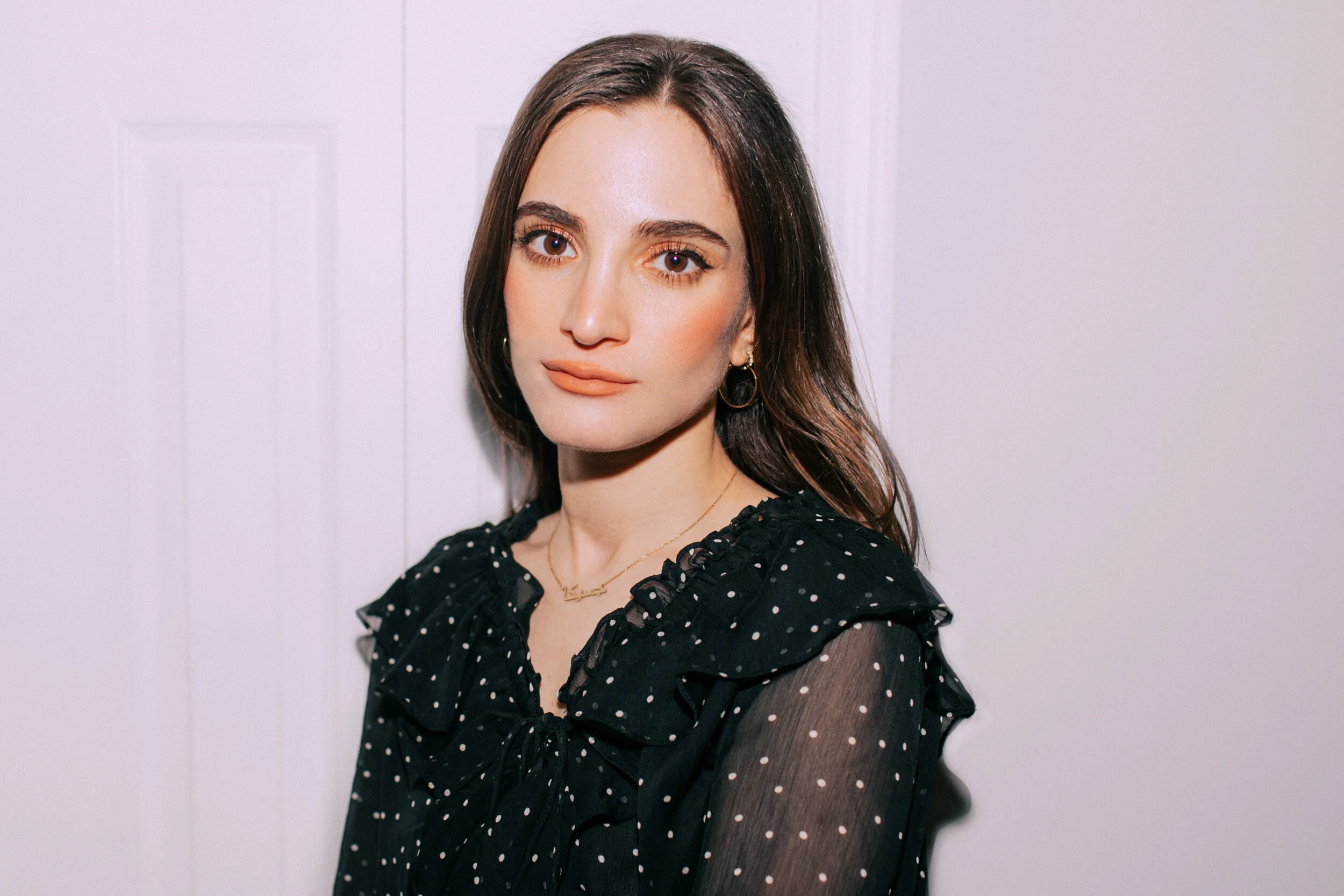
Mid-stride, camera in hand
There is a specific moment in every Jessica Kobeissi video when the shoot stops feeling like a tutorial and starts feeling like something else entirely. The model moves. The light shifts. Jessica adjusts - not with hesitation, but with the quiet confidence of someone who has already run this calculation ten thousand times. She does not explain what she is doing. She just does it. That gap between knowing and explaining is where her entire career lives.
Kobeissi is the most subscribed female photographer on YouTube. She has been for years. But the number is almost beside the point. What she built is something more specific: a format. Before Jessica Kobeissi, there was no reliable template for a photographer to grow a YouTube audience that was both large and genuinely useful to other photographers. She invented one, and then she ran it hard enough that 140 million people showed up to watch.
Neopets to a BFA: the design origin story
She was 13 when she learned to code. Not in a classroom - on Neopets. The virtual pet website had a thriving underground economy of teenagers teaching themselves HTML and CSS to make their account pages look remarkable. Kobeissi was one of them. She was not playing the game; she was redesigning the interface. That instinct - to look at a visual space and immediately think about what it could become - never left her.
She enrolled at the College for Creative Studies in Detroit in 2008, graduating in 2012 with a Bachelor of Fine Arts in Graphic Design. During college she interned at Art Van Furniture and Ambassador Magazine, which gave her her first real taste of editorial and fashion worlds. After graduation, she moved into a full-time role as junior graphic designer at Centigrade, a marketing communications agency. She stayed there until 2014. Then they let her go.
"I shoot for myself. If I'm not happy with the picture, why am I creating at all? What's the point in creating artwork just to please other people and to have their praise and accolades? My biggest thing is, do I like the picture and am I proud of myself as an artist?"- Jessica Kobeissi
The layoff that launched everything
Getting laid off from a marketing agency at 24 is not, on its face, a pivot toward YouTube stardom. But Kobeissi treated it like one anyway. She had been shooting on the side - portraits, fashion, the kind of work that scratches a creative itch that graphic design never quite reached. With no job to return to, she went full-time on the photography business she had been quietly building.
The YouTube channel started as an extension of that - graphic design tutorials at first, then Photoshop walkthroughs, then photography. The audience followed the craft, not the specific medium. By 2016, something clicked. The channel went viral in a way that most photographers' channels do not. She was not just showing beautiful images. She was showing the gap between intention and execution - what it actually looks like to make a great portrait, including the moments when it almost does not work.
The 2016 Inflection Point
Her YouTube channel, initially built on graphic design tutorials, pivoted to photography content and went viral in 2016. The breakthrough came not from a single video but from a consistent voice: honest, unfiltered, technically rigorous without being technical-obsessive. She showed the work, not just the results.
The formats that spread everywhere
Two series define the Kobeissi method on YouTube. The first is "4 Photographers Shoot The Same Model" - a deceptively simple concept where four photographers with completely different styles photograph the same subject in the same location, and the results are almost unrecognizable as coming from the same shoot. The format went viral. It went viral again. It spawned hundreds of imitation videos across the platform, by photographers who understood exactly why it worked: it makes the invisible visible. Style is not something you can explain in the abstract. Side by side, you can see it immediately.
The second series, "Taking Pictures of Strangers," strips away every controlled variable. No booked model, no predetermined location, no mood board. Just Kobeissi approaching strangers and attempting to make portraits that are worth keeping. The series is quietly terrifying in the way all great photography challenges are: there is no safety net, and you can tell. The portraits hold up anyway.
The PewDiePie chapter
In August 2019, Felix Kjellberg - PewDiePie, at that point the most subscribed individual on YouTube with over 100 million subscribers - married Marzia Bisognin in a private ceremony in London. Jessica Kobeissi was the photographer. It was not an accident that he called her. Both Kjellberg and Kobeissi had built their careers on the same platform, understood the same language of visual storytelling, and shared an audience that overlapped in meaningful ways. The choice was deliberate, and the images she delivered were exactly what a couple who met online and built their lives in public would want: specific, warm, and unmistakably hers.
"You never know when your content is going to go viral or people will start being interested. Don't give up."- Jessica Kobeissi
The signature edit
Kobeissi's images are identifiable before you see her name. Warm tones. Skin desaturated just enough to feel cinematic rather than clinical. And then - always - one element that holds its saturation: a garment, usually. An orange dress in a field of muted greens and skin tones. A yellow jacket that reads like a declaration. The technique is not accidental and she has never pretended it is. She sells her own Lightroom presets and Photoshop actions, which means thousands of photographers around the world are shooting in a style that traces directly back to her choices about color grading.
Her approach to teaching this is deliberately non-prescriptive. She has said in interviews that the single biggest mistake new photographers make is becoming obsessive about technical parameters - f-stop, focal length, the "right" lens - before they have figured out what they actually want to say with a photograph. She learned visual language on Neopets before she knew what visual language was. That sequence was useful. Curiosity before curriculum.
The educator
Beyond YouTube, Kobeissi has built a substantial educational footprint. She runs photography workshops across the United States, teaching portrait technique and post-processing. She has created courses on Skillshare and appeared as an instructor on CreativeLive - platforms where she can run deeper into the craft than a YouTube format typically allows. Her online class on color correction and editing translates her visual fingerprint into something students can actually use and adapt.
Media Coverage
Her work and creative perspective have been featured in NBC News, BBC, CNN, Cosmopolitan, The Sun, Buzzfeed, DailyMail, and The Mirror - a media footprint that reflects both the breadth of her audience and the cultural moment her viral formats captured.
The career trajectory in full
Learns web design and coding at 13 by customizing her Neopets account - first exposure to visual design thinking.
College for Creative Studies, Detroit. BFA in Graphic Design. Internships at Art Van Furniture and Ambassador Magazine.
Junior graphic designer at Centigrade marketing agency. Builds photography practice on the side.
Laid off from Centigrade. Launches full-time freelance photography business and YouTube channel.
YouTube channel goes viral. "4 Photographers Shoot The Same Model" format becomes a landmark series on the platform.
Photographs PewDiePie and Marzia Bisognin's wedding. Collaborates on viral content with photographer Brandon Woelfel.
Channel surpasses 1.8 million subscribers. Recognized as #1 female photographer on YouTube. Active workshops, Skillshare, and CreativeLive courses.
On the creator problem
Kobeissi has been candid about the less visible side of building a YouTube channel at this scale. In interviews, she has talked about the fundamental challenge facing any creator who gets big: the content that worked to build the audience is not necessarily the content that serves them once they have arrived. Her audience in 2016 wanted something different from her audience in 2021. Navigating that shift - without losing either group, without burning out, without abandoning what made the channel worth watching in the first place - is the real job. She discusses it with the same directness she brings to photography: as a problem to be solved, not a source of despair.
"A lot of YouTubers realize the content they used to make is no longer working for them and what do you do? A lot of creators only focus on successes and not problem solving."- Jessica Kobeissi
She has also spoken about the gap between the public-facing version of a creative career - the polished images, the subscriber counts, the CNN features - and the day-to-day reality of sustaining one. Her advice to aspiring photographers is characteristically unromantic: do not obsess over technique before you have something to say with it. Shoot for yourself. Stay curious enough to experiment. And when the content stops working, treat it like a design problem. Iterate.
Recommended YouTube videos
Detroit-born and Lebanese-American, Kobeissi represents a specific kind of success story that does not get told often enough: the creative who found the format before the format existed, who built the audience by solving a real problem for real people, and who has stayed honest about how complicated that success actually feels to sustain. She is 36 and still shooting. Still iterating. Still refusing to make pictures that she does not believe in.