The origin story has poor lighting, no ergonomic furniture and the faint possibility of soy sauce nearby. In 2004, Jeong Hee Kim rented a small room behind a friend's sushi restaurant in Silicon Valley and began writing document software. He was 26. His new company had a name that sounded ancient and electronic at once: ePapyrus.
Kim already knew the machinery beneath a digital page. He had spent 2001 to 2003 at Artifex Software, the American company behind Ghostscript, working with PDF technology used in printing. He wanted to start a company using what he had learned, but not simply compete with what he called his old home. His turn was almost mischievous: take technology associated with producing printed pages and use it to remove the paperwork nobody wanted.
He moved from printing to electronic forms, signatures, conversion and document workflows. A month after starting in the United States, he set up the Korean operation with three employees. The early sales pitch was less romantic than the startup setting. Government offices, banks, factories and shipyards all produced forms by the stack. Move those forms into a reliable digital workflow and a signature could arrive instantly, an inspection certificate could stop traveling by hand, and a loan agreement could lose a small forest of duplicate pages.
A paperless founder who still liked paper
Kim's version of paperless was not a crusade against the page. In a 2013 interview, he admitted that he still bought a weekly magazine in print. Paper had a tactile pleasure that software could not reproduce, he said. The target was pointless paper: unused forms printed in advance, dozens of sheets for a routine bank contract, records that had to be carried before work could continue.
That distinction is a small clue to his operating style. He seems drawn less to shiny replacement than to awkward infrastructure. PDFs are not charming. Forms rarely trend. Yet the least glamorous parts of a workflow are often the ones repeated most, and repetition is where software earns its keep.
“Software is a creative work that creates value.”Jeong Hee Kim, translated from Korean
Kim also argued that software should not be priced by counting developers and months as if knowledge work were scaffolding. Value mattered. So did the people who made it. He described recruiting and retaining good employees as the hardest part of his first decade. His answer was unusually participatory for 2013: employees helped debate compensation and benefits, while a self-directed work system let people set goals, choose workload and decide when or where to work.
He named two missions for ePapyrus: contribute to the environment and create good jobs. The language was earnest, perhaps unfashionably so. But it connects the product and the workplace. Remove unnecessary paper from one. Remove unnecessary supervision from the other.
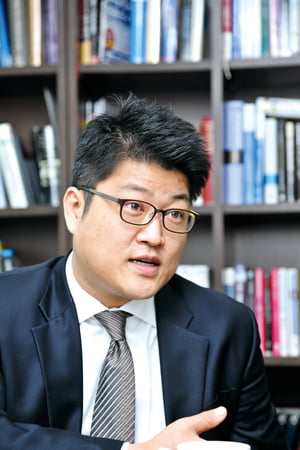
The student who declined to polish the legend
Many founders sand their biographies until every setback becomes a strategic prelude. Kim has done something more entertaining. Speaking to a hometown newspaper, he recalled ranking 27th in a class of 30 at Gyeongbuk Science High School. The students below him left under academic pressure. Kim joked that by staying, he broke the chain before everybody quit and the school disappeared.
At KAIST, where he studied computer science, the transcript did not instantly discover his genius either. He has spoken openly about receiving three academic warnings, leaving and returning before graduating in 2002. His conclusion was not that education was useless. It was that academic achievement did not fit him as well as business. He wanted, in his words, to leave an impact on the world.
This candor does more than decorate the founder story. It explains a kind of resilience without turning it into a motivational poster. Kim was willing to be badly ranked, willing to return and finish, and willing to begin again in a room whose previous business plan involved raw fish. Progress did not require the appearance of inevitability.
The 21-year loop
The employee returns as the buyer
The pleasing symmetry arrived in 2022. ePapyrus acquired Artifex, the company where Kim had learned the PDF trade roughly two decades earlier. Artifex brought Ghostscript, MuPDF and deep roots in rendering, conversion and page-description languages. Kim became its president and CEO. The founder had not vanquished his old employer. He had made it part of a larger document-software family.
The products fit together like a slightly eccentric toolkit. Ghostscript interprets PDF, PostScript, PCL and XPS for printing and conversion. MuPDF is a compact C engine built for quick rendering and document manipulation. PyMuPDF carries much of that capability into Python. SmartOffice handles viewing and editing on mobile and desktop. None is the sort of product announced beside a pop star. Together they sit inside printers, applications, automated workflows and services that need pages to behave exactly as promised.
That reliability changes the usual acquisition arithmetic. A document engine can be small in headcount and vast in consequence because other products depend on it. Artifex says more than 150 original-equipment-manufacturer partners use its software. The value is distributed through devices and applications that may never show the Artifex name. Kim was buying code, certainly, but also years of compatibility work, relationships and the confidence of engineers who would rather not learn why a malformed file can ruin a Friday afternoon.
The deal was one piece of a deliberate sequence. ePapyrus bought Kuminas in Japan and ByteScout in the United States. Instead of shopping for a famous logo, Kim described a list of around 50 smaller document-software companies and a “micro M&A” playbook. The ideal target had useful technology, customers and a sensible connection to products already in the group. Smaller deals could be decided quickly, though integrating teams across countries remained stubbornly human work.
Kim's answer to that cultural problem was not a laminated slogan. The important starting point, he said, was recognizing that people are different. In 2023, his teams spanned the United States, Europe and Asia. The technology could share an API faster than the people could share assumptions. A global software group had to learn both kinds of interface.
The filing cabinet becomes AI infrastructure
For most of its life, PDF has been treated as a destination. You finish the document, press export and send the fixed thing. AI turns the arrow around. Now the question is how to get information back out without wrecking tables, scrambling reading order or separating a label from the number it explains.
That reversal has moved PyMuPDF toward the center of Kim's strategy. The open-source Python library sits on MuPDF and lets developers extract, analyze, convert, render and manipulate documents. In April 2026, Kim said it had passed 610 million cumulative downloads on GitHub in three years and ranked first among global PDF libraries by dependent projects. He reported that PyMuPDF generated 7 billion Korean won of the group's 24 billion won in revenue in the previous year.
The business model pairs generosity with a tollbooth. Developers can adopt open-source technology freely and make it familiar across the ecosystem. Companies that embed it in commercial products buy licenses. Distribution happens through code, one project at a time. Kim said customers included Goldman Sachs, Palantir and Microsoft.
His larger claim is that clean document extraction is part of the data supply chain for retrieval-augmented generation and large language models. A model fed a mangled table does not become wise by wishing harder. It needs the structure preserved before the prompt begins. Kim wants ePapyrus to occupy that quiet position: the gateway where documents become usable machine data.
“We will be remembered as the document-data gateway of the AI era.”Jeong Hee Kim, April 2026, translated from Korean
A long game in a fixed format
In 2024, Kim was selected as a Korea Global Leader at an event organized by Maeil Business Media Group. He credited ePapyrus employees and said he wanted every one of them to feel able to introduce themselves as a global leader. In 2025, Artifex obtained SOC 2 Type 2 certification for its cloud document-processing platform and related services, a useful credential for selling to enterprises and public institutions.
The milestones are less revealing than the sequence. First, learn the engine. Then find a different job for it. Build patiently in an unfashionable category. Let employees shape the workplace. Buy adjacent tools whose users already trust them. Give developers an open door and charge where commercial use begins. Finally, notice when the old filing format becomes a new source of AI data.
Kim's career has the satisfaction of a document closed properly: the engineer leaves Artifex, the founder builds ePapyrus, and the founder returns as the buyer. Yet the file is not finished. His next ambition is larger and less visible. He wants the world's AI systems to pass through technology his group maintains, long before anyone sees an answer on a screen.