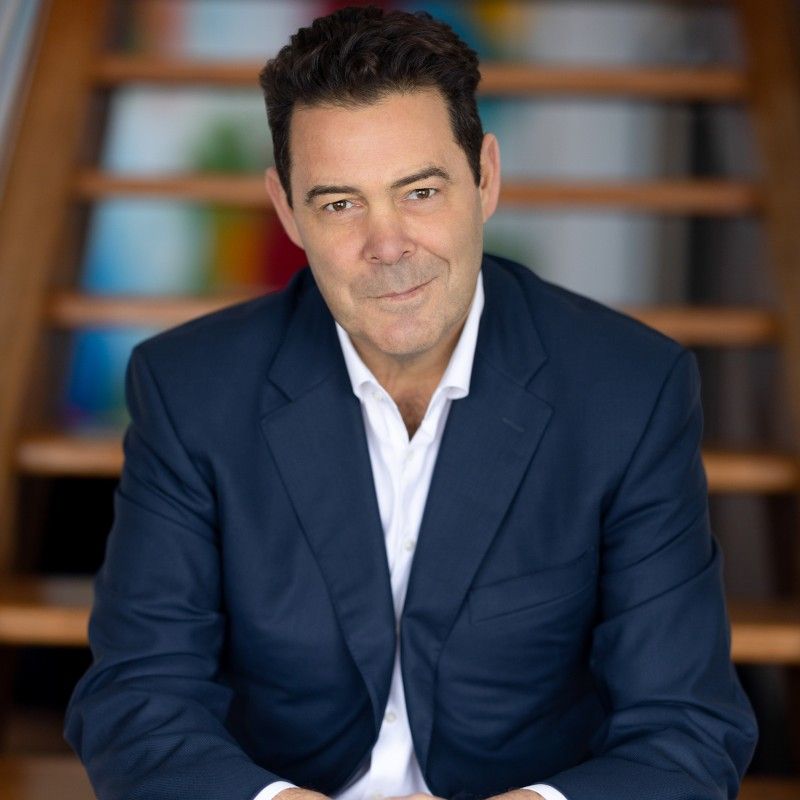
James Metropoulos - Jim to almost everyone who works with him - spends his days thinking about a part of a building that most people never see and never think about. Inside every large commercial HVAC system sits a stack of heat-transfer coils. Air passes through them; they heat and cool it. Over years they clog with grime, dust, and biological film. When they do, the whole system works harder, burns more energy, and pushes dirtier air into the rooms people breathe in. For more than a century, the HVAC industry had no reliable way to actually clean deep inside those coils. Metropoulos built a company to change that.
That company is Blue Box Air, and today it is the center of his working life. As founder and CEO, he leads a Dallas-based clean tech operation whose patented process injects odorless enzymes into HVAC coils to break down the biofouling that accumulates there. The pitch is simple to state and hard to execute: keep the coils clean on an automated schedule, and the system keeps running like new - less energy, lower carbon output, better indoor air. Blue Box calls the automated version of this "Bio-Automation," a system that regularly treats the coils so dirt and microbes never get a foothold.
What makes the idea compelling is the scale of the waste it targets. Blue Box's own framing is blunt: the HVAC system is usually the single largest energy consumer in a building, and most systems run well below their potential because the coils are dirty and no one could properly clean them. The company describes the coil problem as costing the world "tens of billions in shortened equipment life, excess energy consumption, and poor human health." Fix the coil, the argument goes, and you get a rare three-for-one - money saved, carbon avoided, air improved.
"Blue Box is at the forefront of revolutionizing how companies think about the carbon footprint and the quality of their indoor air."
James MetropoulosFrom an idea to a client list
Metropoulos founded Blue Box Air in 2016, starting out of Southern California. The early years followed the familiar shape of a founder betting on a problem nobody else was chasing. By 2017, the company reported growing gross revenue by roughly 390% and began expanding nationwide. In 2018 he was featured in Nasdaq's "Faces of Entrepreneurship" series, where he offered a definition that doubles as a personal operating manual.
The customer roster grew into names that carry weight. Blue Box has counted MGM Resorts, UC Berkeley, General Motors, LA Children's Hospital, and the Golden State Warriors among its clients - a mix of hospitality, campus, industrial, and sports facilities, all buildings where air handling is a serious, expensive concern. The through-line is that each of these operators runs large, complex HVAC infrastructure where even single-digit efficiency gains translate into real money.
"Entrepreneurship is the art of looking at the world differently and creating value by solving big problems with innovative solutions that no one has ever thought of before."
James Metropoulos · Nasdaq, Faces of EntrepreneurshipThe move to Dallas
In 2020, Metropoulos relocated Blue Box Air's headquarters from California to Deep Ellum, the arts-and-warehouse district just east of downtown Dallas. It was a deliberate bet on a new home base rather than a retreat. He described the decision plainly, calling Dallas a gorgeous city with great people and, in the end, "a pretty easy decision." The company set up in Deep Ellum and laid out plans to grow its local team substantially over the following year.
The timing put the company in an unusual position. The relocation coincided with the early months of the COVID-19 pandemic, and Metropoulos moved quickly to adapt the core technology. The same process built to clean coils for efficiency could be reformulated to disinfect a building's HVAC system - a way to reduce the circulation of pathogens through shared air. The company took on disinfection projects, including work tied to Houston's NRG Stadium when it was converted into a field hospital, and offered free treatment to nursing homes and homeless shelters during the crisis.
"This now starts to open up a whole new conversation around Blue Box where a healthy building is now an efficient building."
James MetropoulosThat line captured a reframing he has leaned on ever since: health and efficiency are not competing goals but the same goal seen from two angles. A building that circulates cleaner air is, almost by definition, a building whose HVAC system is running the way it was designed to.
The pivot behind the company
Blue Box Air did not appear out of nowhere. Metropoulos came to it after work in oil and gas, through a venture called Blue Box Energy. When he raised capital and consolidated operations around the air business, he folded the Blue Box Energy team into Blue Box Air. It is a telling pivot - from extracting energy to conserving it - and it helps explain the company's engineering-first, systems-level view of buildings. He is described by his own company as its "chief innovator," with a background in patenting, heat transfer, and industrial systems, and he holds a degree from UCLA.
Ask him how he thinks about the work and the answer tends toward the reflective. His personal credo, as he has described it, is to always keep learning and always keep an open mind - the belief that no matter how well you think you know a subject, there is always a new angle waiting. He has also been candid about the harder parts of the founder's path, describing entrepreneurship as a lonely road, especially early on, when friends and family often see only the risk and downside rather than the vision driving you forward.
"By addressing the HVAC system in this manner, we can greatly improve the safety of any facility's air."
James MetropoulosWhat he is building toward
The larger ambition is to make coil care a standard part of how buildings are run - not an afterthought performed rarely, if at all, but an automated, continuous service woven into a building's operations. In Blue Box's telling, it has pioneered the concept of a "self-cleaning deep coil" that can offer dramatically more heat-transfer surface area than conventional designs, and it markets the ability to meaningfully cut a building's energy consumption and carbon footprint. The company points to headline sustainability metrics - tens of thousands of coils restored, hundreds of millions of kilowatt-hours saved, and large volumes of CO2 emissions avoided.
Those are the company's own figures, and the exact numbers move as the business grows. But the direction is consistent with everything Metropoulos says publicly: that the fastest, least glamorous path to decarbonizing the built environment may run straight through the air ducts. In 2024 he took that message to the "Innovate or Stagnate" podcast, discussing what it actually takes to shake up a slow-moving industry like HVAC. It is a fitting venue for a founder whose entire company rests on the premise that the biggest wins are often hiding in the parts of a building no one bothers to look at.
For Metropoulos, that is the appeal. A dirty coil is invisible, boring, and easy to ignore - which is exactly why it went unaddressed for a hundred years, and exactly why he decided to build a company around it.