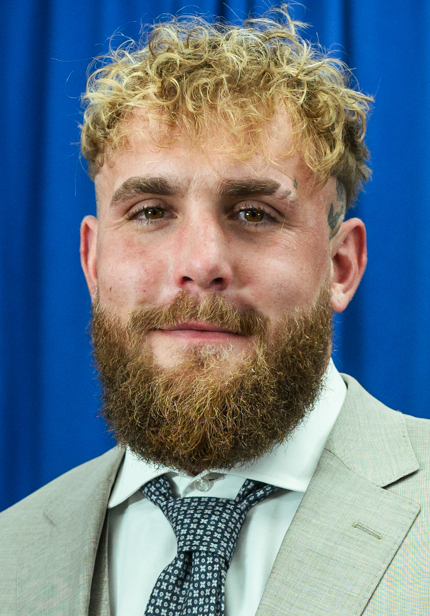
The strange thing about Jake Paul in 2026 is not the boxing. It is the boardroom calendar he keeps between fights. On any given Tuesday he is on a call with Sky Sports negotiating a UK distribution deal for Most Valuable Promotions, his five-year-old fight company. On Wednesday he is reviewing investor decks at Anti Fund, his venture firm. By Thursday his fiancee Jutta Leerdam, an Olympic speed skater from Friesland, is filming Instagram content in a kitchen that doubles as a soundstage. He is twenty-nine years old, has roughly 74 million followers across platforms, and his last opponent put him to sleep on Netflix in front of 33 million people.
None of that should work, narratively. The arc skips chapters. The Disney Channel actor who shared a Westlake, Ohio bedroom with his older brother was supposed to age out of relevance years ago, the way Vine stars usually do. Instead he assembled the pieces of a sports holding company while still cutting weight - Most Valuable Promotions for the fights, Betr for the wagering app, W for the body wash you buy because the algorithm told you to, Anti Fund for the venture bets - and quietly turned himself into a one-man middleman between the creator economy and combat sports.
The signature event is still Paul vs. Tyson. November 15, 2024. AT&T Stadium in Arlington. Sixty-five million concurrent streams on Netflix, the most-streamed sporting event in history at the time. The fight itself was a slow waltz between a 27-year-old in his prime and a 58-year-old who had not fought professionally in 19 years. Paul won by unanimous decision, 80-72, 79-73, 79-73, and the judging was not the controversy. The matchmaking was. Tyson took the loss; Paul took the platform.
"They can't touch me."Jake Paul, on MVP's MMA ambitions, ESPN, 2025
The trick of Jake Paul, the reason he keeps mattering despite a thousand op-eds explaining why he shouldn't, is that he treats his own career as the smallest unit of inventory in a much larger catalog. He is a fighter on the card, yes. He is also the promoter of the card, the part-owner of the betting app on which you might wager on the card, the co-founder of the fund that might one day invest in the venue, and the personality whose 28 million Instagram followers will absolutely watch a vertical clip of the press conference. He has vertically integrated his own attention.
Compare him to anyone in boxing's previous era and the analogy snaps. Don King ran promotions. Floyd Mayweather sold pay-per-views. Roy Jones Jr. owned a piece of his own back end. Paul does all three simultaneously while filming for a YouTube channel he started when he was seventeen, in May 2014, two months after his older brother Logan got there first.
That detail - second-born, two months behind - is doing a lot of quiet work in the Paul biography. He has spent a decade being the brother people forgot to mention first, and he has answered the slight with a level of relentless audience-building that the polite call shameless and the honest call disciplined. Vine in 2013, 5.3 million followers before the app died. YouTube in 2014. A Disney Channel role on Bizaardvark as Dirk Mann from 2016 to 2018. A series of films - Airplane Mode, Mainstream, A Genie's Tail - that he treated less as acting credits and more as audience funnels. By the time he laced gloves against Deji Olatunji in a white-collar bout in August 2018, his entire career was already a feeder system for whatever he chose to do next.
"I'm not in this to be liked. I'm in this to win."Paul, recurring
Boxing was the brilliant detour. He turned pro in January 2020, knocked out AnEsonGib on a Demetrius Andrade undercard, and proceeded to run a five-fight gauntlet of crossover names: AnEsonGib, then Nate Robinson, then Ben Askren, then Tyron Woodley twice, then Anderson Silva, then Tyron Woodley's friend, then Nate Diaz. Critics called it a parade of athletic tourists. Paul called it building a brand. Both descriptions were correct. The bouts sold, and the wins counted on BoxRec the same as anyone else's.
The first loss came in February 2023 in Diriyah, Saudi Arabia. Tommy Fury, half-brother of Tyson Fury, took a split decision. The defeat was real. The narrative absorption was instant. Paul re-strategized, reorganized his team, dropped down in weight class, signed with the Performance Institute people, and ran a string of wins back: Nate Diaz, Andre August, Ryan Bourland, Mike Perry, and then Tyson. The Tyson win was, depending on who you ask, the apex of crossover boxing or its nadir. Either way it crossed the rubicon: a YouTuber outpointed a former heavyweight champion of the world on the largest streaming stage ever assembled for a fight.
Which brings us to December 19, 2025. Miami. Netflix again. Anthony Joshua, the actual former unified heavyweight champion of the world, accepted a fight that the boxing public assumed would be a slaughter. It was. Joshua dropped Paul in the fourth, the fifth, and finally the sixth, knocking him out at 1:31 of the round. Paul's jaw broke in two places. He posted an X-ray to social media with the line "Jaw broken. Heart and balls in tact." Surgeons installed two titanium plates. The fight drew 33 million global viewers. The narrative did not so much absorb the loss as eat it whole.
In May 2026, sitting across from Ariel Helwani, Paul said his boxing career was "most definitely" in doubt. Then he walked it back. He expected medical clearance for sparring inside two to three months. In January he had quietly lost his number-fourteen WBA cruiserweight ranking. The same month he and the PFL ended their multi-year relationship without him ever taking an MMA fight. He has not stopped working. He has stopped pretending he is only one thing.
"Jaw broken. Heart and balls in tact."Paul on X, December 19, 2025
Most Valuable Promotions, the company he co-founded with adviser Nakisa Bidarian in 2021, is the spine. It promoted Katie Taylor vs. Amanda Serrano in April 2022 - the first women's boxing match to headline Madison Square Garden - and then ran the trilogy. It promoted Paul-Tyson. It is launching MVP MMA, with the inaugural card headlined by Ronda Rousey submitting Gina Carano at the Intuit Dome. In March 2026 MVP signed Sky Sports as its UK and Ireland broadcast home. Around the same time it locked in a multi-year ESPN deal in the United States. Paul speaks publicly about competing with UFC. The boxing press finds this funny. UFC executives, less so.
Betr is the other pillar. He co-founded it with Joey Levy in August 2022. It is a micro-betting and sports-media app that has raised tens of millions and been valued in private rounds at roughly $375 million. The pitch is simple and slightly cynical: betting is now the gravitational center of American sports media, the creator economy is the gravitational center of attention, and Betr stitches them together. Anti Fund, his venture firm, is the third leg - undisclosed portfolio, a handful of well-publicized checks. W, the body-care brand co-founded with Geoffrey Woo, has been pegged at around $150 million.
Run the math and the picture is less a fighter with side hustles and more a portfolio with fists. Forbes ranked him number three on its 2025 Top Creators list with $50 million in annual earnings. Different sources put his personal net worth between $100 million and $200 million depending on how you assign value to early equity. The honest answer is that nobody outside the cap tables knows. The honest answer is also that he is one of the very few creators who has converted attention into operating businesses rather than brand deals.
The personality is harder to summarize than the spreadsheet. He is provocative on purpose and earnest by accident. He is a relentlessly competitive person with the metabolism of a media company. He calls out opponents and then negotiates fairly with them in private. He has been wrong about plenty - early-career stunts, public spats, a Calabasas mansion era - and the apology track record is mixed. He has also been right about some of the largest shifts in attention economics of the past decade, which is exactly the kind of thing that makes the cultural establishment furious.
What he aspires to, as best as can be read from interviews and from his own annual letter-style social posts, is to build the first creator-native sports holding company - a vertically integrated stack of promotion, betting, brand and media that does not require him to keep fighting forever. The jaw fractures from Miami may be the inflection point that turns intention into urgency. He is not built to retire quietly. He may not be built to keep getting hit either. The interesting period for Jake Paul, the one the rest of the press has not figured out how to write yet, starts now.