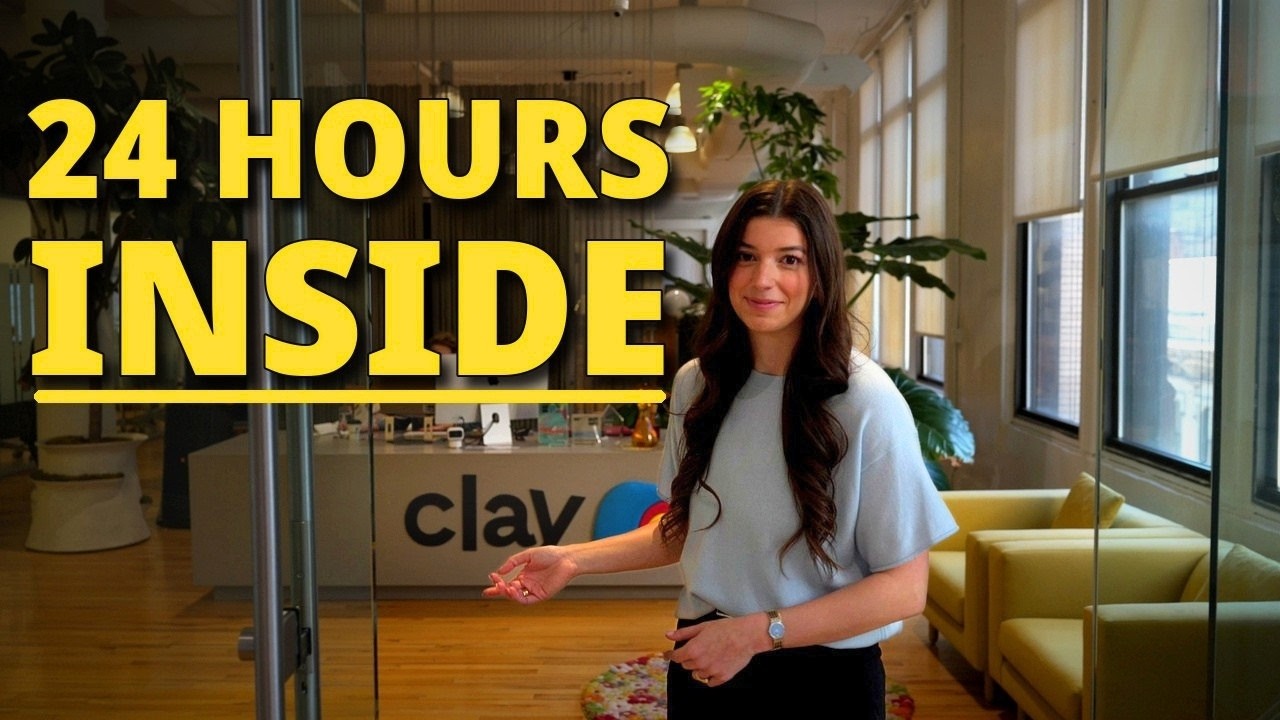
There is a new job spreading through the fastest-growing startups in America, and almost no one can tell you what it is. It is called a go-to-market engineer. Is it engineering? Is it marketing? Is it sales? Is it internal or external? What do these people actually do all day? In the last year alone, postings for the role have surged more than 5,000 percent — a number that usually signals either a bubble or the birth of an entirely new category of work. To find out which, the host of the web series Stories of Scale did the only sensible thing: he boarded a train to New Jersey and spent an entire day shadowing the person who arguably invented the title.
That person is Everett Berry, Head of Go-To-Market Engineering at Clay — a company founded in 2017 that, in the span of a few years, went from a small product almost no one used to a growth engine powering teams at some of the largest companies in the world, including Anthropic and Google. Clay is now valued at $5 billion. And the odd, hard-to-pin-down discipline of "go-to-market engineering" appears to sit at the very center of how it scaled so fast. Clay did not merely adopt the role. It coined it.
The episode opens in motion, which turns out to be the only speed Berry has. The commute is a running gag and a genuine logistical puzzle: a 45-minute train ride where the cell service, in his words, "goes in and out," forcing him to get all his work queued up before the signal drops. On the way in, he has to write a full LinkedIn post and prep for an enablement session he is presenting later that day. "The trick with this commute," he explains, "is basically the cell service goes in and out, so I got to get all my stuff ready to go." The host, watching him thumb out a post while racing the clock, offers the only verdict available: "You've mastered your commute."
Berry says this half as a joke, but by the time he reaches the office, it is already coming true in the small way that offices allow. His coworkers stop to snap photos of him — mostly, the host suspects, because they find it funny that he is being trailed by a camera crew. "Smile at the camera really quick," someone says. "Make Everett famous." He posts the LinkedIn update, someone suggests he comment "So insightful," and just like that, the day's first deliverable is shipped before he has even sat down.
The Question Nobody Can Answer
Here is the problem that makes Clay such a confusing company to profile: everyone there is a go-to-market engineer, and everyone there defines it slightly differently. Wandering the office while Berry disappears into a meeting with a colleague named Zach — a conversation the host admits he could not follow "within about 30 seconds" — he starts asking people point blank what they do.
"I do go-to-market engineering here." "I am a go-to-market engineer." "I am an internal go-to-market engineer." The answers stack up without clarifying anything. Then one employee cuts to the heart of why the whole thing is so slippery: "I am a go-to-market engineer. I am the core user of every other company. We try to sell to people like me." In other words, Clay's product is built for go-to-market engineers, Clay employs go-to-market engineers to sell it, and the customers buying it are — go-to-market engineers. It is a hall of mirrors. One employee even warns the crew directly: "Trying to explain this in a video, I think you guys will have a lot of trouble."
They were not wrong. But the fog begins to lift the moment a man named Spencer reaches, unprompted, for a pickle.
The Pickle Theory of Everything
"I had to fall to the pickle analogy," Spencer says, "which is imagine you make pickles." The host, remarkably, confesses he has never eaten one. ("You've never had a pickle? That's heinous.") Undeterred, Spencer lays out the entire discipline through the lens of a small pickle-maker in New York City.
The core question any business faces, he explains, is simple: how do you grow? And that reduces to two smaller questions — who are my customers, and how do I find more of them? A pickle-maker in New York needs a list of every deli in the city, sorted into customers and non-customers, so they know exactly where to sell. Maybe they want to expand into new pickle varieties, so they track which delis buy which jars and which they don't. "We build that list. We find the right people. We find the decision maker who's the most likely to buy the pickle. And then we sell you pickles."
That, stripped of jargon, is the job. A go-to-market engineer takes messy data about who is out there, tracks signs of interest — someone visiting your website, say — and analyzes buying behavior. Then they turn all of it into a system that tells you who to sell to, who is most likely to buy, and how to reach them. And instead of doing that work by hand, the way teams always used to, they automate the whole thing. Clay is the tool that lets them build those systems.
Spencer, it should be noted, is also the office's self-appointed morale department. "It might be because I'm in a good mood, but I've been hyping people up," he says, before delivering some genuinely awkward hype ("this is not good hype, we got to find better hype"). The team's affectionate verdict: "Spencer is just the best hype man. Spencer brings the best energy to the office."
Five Years, Zero Dollars
Downstairs, the host runs into Varun, one of Clay's co-founders, and asks the obvious question: how did this company get here? The answer is not the tidy rocket-ship story you might expect. For its first five years, Clay made basically nothing. "Nothing really happened for a while," Varun admits.
The turn came from a deceptively simple idea: what if a spreadsheet could actually pull data from anywhere on the internet? In February 2022, the team launched that product on Product Hunt — and started noticing something in who showed up. The people who truly got it were technical, scrappy operators using Clay to build systems for finding and reaching customers. Watching those users work gave the company its direction. Clay stopped being merely a data tool and became a system for finding the right people, understanding them, and reaching out to them.
Then, in late 2022, artificial intelligence poured accelerant on the whole thing. Suddenly teams could not just find the right people but automatically generate personalized outreach — all inside Clay. That is when startups piled in. Varun remembers the exact inflection point with a customer's name and a date: "Rippling was a really meaningful customer for us. They signed in March of 2023. They were the customer that pushed us over a million dollars."
Why Clay Refused to Hire Salespeople
Heading into 2024, Clay hit a wall of a different kind. Startups loved it. Enterprises would not touch it. Varun's reasoning was almost circular in its honesty: "Well, how do we become an amazing company? You kind of need other amazing companies to use your product. And it just so happens that other amazing big companies don't want to use your product unless you help them. So we're like, okay, how do we do that? Well, apparently that's what sales is."
But Varun did not want traditional salespeople. The product was too complex to hand to someone who had never used it. So he looked at Clay's own community for people who already understood the tool — and found Everett Berry there. "You were using Clay before you joined Clay," the host confirms. Varun's pitch was blunt: "Hey, what if you did sales?" Berry's reaction was exactly what you would expect from an engineer. "I was like — first of all, I'm more of an engineer. Second of all, I'm more of a growth person, and sales is..." He trails off, and the host finishes the thought for a generation of technical people: "Sales is icky."
That reluctance was precisely the point. Varun wanted someone who could build systems and show another company how to grow using Clay, not someone who could work a room. The naming came almost as an afterthought. "At one point I was like, 'So Varun, should I be head of sales?' And he was like, 'No.' He was like, 'GTM engineering is a thing.'" And just like that, the team had a name.
Success was not instant. "I didn't sell anything at Clay for six months," Berry admits. What eventually cracked it was a change in method. Instead of telling companies what the product could do, he started building real workflows for each prospect — solving an actual problem before asking for a dollar. Nobody liked their existing data stack: too expensive, poor quality, too many vendors. So Clay would prove it could fix that with a live data test, land the customer on that one use case, then expand into outbound, inbound, CRM, and beyond. By the end of the year they were signing Figma and OpenAI. By 2025 the approach had scaled Clay past $100 million in revenue.
The Twist: There Are Two Teams
Just when the picture seems to snap into focus, a go-to-market engineer named George stops the host in his tracks. "So, there's two go-to-market engineering teams." Two? The host goes hunting for Berry to get it straight, and Berry maps it out.
Most companies, Berry explains, have only the internal team. These are not traditional ops or marketing people. They are engineers — but instead of building software, they build the systems that power a company's revenue: pipeline operations, automated follow-ups, content generation. Their job is to sort through the universe of prospects and surface the best ones to target.
What Clay did that almost no one else has is stand up a second team. It took people with the exact same skill set as the internal team and deployed them directly to customers — a forward-deployed sales force made of builders. This is Berry's team. When the internal team qualifies a lead that looks like a strong enterprise fit, it hands it off to the deployed team, which shows up almost as a go-to-market consultant. "We're figuring out, hey, what is the root cause of problems you're facing in your go-to-market stack? And how do we build something in Clay that will solve that problem?" Every build is completely custom — a one-to-one proof of concept assembled pre-sale on a small sample of the prospect's own data.
How the split actually works
The division between the two teams is not by rank but by temperament. They are, as the host puts it, "people with the same skills pretty much divided depending on personality." The more engineering-minded gravitate toward internal infrastructure; the ones who enjoy customer conversations end up forward-deployed. And the magic ingredient is that the people selling Clay are the same type of person who buys it. They feel the customer's pain because they have lived it.
The Flywheel
Put the two teams together and you get what Berry calls a flywheel — and what the host calls a revenue engine. The internal team generates the pipeline. The forward-deployed team closes it. And everything the deployed team learns inside customer accounts flows straight back into Clay's own systems, sharpening the next cycle. "It's a flywheel," Berry says, "because we help customers with Clay, we learn a lot about what they're doing with Clay, and then we feed that back into our team so that we can do cool stuff with Clay, too."
He offers a small, vivid example of what "cool stuff" means in practice. Say the CEO is headed to San Francisco. Who are the 20 best people to seat around a dinner table with him to drive the most impact? Clay keeps a live table you can filter in real time — SF, Austin, NYC — to build hyper-targeted guest lists, send invitations on the founder's behalf, and log every response and registrant. Who built that system? "This was created by our GTM engineers," Berry says. "A fully deployed GTM would build this for our customers."
The day, appropriately for a man whose commute is a sport, never really slows down. Berry vanishes into so many back-to-back meetings that the host loses him repeatedly ("Well, lost Everett... the problem with these operators, they're just so busy"). There is a customer check-in with someone from AWS, held on a stroll through a park because, Berry insists, meeting customers outside the office is entirely normal. By the time the crew decamps to Berry's favorite pub to close out the day, the thesis has landed. Clay didn't just coin the term go-to-market engineer. It became the single best example of what the role can do: two teams, one loop, and a $5 billion company to show for it.
And the host? He kept his promise. In the episode's final beat, having confessed all day that he had never eaten a pickle, he picks up a whole one and takes the plunge on camera. "This is for you, Susan. Can I eat the whole thing?" A pause. A grimace. "I don't know how I feel. I actually don't know. Can I have water?" It is, in its way, the perfect ending — a reminder that even after a full day of pickle analogies, some things you only understand by trying them yourself.