Founder / Operator / Montevideo
Ilan Bajarlia
He named his company after a sound: knock-knock. Then he taught the world's brands to walk through Latin America's door.
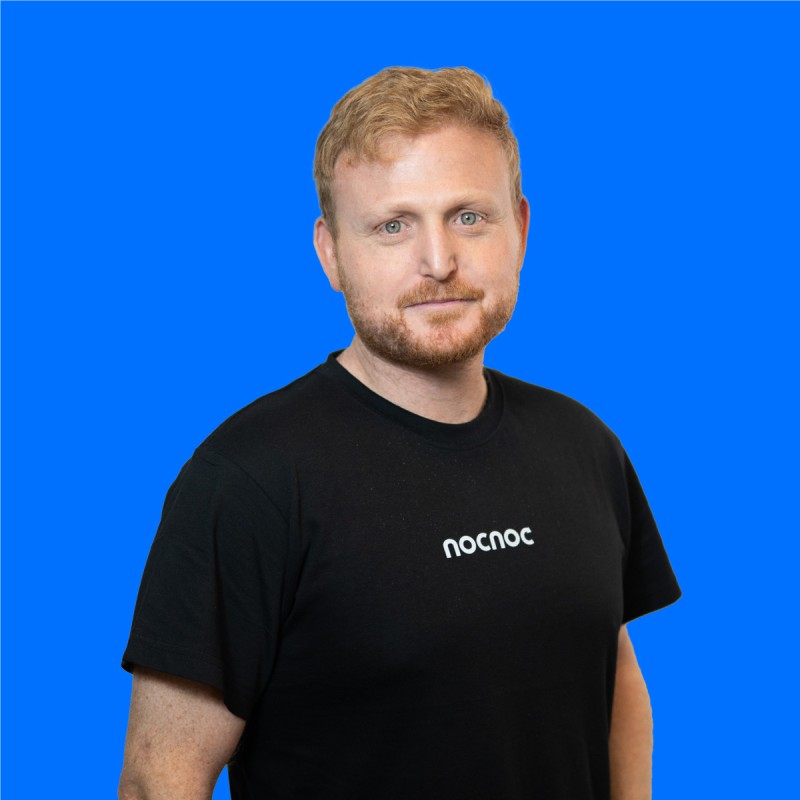
Ilan Bajarlia. Photo: Nicolas Garrido / Forbes Uruguay.
He named his company after a sound: knock-knock. Then he taught the world's brands to walk through Latin America's door.
Latin America has no Amazon. That is the whole business. There is no single store where half a billion people shop, no winner that took all. Instead there are twenty large marketplaces - Mercado Libre, Americanas, Carrefour, Magazine Luiza, Coppel, Walmart, and more - each with its own rules, its own currency quirks, its own appetite. For a brand in Ohio or a seller in Shenzhen, that is not a market. That is a maze.
Ilan Bajarlia built the key. nocnoc, the company he co-founded in Uruguay in 2018, takes a global seller and makes them present across the region's biggest marketplaces at once - listings, marketing, customer messages in local languages, logistics, returns, the whole circuit. The seller keeps focusing on what they already sell. nocnoc handles the part that used to be impossible.
Today nocnoc connects more than 2,500 brands and digital sellers from the United States and China with shoppers across Brazil, Mexico, Colombia, Chile and Argentina. The company calls itself the largest cross-border store in Latin America, and the numbers back the boast: gross merchandise volume tripled in a single year, growth runs around 250% annually, and the reach stretches toward 500 million consumers. PayPal Ventures led its Series A. Banco Santander's venture arm is on the cap table. Most people in Silicon Valley have never heard of it.
Role: CEO & Co-Founder, nocnoc
Based: Montevideo, Uruguay
Founded nocnoc: 2018
Raised: ~$22M total
Lead investor: PayPal Ventures
Before: dLocal, AstroPay
Cross-border never dies. It moves.
The risk gene came early. Bajarlia grew up watching his father run a furniture company, which is a particular kind of education - you learn that inventory is a bet, that a slow season is a held breath, that the person who signs the lease sleeps differently than the person who collects a salary.
But his first venture had nothing to do with commerce. In 2014 he founded Educacion Responsable Uruguay, an emotional-education program for children and teenagers. It was not a side hobby. Under his leadership it reached more than 45 schools and 10,000 students - a founder learning to scale something before he ever scaled a marketplace, and a tell about what he values. Years later, running a high-growth tech company, he would still budget for his employees' therapy, sports and vacations, and call talent retention a strategy rather than a courtesy.
Then came the apprenticeship. From 2015 to 2017 he worked in business development at AstroPay and dLocal - the latter now a Uruguayan payments unicorn - building partnerships across Latin America. He closed deals with GoDaddy, Avast, ESET and Endurance International Group. He learned, in other words, exactly how hard it is for a global company to do business in a fragmented region, and exactly how valuable it is to be the one who makes it simple. All three nocnoc founders - Bajarlia, Diego Szilagyi and Joaquin Colella - came out of dLocal. They walked out, looked at Latin America, and saw a captive e-commerce market worth hundreds of billions of dollars.
All three nocnoc co-founders are alumni of dLocal, Uruguay's payments unicorn - a small country quietly minting a generation of cross-border operators.
Before the cap tables and Series A, his first thing that scaled was an emotional-education program for kids.
In the United States, e-commerce has Amazon and Walmart. In China, Taobao and JD. One or two giants where you list once and reach everyone. Latin America has nothing like it - marketplaces make up roughly 80% of the region's e-commerce, but no single platform dominates. That fragmentation is exactly what scares off outsiders, and exactly what nocnoc sells against.
There is a quieter advantage too, the kind founders brag about only to other founders: nocnoc pays its sellers every 15 days, in local currency. The industry standard is 40 to 50 days. For a seller managing cash flow across borders, that gap is the difference between a partner and a problem.
Seller payout speed. Faster cash is the pitch sellers actually feel.
Marketplaces make up 80% of e-commerce in Latin America, but are highly fragmented.
Most cross-border businesses fear policy. Tariffs, duties, deregulation, a new president with a chainsaw - the headlines that make investors flinch. Bajarlia treats them as terrain. When Washington raised tariffs, he saw complexity, and complexity is what drives sellers toward a partner who already knows the route. When Argentina's government under Javier Milei deregulated imports in late 2024 and opened a $400 duty-free lane, nocnoc walked back into the market the same month.
It is a worldview as much as a strategy: the river always finds a way downhill. Your job is to know the river.
Cross border e-commerce is growing faster than local commerce in the last five years.
People are keen to buy products that they can't buy in their local market.
His pre-startup venture taught emotional intelligence to schoolchildren. He still treats soft skills and employee wellness - therapy, sports, vacations - as core infrastructure, not perks.
The CEO of a 250%-growth e-commerce company keeps his own money conservative: mostly stocks and bonds, almost no crypto. The risk goes into the company, not the portfolio.
nocnoc. Knock-knock. The sound of the world's brands arriving at Latin America's door - a company name that is also its entire thesis.