He mixed his first batches in a Brooklyn apartment. Now his gummies outsell every other brand at Whole Foods.
In October 2025, Plant People walked into 820 Target stores at once. A few weeks later, a private-equity firm called Manna Tree handed the company roughly $7.9 million and a strategic seat at the table. For most founders that would be the headline. For Hudson Davis-Ross, it was the part of the story that took seven profitable years to set up.
He runs Plant People, the Austin functional-wellness brand whose gummies sit at #1 on the supplement shelf at Whole Foods Market, Sprouts and Erewhon. Functional mushrooms, adaptogens, hemp, vitamins. Doctor-formulated, non-GMO, vegan, junk-free. The kind of label that reads like a manifesto because, for Hudson, it basically is.
His through-line is plain enough to print on a tin: alternative medicine should be the first choice, not the consolation prize. He has spent a decade and four consumer brands trying to make that idea taste good enough to sell at scale.
Plant People started on a trail. Around 2016, Hudson met Gabe Kennedy on a hike. Both were recovering from traumatic spinal surgeries, and both had found that mushrooms, herbs and plant medicine did more for them than the pharmaceuticals on the nightstand, and with fewer side effects. The conversation that should have ended at the trailhead kept going.
It helped that Kennedy grew up inside the answer. His mother practices acupuncture and Chinese herbalism; his father is a chiropractor and acupuncturist. Hudson, a Park Slope kid from Brooklyn, came at it from the other direction, as the operator and brand builder. The first formulas were blended in Hudson's apartment, with Gabe's parents acting as the in-house pharmacopeia.
There is a tidy detail in his transcript that explains a lot: at Brown, Hudson studied East Asian Studies and Entrepreneurship, graduating in 2009. The combination - ancient herbal traditions on one side, the mechanics of building a company on the other - turned out to be the whole business plan a decade before there was a business.
Plant People officially launched in 2018 and drew early ink from The New York Times, Forbes and Vogue. The team went from two people to fourteen. Then 2020 arrived and roughly 70% of the business vanished as retail shut its doors. The company pivoted its product line, kept its head, and lived. Survival, it turns out, is its own kind of product-market fit.
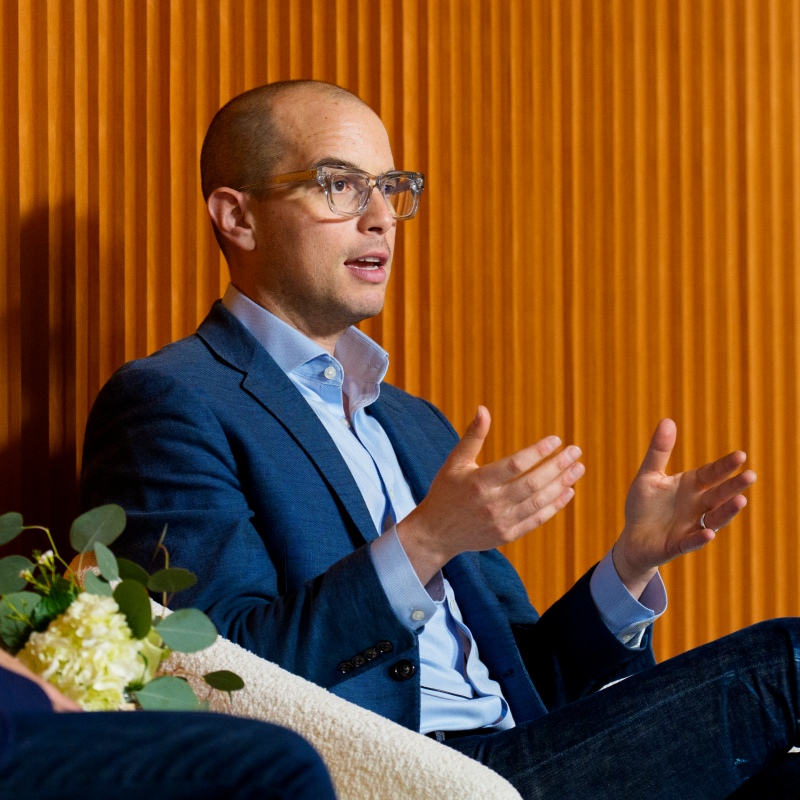
Launched Gilt's Home and Food & Wine divisions and helped push the flash-sale pioneer into 120+ countries. His first boss there, he says, built his professional foundation.
Co-founded the nitro cold brew coffee company that grew rapidly across the US in kegs and cans. He later served as a Board Director.
Founded a branding and strategy consultancy whose client roster reads like a Brooklyn dinner party: A24, Chobani, adidas, TULA, Ritual.
Was a founding-team member and COO at the venture-backed ecommerce wellness brand - reps for the playbook he'd run again at Plant People.
Alternative medicine should be a primary choice, not a secondary one.
Graduates Brown (East Asian Studies & Entrepreneurship); joins Gilt Groupe.
Co-founds RISE Brewing Co.
Founds Crosby Advisory.
Meets Gabe Kennedy on a hike; formulas begin in Hudson's apartment.
Co-founds Plant People.
Official launch; featured in NYT, Forbes, Vogue.
Loses ~70% of business in the pandemic; pivots and survives.
National distribution: Target, Whole Foods, Sprouts, REI.
Launches in 820+ Targets; closes ~$7.9M Series A led by Manna Tree.
Ask him about a disaster and you'll learn something about temperament. Early on, Hudson approved a print run of 2,000 sell sheets with the company name spelled wrong. His response was to laugh, not to spiral. In a category that markets serenity, that is arguably on-brand.
The operating philosophy is just as compact: make the small things matter, and the big things matter even more. It shows up in how he builds a team. Every hire, he says, should have ownership and feel like a key decision-maker - family, not headcount.
It's crucial that each person we bring on has ownership in the company and feels as if they're a key decision maker.
He calls Plant People agile and fast-deciding, on one condition: the call has to line up with the brand's values and mission. Speed is allowed. Drift is not.
This investment gives us the capital and strategic partnership to accelerate distribution expansion, increase brand awareness and invest in innovation.
We're a very agile company and we make decisions quickly - as long as whatever we decide is aligned with our values, mission, and overall on-brand guidelines.
Make the small things matter and the big things matter even more.
We spent seven years building Plant People profitably with minimal outside capital, proving our model works.
My first boss, Crystal Caligiuri at Gilt Groupe, got me on the right tracks to help me build my professional foundation.
Strong product-market fit for clean, great-tasting gummies that genuinely work - and a loyal customer base that trusts our science-backed formulations.
The Manna Tree money, with Unilever Ventures riding along, is fuel for the obvious things: more shelves, more awareness, more innovation. The hard part is the quiet one. Hudson frames success as growth that keeps the clean ingredients, the science-backed formulations, and products people actually enjoy taking. Plenty of brands have grown by getting worse. He's betting against it.
Plant People grew gross revenue around 117% year over year heading into 2024, with roughly 120% projected for 2025. The retail map keeps widening. The DTC channel keeps scaling. And the premise hasn't moved an inch since the apartment: nature, taken seriously, can be the first thing you reach for.