A preschooler who can distinguish a stegosaurus from a triceratops may still find the letter S rather troublesome. Parents know this curious imbalance. A child’s attention can be wonderfully precise, provided the subject has teeth. HOMER, the early learning brand owned by Begin, works in that gap: the distance between what children want to explore and what adults hope they will learn.
- Personalized reading practice, with math, creativity and social-emotional activities alongside it.
- A paid, ad-free app for young learners; Begin currently markets it to ages 2-6.
- A much-advertised 74% result comes from a six-week early-literacy study, with specific conditions.
- Four child profiles per subscription, plus resources that take learning off-screen.
A parent needed a sequence
In 2013, EdSurge described Stephanie Dua’s predicament: her daughter lacked confidence learning to read, and the available apps felt haphazard. Dua had led New York’s Fund for Public Schools. Professional proximity to education had not supplied the thing she needed at home: a coherent route through the beginning of reading.
The first disappointment, then, belonged to the existing options. Dua responded by building a company. Learn with Homer arrived on iPad with phonemic awareness, literature and nonfiction woven together. There were 30 learn-to-read lessons, 33 discovery lessons and a collection of stories, poems and songs. An early seed round had supplied $2.2 million. The mascot was a pigeon poet, a salute to the Greek Homer. Literacy had acquired a bird with credentials.
The original ambition matters. A child must connect sounds to print, but also understand the words being decoded. Knowledge about animals or the wider world gives those words somewhere to live. HOMER’s literacy materials explain that relationship between reading skills, vocabulary and comprehension. A catalogue of isolated games would have made a different product.
Dinosaurs at the door, phonics underneath
The modern app asks adults about age, interests and learning level. Its advertised interests include vehicles, space, robots and dinosaurs. Beneath those invitations runs a reading pathway moving through letters and sounds toward words and comprehension. Personalization has an instructional job as well as a decorative one.
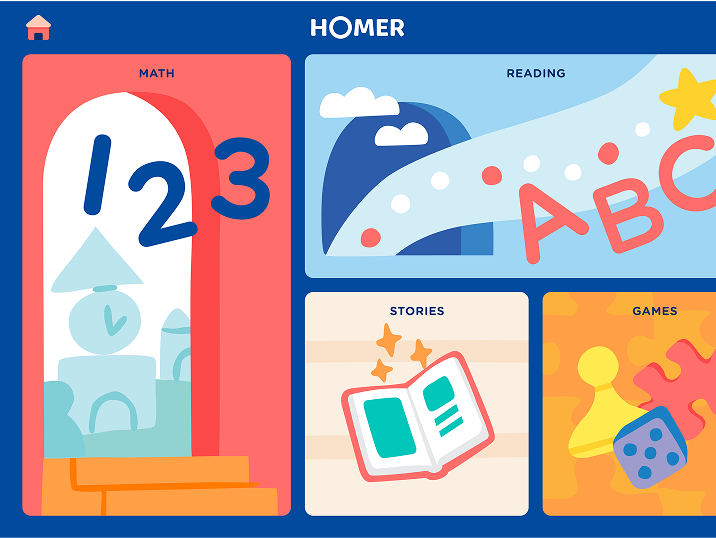
Reading remains the centre of gravity, with activities in math, social-emotional learning, creativity and thinking skills around it. HOMER’s older pages describe ages 2-8; Begin’s current product page concentrates on ages 2-6. Parents should judge the match by the child’s reading stage, rather than treating a birthday as a placement test.
For a family, this means a useful distinction between choosing content and planning instruction. A parent can offer a familiar interest without having to assemble every lesson from scratch. HOMER supplies the ordering; the adult can watch whether that ordering fits. The value is in reducing the work of finding a suitable next activity, while leaving room to notice when a child needs repetition or help.
The app is ad-free and designed for children to navigate after an adult sets up their profile. That arrangement addresses two customers at once. The parent needs a reason to trust the purchase. The child needs a reason to return. An impressive curriculum that nobody opens has a rather quiet educational career.
& sounds
& words
& meaning
Reading progression, simplified from HOMER’s published pathway.
The number that needs a classroom
HOMER advertises a 74% increase in early reading scores with 15 minutes of daily use. The study summary by literacy researcher Susan B. Neuman gives that tidy number a more interesting setting: seven Head Start classrooms, 82 children, and six weeks.
Children were randomly assigned to HOMER or a math app for the same daily duration. Moderators kept them on task; teachers supplied no instruction. The 74% figure describes the treatment group’s pre-test to post-test increase in phonological awareness, the ability to notice and work with sounds in language. Significant gains also appeared in print knowledge and letter sounds.
74%: reported growth in phonological-awareness scores within the HOMER group.
The control group started ahead on phonological awareness, then declined while the HOMER group improved. That initial imbalance deserves attention. So does the setting: structured use of an earlier app, with adults ensuring participation. The result supports a particular learning intervention. It cannot promise every modern subscriber the same gain, or measure all the subjects HOMER now offers.
The grown-up pays for the play
HOMER’s economics are ordinary subscription economics, with an unusually short end user. The legacy Learn & Grow page currently displays $9.99 monthly and a $59.99 annual offer. Begin’s shop separately lists HOMER from $6.66 per month. These are storefront offers checked in October 2026; checkout and renewal terms determine the actual bill.
A subscription permits four child profiles. Gift plans and hands-on kits offer additional ways to buy. Families can compare the reading pathway with ABCmouse’s paid early-learning programme or Khan Academy Kids’ free alternative. Ad-free play alone cannot settle that contest; free competitors can offer it too. The question is whether HOMER’s particular sequence and interest matching suit this child.
In September 2020, parent company Begin announced a $50 million Series C and separate $25 million growth financing. The announcement described a wider curriculum and digital, physical and in-person experiences. Sesame Workshop brought a curriculum partnership; Gymboree offered planned global distribution. Those relationships explain the expansion more concretely than a funding total does.
The lesson leaves the tablet
The practical details reveal the limits. Offline play works for activities already visited; storage pressure can remove older ones. A parent preparing for a journey must open the desired content beforehand. A fluent older reader may also have little use for a pathway designed around early literacy.
HOMER’s 2026 educator curriculum offers an optional 16-week plan and three assessments, mixing app sessions with books, crayons and movement. Its introduction says educators and homeschooling families wanted clearer, structured guidance. Here the company’s response is visible on paper: an app becomes one tool in a teaching plan.
“We’re on a mission to give kids the best start to their learning journey.”HOMER’s published mission
What can a reader copy? Start with something the child already cares about, choose a skill deliberately, and give it a second life away from the device. A dinosaur story can lead to listening for sounds, then spotting letters in a book. That is an editorial lesson drawn from HOMER’s design, not a promised outcome. Even a creature with teeth needs somewhere to take its next step.
Visit HOMER ↗ · Parent resources ↗ · The launch story ↗
LinkedIn · X · Instagram · Facebook · HOMER on YouTube ↗