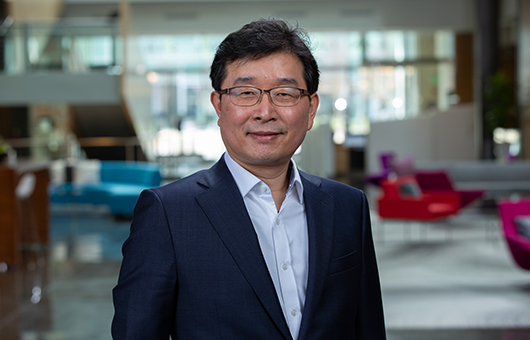
A founder who decided to remove cancer's targets, not just block them
Ho-Juhn Song runs a company built on a contrarian idea: that the most stubborn proteins in cancer should be dragged off the cell and destroyed rather than merely inhibited. That idea is PineTree Therapeutics, the Cambridge, Massachusetts biotech he co-founded in 2019 and still leads as CEO.
PineTree is preclinical, which in biotech means it has not yet put a drug into a human patient. What it does have is a platform called AbReptor and a growing body of data suggesting the approach can reach targets that conventional cancer drugs leave on the table. The company describes the platform as a way to selectively degrade membrane-bound and extracellular proteins, a category that includes the receptor tyrosine kinases, or RTKs, that drive many solid tumors and are often the reason a therapy stops working.
Song's framing of the problem is direct. Most targeted cancer drugs work by blocking a protein's activity. The tumor adapts, the protein mutates or over-produces, and resistance sets in. Degradation aims to sidestep that cycle by eliminating the protein itself. "The AbReptor platform has repeatedly demonstrated durable activity across a broad range of RTK targets, including models resistant to standard-of-care therapies," Song said when the company announced its most recent raise.
That raise came in October 2025: an oversubscribed $47 million Series B, money earmarked to push the company's lead preclinical oncology programs toward Phase I clinical studies and to widen the AbReptor platform into a broader portfolio of multispecific degraders. Investors included a mix of Korean and US venture funds, among them Korea Investment Partners, Smilegate Investment, SV Investment, DSC Investment, STIC Ventures, and Atinum Investment. With that round, PineTree's total funding reached roughly $111 million.
The number that turned heads first, though, came a year earlier. In July 2024, PineTree licensed its lead EGFR degrader program to AstraZeneca in an agreement valued at more than $500 million in potential milestones and royalties. Global pharmaceutical companies do not license preclinical platforms casually, and the deal amounted to a validation of the science Song had spent five years building. EGFR is one of the most heavily targeted proteins in oncology, and resistance to EGFR inhibitors is a defining problem in lung cancer. A degrader that works where inhibitors falter is a genuinely valuable asset.
The AstraZeneca agreement did something else for a small company: it validated the platform without emptying it. Song licensed a single program, the lead EGFR degrader, while keeping the underlying AbReptor engine and its follow-on candidates in house. That structure is deliberate. It brings in non-dilutive capital and a marquee partner, and it leaves PineTree free to keep building a pipeline it fully owns. For a founder steering a preclinical company through the long, expensive march toward the clinic, that balance between partnership and independence is one of the hardest calls to get right.
Degradation, aimed at the surface of the cell
Targeted protein degradation is one of the hotter areas in drug development, but most of the attention has gone to intracellular approaches like PROTACs, which hijack the cell's internal disposal machinery to break down proteins inside the cell. Song's bet is different. AbReptor is designed to work on proteins at and outside the cell membrane, a space that intracellular degraders cannot reach. That is a meaningful distinction, because a large share of validated cancer targets, including the RTK family, live on the cell surface.
The company has signaled ambitions beyond single-target degraders. It has described work on trispecific degraders and on combining degradation with antibody drug conjugate, or ADC, style targeting, an approach it refers to as degrading ADCs. The through-line is durability: the argument that removing a disease-driving protein produces a longer-lasting effect than blocking it, particularly in cancers prone to recurrence.
PineTree's public keywords read like a map of where the platform is meant to travel: non-small-cell lung cancer, pancreatic cancer, breast cancer, bispecific and multi-specific antibodies, receptor degradation, and extracellular protein degradation among them. The common thread is the surface of the cell and the proteins that sit on it. Antibodies are naturally good at recognizing those surface proteins, which is why an antibody-based degrader is a logical vehicle for reaching targets that small molecules struggle with. Song's platform, in effect, marries the targeting precision of antibody engineering with the finality of degradation.
None of this is proven in patients yet, and Song is careful to describe the work in terms of models and preclinical activity rather than clinical benefit. That is the honest position for a preclinical founder to hold. The value of the company today rests on the strength of its platform data, the credibility of its partnerships, and the judgment of a CEO who has spent a career deciding which biological targets are worth years of effort. The clinic is where those judgments finally get tested.
From Chungnam to Corvallis to Cambridge
Song's route to founding a Boston-area biotech ran across two continents. He earned a B.Sc. in biology and an M.S. in genetics from Chungnam National University in South Korea, then completed a Ph.D. in genetics and neurobiology at Oregon State University. A post-doctoral fellowship at Novartis followed, and it turned into a career.
At the Novartis Institutes for BioMedical Research, Song worked as a project team leader specializing in novel target discovery, in the functional genomics and developmental molecular pathway groups. It is the kind of role that trains a scientist to look for the disease drivers that others miss, and to think about which proteins are worth going after in the first place. Over his tenure he directed research teams across three very different therapeutic areas: oncology, immune disorders, and neurodegeneration, and helped generate multiple clinical candidates.
That breadth matters to how PineTree is positioned. The AbReptor platform is described as relevant to oncology, inflammation, and immunology, which mirrors the range of Song's own research background. Founders often build the company they were trained to build, and PineTree reads like a distillation of a career spent asking what to target and how to hit it.
A Cambridge lab with a Korea-Boston backbone
PineTree is headquartered on Concord Avenue in Cambridge, in the dense cluster of life-sciences companies that surrounds Kendall Square and MIT. It is a small team by headcount, the kind of lean preclinical operation where the science, not the org chart, is the product. What sets its cap table apart is the heavy presence of Korean venture funds alongside US investors, a bridge that reflects Song's own background and gives the company a distinctive financing base as it heads toward the clinic.
For all the platform language, the goal Song describes is concrete: get durable responses in cancers where drug resistance and tumor recurrence limit what current therapies can do. The next milestone is the one every preclinical founder fixates on, moving a lead program into first-in-human studies. The Series B was raised to fund exactly that, and it is the yardstick by which the next phase of PineTree, and of Ho-Juhn Song's tenure as its CEO, will be measured.