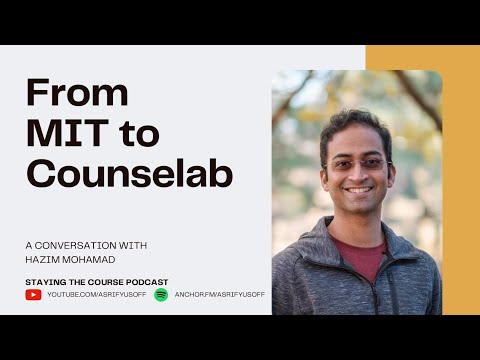
The Bet He Placed on Himself
There is a specific kind of professional competence that makes leaving comfortable. Four years managing risk for the World Bank - not tracking risk, not studying it, but managing it, overseeing roughly $40 billion in Treasury portfolio assets - gives you a particular kind of clarity about what risk actually costs. Hazim Mohamad understood the math. And then, in 2021, he did the math on himself.
He left. Not to another bank. Not to a hedge fund. To a Google Form and a theory about why most business ideas die before they become businesses.
The theory was simple and specific: 61% of Americans have business ideas. 90% never pursue them. Five out of six reasons for abandonment trace back to one missing person - a cofounder. Hazim spent two weeks interviewing around 50 people to validate this before writing a single line of code. The Google Form came first. The manual matching on LinkedIn and Reddit came next. The first 10-15 paying customers came in June 2023 - before any app existed.
"I sat on an idea for two years, but it was only when Carin reached out that we started exploring together and building."
- Hazim Mohamad, on co-founding CoffeeSpace with Carin GanThat detail matters more than it first appears. CoffeeSpace - a platform dedicated to solving the cofounder problem - was itself only started because Hazim found a cofounder. Carin Gan, a former Facebook software engineer, had crossed paths with him before. The pair had already built Counselab together in 2021, a marketplace for on-demand career advice. When the idea for CoffeeSpace crystallized, the cofounder was already there. The irony was not lost on him.
From Kuala Lumpur to Cambridge to San Francisco
Hazim Mohamad grew up in Malaysia, attended Kolej Yayasan Saad for secondary school, then left for Warwick Business School in the UK to study Accounting & Finance. He graduated in 2016, but not before pulling off something unusual for a university student: he co-founded a conference.
The Warwick ASEAN Conference was born from a 60-second pitch Hazim gave to Tony Fernandes, CEO of AirAsia, at a dinner in London. Fernandes said yes. The conference went ahead, headlined by the AirAsia CEO, and Hazim served as Chief Coordinator. A student founding something real, with real speakers, from a single elevator pitch. The pattern was set early.
He also served as Director of the UK Office for Aseanite, a social enterprise fund investing across Southeast Asia. He was building community and networks before building companies.
Then MIT Sloan. The MSc Finance program ran from January 2016 to January 2017 - one of the sharpest concentrations of financial and entrepreneurial knowledge available. From there, the World Bank called. Market Risk Analyst, Treasury division. The $40 billion portfolio. Four years of learning how the largest institutions in the world think about capital, exposure, and protection.
And then the jump.
"Whatever the company needs, if no one else in the company can/wants to do, then by default...you'll be the one."
- Hazim Mohamad, on the realities of early-stage foundingBuilding CoffeeSpace: Speed Over Perfection
The founding approach was textbook lean - except Hazim actually followed it. Fifty interviews in two weeks. A Google Form as the first product. Manual matching. Real customers before a real product. By July 2023, a mobile app existed. By December 2023, there were 800 users and 60 paying customers. By mid-2024, 7,000+ users, 200,000+ swipes, and a compound monthly growth rate in swipes of 82%.
CoffeeSpace functions like Hinge for entrepreneurs. Daily curated recommendations rather than infinite browse mode. A semantic matching engine that looks past job titles and keywords - surfacing people who align on vision, mindset, and momentum. Granular filters for skills, commitment level, location, industry. A transparent invitation system. And built on a freemium model: 10 free matches monthly, $50/month for premium filters.
The platform serves founders from Stanford, CMU, UC Berkeley, Amazon, Google, and Meta. The third co-founder, Fauzan Reza Maulana, joined as CPO. The team grew to 22 people. The platform drew backers from the Onfido co-founder network, YC alumni, and angels from Quantum Black, Google, and Meta.
In October 2024, CoffeeSpace was selected for TechCrunch Disrupt's Startup Battlefield 200 - one of the most visible stages for early-stage companies in Silicon Valley. TechCrunch published a feature the following month. Product Hunt logged them as Top 5 Product of the Day. Wharton Magazine ran a profile. By mid-2025, 25,000 active users. 2 million swipes. A $1 million pre-seed closed.
The Philosophy That Powers the Product
Hazim talks about entrepreneurship in terms of three priorities: resourcefulness (doing much with little), speed and agility (rapid experimentation), and customer-centricity (building from feedback, not assumption). These are not platitudes when they come from someone who ran a manual matching service from a spreadsheet before building a mobile app. He built the way he talks about building.
The deeper insight behind CoffeeSpace is statistical, not emotional. Hazim noticed that aspiring entrepreneurs who actively discuss their ideas are at least ten times more likely to actually build. CoffeeSpace is not just a dating app for founders - it is a forcing function for idea activation. The act of creating a profile and engaging with potential partners is itself a commitment signal. The platform is designed to increase the population of people who actually start companies, not just think about them.
"Aspiring entrepreneurs who actively discuss ideas are at least 10 times more likely to actually build."
- Hazim MohamadThat is a different kind of ambition than "we want to connect founders." It is a claim about changing the base rate of entrepreneurship itself. CoffeeSpace positions itself not as infrastructure for founders who have already decided, but as the activation layer for founders who haven't yet.
What Comes Next
With $1 million raised and 25,000 active users, the question for CoffeeSpace is velocity. The platform already serves CPG businesses, funds, and non-tech ventures alongside the expected Stanford and Google crowds. The matching engine runs on OpenAI's API. The stack includes Next.js, React Native, GraphQL, Kubernetes, and Redis on Akamai and AWS infrastructure - a setup built to scale, not just prove a concept.
Hazim's stated vision frames CoffeeSpace alongside what Tinder did for dating. Whether that analogy holds depends on whether the cofounder problem is as common and as solvable as the loneliness problem. The data he has assembled suggests it might be. Sixty-one percent of Americans with business ideas is not a niche. Ninety percent never acting on them is not a small market failure. It is an enormous latent supply of potential founders who never found their person.
CoffeeSpace is the bet that the right product, at the right time, with the right matching engine, can change that number. Hazim Mohamad left a $40 billion portfolio to find out. That is either the best risk calculation of his career, or the most expensive - and he seems to be the last person who would be surprised by either outcome.