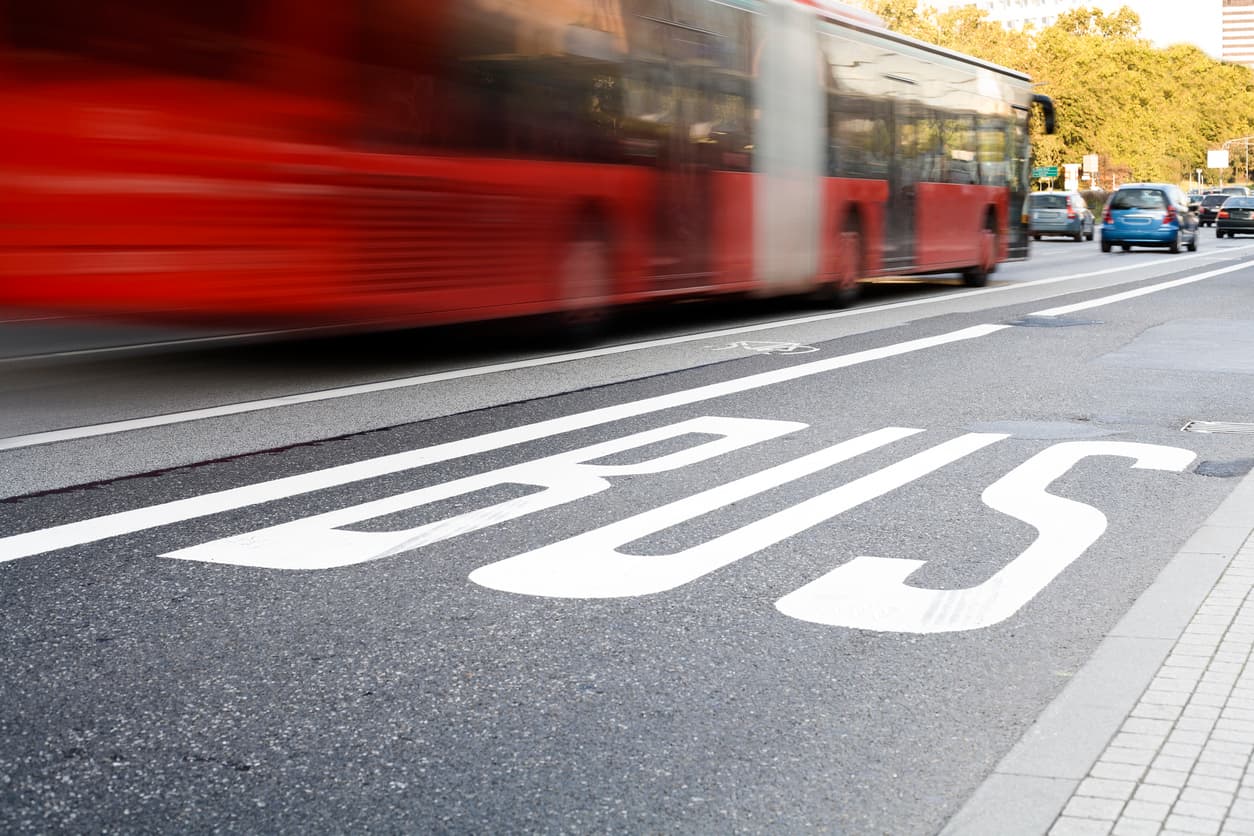
There is nothing quite so democratic as a bus, and nothing quite so undemocratic as the man who parks across its path. Civilization, we are forever assured, advances by grand gestures — gleaming towers, ribbon-cut bridges, the sort of monuments that arrive with brass bands and budgets measured in the billions. Yet the truest measure of a city is far humbler: whether the eight o'clock bus can simply get through. Hayden AI has staked its entire enterprise on that unfashionable proposition, and in doing so has discovered something the great planners often miss — that genius is frequently a matter of attention rather than expense.
"Typically when you talk about smart cities," the company observes, "people are talking in terms of billions of dollars." It is a sentence that ought to be embroidered on a cushion in every mayor's office. The smart city, as conventionally sold, is a thing of staggering cost and even more staggering vagueness. Hayden AI proposes a delicious inversion: "For a fraction of that cost, we can make a city smarter almost overnight." One does so admire ambition that arrives without an invoice the size of a cathedral.
The Tyranny of the Idle Car
Consider the arithmetic of obstruction, for it is more wicked than it first appears. "Our cities are faced with increasing number of people," the company notes, "but the real estate to transport people is fairly limited." The land does not grow; the crowd does. Into this delicate equilibrium strolls the parked vehicle, and the consequences are anything but private. "When you park your vehicle at a bus lane," Hayden AI explains, "you're blocking the path of 50 or 60 people in a bus, the downstream effects get magnified throughout the entire transit system."
It is the sort of selfishness that masquerades as a small thing. One car, one moment, one harmless little stop — and behind it, sixty souls held in suspended animation, each minute of their delay rippling outward into missed connections and lengthening queues. The single idler imagines himself a footnote; he is in fact the opening line of a very long tragedy. Hayden AI's response is refreshingly unsentimental: "We're trying to solve the problem at the root cause."
Enforcement, in the old order of things, was a thing of clipboards and patience and the limits of the human eye. "Traditionally," the company concedes, "enforcement on transit buses has been a very manual process" — which is a polite way of saying it scarcely happened at all. To watch every lane on every route was an impossibility, and impossibilities have a way of becoming permissions. The idler thrived precisely because no one was looking. Hayden AI's quiet wager is that the bus itself might learn to look.
The shift from the manual to the automatic is, of course, the entire drama of the modern age in miniature. Whatever depends upon the vigilance of a tired official will, in time, depend upon nothing at all; attention is a finite and expensive commodity, and no city has ever had enough of it to spare. "By deploying AI," the company explains, "we've really been able to make this a much more efficient process." The phrase is unassuming, yet the implication is vast: a lane that was once watched by no one is now watched, gently and ceaselessly, by every bus that passes through it. The eye does not tire, and the idler can no longer rely upon the kindness of an empty street.
A Box of Brains Behind the Windshield
The apparatus is almost charmingly modest. There is no fleet of drones, no surveillance citadel humming in the desert. "It's installed on the buses with cameras that get mounted behind the windshield," the company explains, "connected to a compute box that's inside the bus." That box, unglamorous as a lunch pail, is the soul of the thing. "Really the brains of our system is our compute box," they say, "and that compute box allows us to do a significant amount of processing right on the bus."
Here is the elegance: the bus does its own thinking. It does not phone home with every passing face; it reasons on the spot. "The AI running on our device has the smarts to understand that there is a violation taking place, make a small video clip of it, blur out all license plates, blur out any faces, and only then transmit it up to the cloud." The intelligence travels with the vehicle, deciding in the moment what matters and discarding, with admirable discretion, all that does not. And the whole performance asks nothing of the person at the wheel: "Our AI platform is completely automated. There is no driver intervention needed." The driver drives; the bus observes.
The Manners of a Machine
It is fashionable to fear the watchful machine, and not without cause; the camera has too often been the instrument of the snoop. Hayden AI, to its credit, has anticipated the objection and answered it before it was raised. "We take privacy very seriously," the company insists, "and have designed our system to be privacy first." This is not the afterthought of a guilty conscience but, they argue, a principle built into the silicon itself.
The discipline is in the restraint. Faces vanish into blur; license plates dissolve before they ever leave the vehicle. "Only the evidence that's connected to an actual violation is ever sent to the cloud for processing," the company explains, and "other images aren't ever accessed or used for any other reason." The machine, in short, has been taught manners — it sees a great deal and remembers almost none of it, retaining only the single guilty frame and forgetting the innocent crowd entirely. And there is a certain rough justice in the result: "If you have been caught to be violating, you were truly impeding the path of the bus." The system does not invent sinners; it merely declines to overlook them.
By Riders, For Riders
What lends the enterprise its warmth is the perspective from which it was built. This is not a contraption dreamed up in some glass tower by men who have never waited at a stop in the rain. "It was designed by transit riders for transit riders," the company says, and "everyone at Hayden AI sees the problems that public transit faces." The designers, in other words, are also the aggrieved — they have stood at the curb, watched the bus inch toward them, and felt the small fury of an avoidable delay.
"Public transit plays a key role in making sure cities work," the company observes, and its own ambition is deliberately supporting rather than supreme: "Our role is to enhance that transportation network." There is a modesty in that framing one cannot help but applaud. The platform does not propose to reinvent the city; it proposes to let the city's existing arteries flow as they were always meant to. "The Hayden AI platform is a key tool in improving the efficiency of public transit systems" — a tool, note, and not a tyrant.
The Dividends of Paying Attention
And what does all this watchfulness purchase? Not, as the cynic might suspect, merely a fatter ledger of fines, but a cascade of public goods. "We've seen in places where we've deployed," the company reports, "a reduction in collisions, an increase in on-time arrivals, a decrease in greenhouse gas emissions, and ultimately an improvement in the number of riders using public transit every single day." Each of these is a virtue in its own right; together they form a rare and happy circle. The cleared lane is a swifter lane; the swifter bus is a safer, greener bus; the reliable bus wins back the rider who had quietly given up on it.
It is the most satisfying of paradoxes — that the way to fill a bus with people is to clear the road of cars. The company's most affecting note is not technical at all but moral: "We're helping people that need the most help, and the fact that they can rely on public transit because of the work that we have done is probably the most exciting part of working here at Hayden AI." One suspects Wilde himself would have approved, for he understood that the smallest courtesies — a clear path, a kept promise, a bus that simply arrives — are in the end the only luxuries that matter. The lane has eyes now. Mercifully, it has chosen to use them on our behalf.