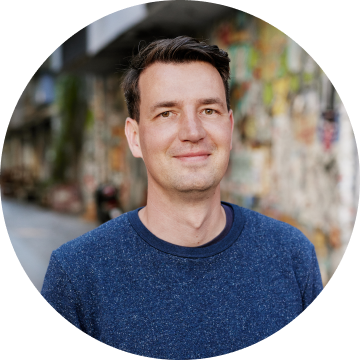
A second act built entirely around reliability
Most software gets built and shipped. Hannes Lenke has spent his career on the quieter question that comes after: is it still working right now? Today he answers it as CEO and co-founder of Checkly, a monitoring platform that treats uptime as something developers own in code rather than a dashboard someone else babysits.
Checkly's premise is simple to state and hard to execute. Engineers write checks - synthetic tests that behave like real users hitting an API or clicking through a web app - and run them continuously from around the world. When something breaks, the alert lands with the team that can fix it, wired straight into the tools they already use. Lenke calls the approach Monitoring as Code, and he has spent years arguing that it belongs in the same repository as the software it watches.
That conviction did not appear overnight. Checkly began as a bootstrapped side project by Tim Nolet, who had been head of IT at Unu, a Berlin electric-scooter startup. Nolet's developers needed to watch their APIs and user flows, but nothing on the market fit a modern, JavaScript-heavy DevOps workflow. So he built his own. Around the same time he met Lenke, who was coming off the acquisition of his first company. The two decided to join forces, and Lenke brought in Timo Euteneuer - a co-founder from that earlier venture - to round out the team.
The earlier venture matters, because it explains how Lenke thinks. In 2011 he founded TestObject, a cloud-based mobile app testing company. It was acquired by Sauce Labs in 2016, after which Lenke stayed on as General Manager for EMEA. Testing, then cloud testing, then the leap to monitoring in production: it is a straight line through one problem, viewed from progressively later in the software lifecycle. By the time Checkly formed, Lenke had already spent the better part of a decade making sure other people's software actually did what it claimed.
"A startup is a long-term commitment. It's a marathon, not a sprint."Hannes Lenke
Checkly's growth followed a deliberate arc. Accel led a $2.25M seed round in 2020, when the company had roughly 125 paying customers running about a million checks a day. A $10M Series A followed. Then, in the summer of 2024, Balderton Capital led a $20M Series B, with existing investors Accel and CRV participating and Balderton partner Colin Hanna taking a board seat. Total funding reached $32.25M. The stated goal was blunt: help engineers detect and resolve issues 10x faster.
Lenke has been open about the operational choices behind that growth. Checkly started product-led, letting developers find and adopt the tool on their own, then layered in a dedicated sales motion as it matured - the kind of shift many founders resist until it is overdue. He has also leaned into being remote-first, describing a company rooted in Berlin with a US presence in New York, held together by weekly stand-ups, Slack, Notion, and a heavy dose of transparency. The upside, he has said, is access to a global talent pool. The cost is that communication has to be deliberate rather than accidental.
The technical bets are just as telling. Checkly runs on Playwright, the open-source browser automation framework from Microsoft, and has pushed toward connecting synthetic monitoring with OpenTelemetry tracing - so a failing check does not just say something is wrong, but points toward where. In 2023 Gartner began citing Monitoring as Code as an emerging practice, and Checkly appeared in the Hype Cycle for multiple consecutive years. For a category Lenke helped name, that is a form of vindication.
He has kept building. In late 2025 the company launched Playwright Check Suites, which it framed as the next phase of synthetic monitoring. In early 2026 Lenke published a piece on what he calls the agentic software layer - a signal that Checkly intends to fold AI-assisted reliability into the same code-first philosophy. The throughline never changes: give developers clear signals, keep monitoring close to the code, and get people back to the work that matters.
Ask him for advice and it stays grounded. Test the waters before you commit. Verify the idea. Treat the whole thing as a marathon. It is unglamorous counsel from someone who has run the distance twice - and who seems in no hurry to stop.
One problem, viewed from later and later
Fun facts & quirks
- He has spent essentially his entire career in one lane - software testing and reliability - moving from mobile testing to cloud testing to production monitoring.
- He is a two-time founder who kept part of his founding team intact across both companies.
- His X/Twitter handle is simply @HLENKE.
- Checkly's monitoring runs on the same open-source Playwright framework used by developers worldwide.
- Checkly started life as a nights-and-weekends side project before it was ever a company.