A neutral broker in the fight over drug prices
Girisha Fernando spends his weeks between two cities and one problem. In Basel, where his company Lyfegen was born, and in New York, where he is trying to plant it in the largest and most complicated healthcare market on earth, he keeps returning to a single question: what should a medicine actually cost? His answer is not a number. It is a piece of software that lets the people who pay for drugs and the people who make them agree on price based on how well the drug performs for real patients.
Lyfegen is a SaaS platform that sits between health insurers, hospitals, pharmaceutical companies and medical device makers. It lets them design value-based agreements, simulate the financial impact of different pricing models, and automate the rebates that flow back and forth when a treatment does or does not deliver. Fernando likes to describe the role in plain terms. "We're the Switzerland between the payer and the pharma company," he has said, a line that captures both the neutrality of the product and the country that shaped him.
That neutrality matters because the two sides rarely trust each other. Payers suspect they are overpaying for medicines that may not work as advertised. Manufacturers argue that a one-time cure, however expensive, can be cheaper than a lifetime of managing a disease. Fernando refuses to treat that tension as unsolvable. "Why shouldn't a drug cost $3.5 million if it cures a patient costing $10 million?" he asks. The point is not that price is irrelevant. It is that price should be tethered to value, and that measuring value at scale is an engineering problem software can take on.
"We want to change the healthcare system. This is about life and death."
Girisha Fernando, CEO & Founder, LyfegenThe idea that started at a pharma desk
Fernando did not arrive at this from the outside. He spent close to a decade at Roche, one of the largest pharmaceutical companies in the world, moving through commercial, market access, pricing, IT and clinical trial operations. He rose to become one of the youngest directors in his IT department, working on the systems that supported pricing and market access just as Roche was investing heavily in personalized medicine.
That was where the light-bulb moment came. He watched a flood of healthcare data pile up and the reimbursement process struggle to keep pace. New treatments like Zolgensma, the gene therapy carrying a multi-million-dollar price tag, were arriving faster than the old ways of paying for them could adapt. He became convinced that medicine needed new payment models, and that the only realistic way to run those models was with technology. In 2018, at 29, he left the security of a corporate director's title to build it.
He co-founded Lyfegen in Basel with Nico Mros and Michel Mohler. The early product leaned on blockchain and cloud infrastructure to let insurers and manufacturers negotiate prices tied to effectiveness for individual patients. The technology has evolved since, but the founding thesis has not: shift healthcare from paying for volume to paying for outcomes, and make health more equitable in the process.
"Healthcare is a tough nut to crack. There are so many issues and problems."
Girisha FernandoFrom asylum seeker to founder
The willingness to take that leap has roots. Fernando's family fled Sri Lanka when he was three years old, seeking asylum in Switzerland. His mother worked as a teacher and his father found work at a small biotech company in Basel. He credits both of them with teaching him to take risks and to challenge the status quo rather than accept it. He grew up between local and international schools and came out multilingual, speaking English, the Basel dialect, standard German and French.
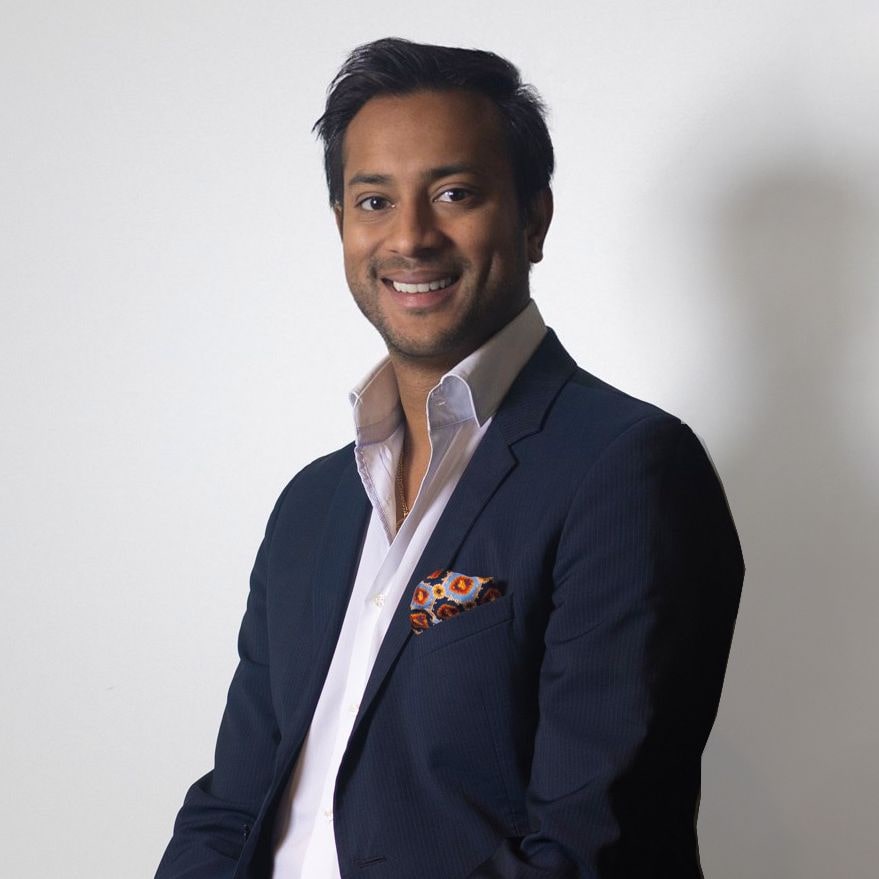
Those who have met him describe a founder who is ambitious about the mission but understated in person. He tends to pair a sports jacket with white Veja sneakers, and he talks about patients more than valuations. The gap between the size of the goal, changing a global healthcare system, and the calm way he discusses it is part of what makes the pitch land.
Betting on the United States
Lyfegen's early credibility came from the names willing to work with it. For a company only a few years old, partnerships and collaborations involving major payers and manufacturers such as Johnson & Johnson, Pfizer and Sympany signaled that the value-based thesis was more than a pitch deck. Fernando has continued to build out the product, including a Model & Agreement Library that turns real value-based drug contracts into a reusable repository, so that outcome-based deals do not have to be reinvented every time.
Now the focus is the US. Fernando splits his time between Basel and New York because the American market, with its tangle of payers, manufacturers and pricing pressure, is both the hardest place to win and the biggest prize. He has talked about reaching profitability within a handful of years, an unusually grounded ambition in a sector where many founders chase scale first and economics later. The measured tone is deliberate. For Fernando, the stakes are not abstract growth curves. They are whether a patient gets access to a medicine that could change or save their life.
The transition he is chasing, from fee-for-service to value, has been discussed in healthcare for years without ever fully arriving. What Fernando brings is a builder's impatience with talk. He saw the inefficiency from inside a pharma giant, decided the fix had to be software, and left to write it. Whether Lyfegen becomes the connective tissue between payers and pharma at global scale is still an open question. But the company is already in rooms most five-year-old startups never reach, and its founder is treating the problem with the seriousness it deserves.