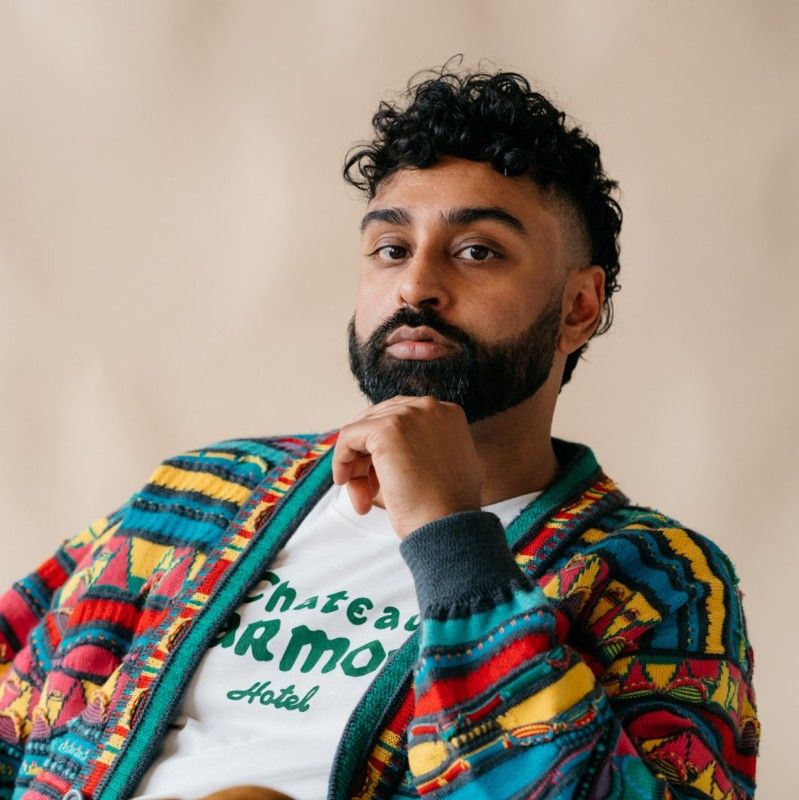
Turning listeners into creators, without cutting artists out
Gaurav Sharma runs Hook on a single conviction: fans should be able to remix the music they love, and the people who made that music should stay in control of it.
From a small office near Riverside Boulevard in Manhattan, Sharma is trying to answer a question the streaming era left open. Fans no longer just listen to music. They clip it, caption it, speed it up, mash it together and post it - most of it in a gray zone where nobody quite has permission and nobody quite gets paid. Hook, the company he founded, is his attempt to move that behavior into the light. The app hands users a library of more than 20 million licensed songs and a set of AI tools to remix them - changing genre, tempo and mood, layering effects, stitching tracks together - and then lets them share the result to TikTok, Instagram, Snapchat or inside Hook itself. The difference from the free-for-all it replaces is that rights holders stay in the loop, keep ownership and share in the money.
In early 2026 that pitch drew a $10 million Series A led by Khosla Ventures, with Point72 Ventures, Imaginary Ventures and Waverley Capital - the fund co-founded by former Warner Music CEO Edgar Bronfman Jr. - joining in. The round brought Hook's total funding to roughly $16 million. The cap table reads like a who's who of people who normally have reason to be wary of anything that touches their catalog: Kygo's Palm Tree Crew, Three Six Zero, Avex, The Raine Group and producer KSHMR among them. Getting the music industry to fund a remix startup is not a small thing, and it is the clearest signal of what Sharma has spent his career learning how to do.
"Fans want to express themselves with the music they love, and artists deserve to stay in control of how their work is used."
Gaurav Sharma, on building HookAn engineer who studied composition
Sharma is not a business-school operator who wandered into music. He studied at Johns Hopkins University and the Peabody Conservatory, focusing on computer music composition and engineering - the rare founder equally comfortable talking about a chord change and a licensing waterfall. That double fluency runs through how he describes his work. He tends to talk about music less as content and more as a language people use to say things they cannot say on their own.
"Music expression for regular, non-musicians is typically through an artist," he has said. "It's through something familiar." It is a small observation with a large company hiding inside it. If most people express themselves best through a favorite artist rather than an original song, then the job is not to help everyone become a songwriter. It is to let them bend and reshape what already exists - and to make that legal and rewarding for the artist on the other end.
The month that taught him the business
His timing with the music industry has a dark comedy to it. He graduated around 2010 and took a job at a major label. It lasted about a month before layoffs hit, in the thick of the post-Napster collapse when the old model was falling apart and no one had built the next one. It was a brutal introduction, but a useful one. He learned early that the music business runs on cycles of disruption, and that the winners are usually the ones who read the shift before the incumbents do.
What followed was a decade of building at the intersection of music, data and consumer behavior. He co-founded Pinpuff, an analytics tool that measured influence on Pinterest, which was acquired by Science Inc. in 2012. He co-founded HelloSociety, an influencer marketing agency later acquired by The New York Times. He held A&R and lifestyle marketing roles at Sony Music. Each stop taught a piece of the puzzle he would later assemble: how audiences behave, how influence spreads, how rights and money actually move.
Scaling India's soundtrack
The most formative chapter came as chief operating officer of JioSaavn, India's largest music streaming service. There Sharma helped negotiate global licenses with major labels and helped grow the platform to hundreds of millions of monthly listeners. Along the way he watched a market remake itself in fast-forward. Early on he found that the iTunes download model simply did not translate - people were buying SD cards preloaded with songs rather than paying per track - which pushed the business toward streaming. He also watched distribution democratize in real time, as Indian music shifted from being roughly 95 percent Bollywood to closer to two-thirds, because digital platforms finally gave independent musicians the same reach as the film studios.
That experience left him with a working theory he now applies to Hook: technology does not just change how music is consumed, it changes who gets to participate in making it. Streaming was the fix for the 2000s digital shift. Sharma argues that licensed, fan-driven remixing is the fix for the social-media era - a way to capture the value in behavior that is already happening everywhere, uncompensated.
"Our platform gives artists agency in how their fans interact with or express themselves with their music."
Gaurav SharmaResearch on a college campus
The idea for Hook did not arrive as a slide. Before building it, Sharma went to his brother's campus at Syracuse and interviewed students about why they posted remixes of songs instead of their own original tracks. The answers - people using a familiar song as a vehicle to say something personal - became the thesis of the company. It is a very Sharma way to start: not with a demo, but with a question asked to real people, in person.
He is also a contrarian about the very technology his company runs on. In an era racing to build AI that generates finished songs from a text prompt, Sharma champions what he calls "creative misuse" - encouraging users to break the tools, bend them past their intended purpose, and make something the system never anticipated. To him, that friction is where art actually lives, and it is a pointed rejection of the idea that the future of music is a prompt box spitting out synthetic tracks. Hook's bet is on human participation, amplified by AI, rather than human replacement by it.
The artist-first wager
The strategy is showing early results. Hook has run label campaigns that generated more than 250 million views across social platforms, and it has landed direct collaborations with artists including The Weeknd, Joji, Metro Boomin, Lil Wayne and Empire of the Sun - the kind of names that only sign on when they trust the model. Licensing partnerships with Downtown, Too Lost, Primary Wave and Avex keep the catalog growing. Internally, Sharma promoted Simmi Singh to chief operating officer and chief product officer to steer the next phase of growth. The near-term roadmap: an Android launch, native video and recording, deeper community features and more licensing.
What Sharma is really selling is trust - to artists, to labels, to investors who have all been burned by technology that promised to help them and instead routed around them. His whole career reads like preparation for that sale. He knows the licensing math from JioSaavn, the audience behavior from Pinpuff and HelloSociety, the creative instincts from Peabody, and the industry's scars from that one-month job in 2010. Hook is the place where all of it finally points in the same direction.
"We're building the social music platform where creativity can thrive," Sharma says, "and where ownership and monetization remain artist-led from day one." Whether the remix generation and the rights holders can be made to want the same thing is still an open question. Sharma has spent fifteen years getting ready to answer it.
In His Words