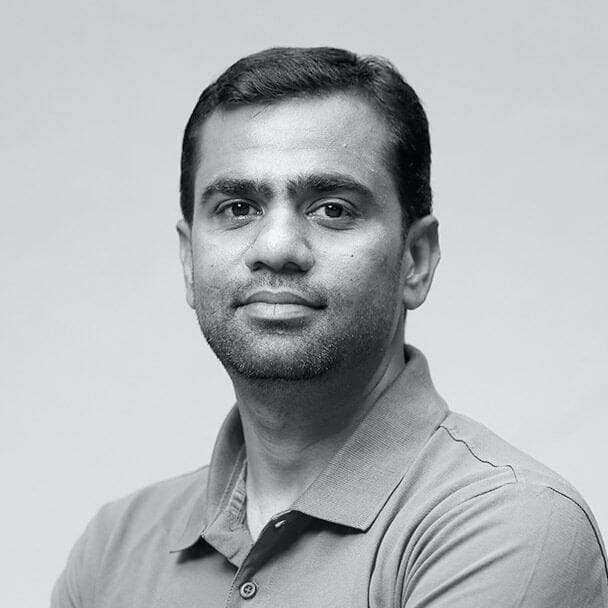
Ganesh Shankar runs Responsive, the software company that most salespeople have leaned on without ever knowing its name. When a company answers a request for proposal, a security questionnaire, or a due diligence form, there is a good chance the answers are flowing through his platform. The category has a mouthful of a name - strategic response management - but the idea is simple: stop treating every proposal as a blank page and start treating institutional knowledge as something you can search, reuse, and improve.
Today the company is headquartered at The Star in Frisco, Texas, the Dallas Cowboys' campus, a long way from where Shankar started. It employs more than 550 people across three continents and counts 25 of the Fortune 100 among its customers. Users move somewhere between $10 and $15 billion in deals through the software every month. And yet the most interesting number attached to Responsive is a small one: roughly $27 million. That is all the outside capital Shankar raised to build it.
Businesses need to be sustainable. We don't have the mindset of growth at any cost.
- Ganesh ShankarThe task that became a company
Before Responsive, Shankar was a director of product management. RFPs were not in his job description, but they found him anyway. By his own estimate, 25 to 30 percent of his time went to helping the sales team craft responses - hunting down the right answer, chasing the person who knew it, formatting the document, doing it again next week. His two future co-founders, AJ Sunder and Sankar Lagudu, sat close to the same problem as an engineering manager and an implementation manager.
In 2015 the three of them decided the problem was worth a company. They funded the early software development out of their own savings, kept their paychecks coming as long as they could, and launched the product in 2016 under the name RFPIO. None of the three had run sales or marketing before, which they call their biggest early obstacle. It did not slow them down the way they feared. The marketing worked well enough that, for a stretch, the entire sales pipeline came from inbound leads.
Bootstrapped, on purpose
The founders paid for development themselves before taking outside money. The first institutional round - about $25M from K1 Investment Management - did not arrive until 2018.
Inbound from day one
With no sales background between them, the founders leaned on content and marketing. The pipeline filled itself with inbound demand.
A pay cut on the way up
Shankar's route to software was not a straight line. He grew up in Coimbatore, India, in a family that valued steady government work - his father was a retired agriculture department official, and his grandmother made her preference for government jobs plain. He studied computer science as an undergraduate, decided it was not his calling, and went straight into an MBA in finance and marketing. His first jobs were in financial services: selling mutual funds and insurance as a rep, then managing dozens of sales reps across South India for a stockbroker.
The 2008 crash changed his mind about all of it. He watched investors lose their savings, some of them in tears, and decided he wanted work where he would not feel so helpless. So he took a junior business analyst role and a steep pay cut, trading a senior finance title for a foothold in technology. Over the next several years he worked his way back up to director of product management - and, without planning to, straight into the RFP problem that would define him.
I felt like technology is something if I get my hands on I would not be helpless. I could make a meaningful impact.
- Ganesh Shankar, on leaving financeWhy RFPIO became Responsive
The RFPIO name did its job for years. But Shankar came to see it as too narrow for what the company had become. Customers were using the platform for far more than requests for proposals - security questionnaires, grants, ESG disclosures, due diligence forms. The common thread was not the acronym. It was being responsive: fast, agile, ready with the right answer. The rebrand to Responsive in 2022 was less a marketing exercise than a correction, aligning the name with the company's actual character.
That instinct - name the thing accurately, then build toward it - shows up in how Shankar talks about AI. Responsive uses generative AI to draft proposals in minutes and is moving toward AI agents, but he is pointed about the limits. Good content management has to come first, he argues, because AI cannot untangle conflicting or incomplete data on its own. And he keeps returning to a phrase: humans in the loop. He frames the coming disruption in stark numbers - by his reckoning around 80 million jobs replaced and 180 million created - while insisting judgment stays with people.
Draft in minutes
Generative AI produces comprehensive proposal drafts fast, cutting response times by roughly 40 percent.
Humans in the loop
Shankar positions human judgment as central, resisting the pull toward full automation.
Content first
AI is only as good as the library behind it. Strong content management is the prerequisite.
The founder underneath the metrics
Ask Shankar to tell his origin story and he resists the drama. He describes his path as a series of fortunate events and credits the people who helped him along the way. The gratitude is not just tone. About 50 of the company's earliest employees stayed on as it grew past 550, a retention record he brings up more readily than the revenue figures.
There is a well-worn anecdote he offers about where the sales instinct came from: at age six, he went door to door in Coimbatore selling gooseberries. There is a less charming one about the machinery of ambition. He nearly missed out on a US work visa because his education timeline - a three-year undergraduate degree plus a two-year postgraduate program - did not fit the standard four-plus-two requirement. He got through it, built the company in America, and became a naturalized citizen, while deliberately keeping ties to his roots and building near his birthplace despite the limited local tech scene.
The recognition has followed. He was named one of the top 50 SaaS CEOs of 2022, won Ernst & Young Entrepreneur of the Year for the Pacific Northwest in 2020, and landed in Portland Business Journal's 40 Under 40. Asked what he would tell his younger self, his answer is characteristically plain: be humble, network and validate, and know that it is okay to say no and to pivot at the right time.
Be humble. Don't take it to your head. Network, network, network and validate. It's okay to say no. Pivot at the right time.
- Ganesh Shankar, advice to his younger selfThe aspiration he describes now is bigger than proposals. He wants Responsive to become the most powerful information exchange platform in the world - a place where organizations stop shuffling standalone documents back and forth and instead collaborate on a shared source of truth. It is an ambitious frame for a company that started because one product manager was tired of answering the same questions over and over. But that is the pattern with Shankar: notice the boring task everyone else tolerates, and build until it disappears.
▶ Watch: Founder Insights with Ganesh Shankar