A four-person team in Denver is trying to fix one of joint replacement's quietest disasters - by sending antibiotics straight into the joint, where the infection actually lives.
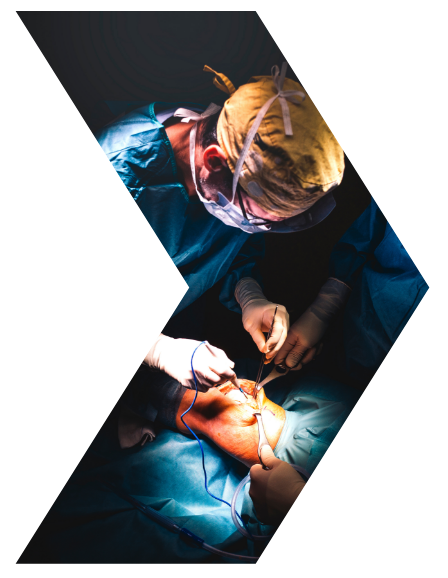
The operating room, framed in ForCast's own forward-pointing chevron. The infection ForCast targets starts in moments like this - and can outlast the surgery by years.
Somewhere right now, a joint replacement that went perfectly is failing. Not because the hardware broke, but because bacteria found it, settled in, and built a wall. ForCast Orthopedics exists for that patient. The company is a development-stage drug-device maker in Denver, Colorado, with roughly four employees, two FDA-designated programs, and a single stubborn target: periprosthetic joint infection, or PJI.
It is not a household name. It does not want to be. ForCast's pitch is narrow on purpose - "Pioneering the treatment of joint infection," as the company puts it - and that narrowness is the whole strategy. While the orthopedic industry chases better implants and faster recoveries, ForCast is staring at what happens when those implants get infected, which is a problem most companies would rather leave to the surgeons and the antibiotics. ForCast thinks both of those are losing the fight.
Here is the uncomfortable part. PJI is rare, which is exactly why it gets under-resourced. But when it hits, it is brutal. The infecting bacteria do not just float around the joint - they stick to the prosthesis and form a biofilm, a slimy protective layer that shrugs off the systemic antibiotics coursing through the bloodstream. The drugs arrive, knock politely, and never get in.
So the standard treatment escalates. Often that means a two-stage revision: pull the infected implant, place an antibiotic-loaded cement spacer, wait, then operate again to put a new joint in. Weeks of IV antibiotics. Months of disruption. PJI can threaten the joint's function, the limb itself, and in the worst cases the patient's life. It is, by any honest measure, a treatment built around the limits of the tools, not the needs of the patient.
ForCast's read on the situation is blunt: flooding the entire body with antibiotics to treat one infected joint is both too much and not enough. Too much for the patient's system. Not enough at the one spot that matters. That gap - between where the drug goes and where the infection lives - is the company's entire reason to exist.
ForCast was built by people who had seen the problem from both ends. Jared Foran, MD, is an orthopedic surgeon and co-founder who serves as the company's chief scientific and medical officer - the person who has actually stood over the failed joints. Peter Noymer, PhD, is a life-sciences entrepreneur and the executive chairman and CEO - the person who knows how to turn a clinical conviction into a regulated product.
Their bet is almost embarrassingly simple: if the infection is local, the treatment should be local too. Deliver targeted, high-concentration antibiotics directly into the infected joint, build up a local reservoir strong enough to disrupt the biofilm, and do it with a device that automates the whole thing rather than asking surgeons to improvise. The bet got a serious vote of confidence in 2025 when Charles A. DeCook, MD - a practicing orthopedic surgeon and serial entrepreneur - led the Series A through his firm OrthoInnovations and joined as chief innovation officer.
The platform has a name that sounds like advice: WIIS, the Wearable Intra-Articular Infusion System, pronounced "wise." It is a proprietary delivery mechanism that automates infusion of antibiotics directly into the joint space. Rather than relying on a cement spacer to slowly leach drug, WIIS is designed to actively deliver targeted therapy and maintain a local antibiotic reservoir aimed squarely at the biofilm.
Then there are the drugs. ForCast runs two programs, structured to cover the bacterial bases. FC001 uses vancomycin for gram-positive infections; FC002 uses tobramycin for gram-negative ones. Between them, the company wants to handle the organisms most likely to colonize a joint. To make WIIS work as a wearable, ForCast partnered with KORU Medical Systems in September 2025 to integrate KORU's FreedomEDGE infusion pump - the part that actually does the pushing.
Wearable Intra-Articular Infusion System. Automates targeted antibiotic delivery into the infected joint, building a local reservoir to disrupt biofilm. Integrates KORU's FreedomEDGE pump.
Vancomycin for gram-positive PJI. Holds FDA Orphan Drug and QIDP designations, with eligibility for Fast-Track and Priority Review.
Tobramycin for gram-negative PJI. Holds FDA QIDP designation. Together with FC001, it aims to cover both halves of the bacterial map.
Let's be skeptical for a second, because ForCast is pre-commercial and the only honest scorecard is the one made of facts. No approved product. No revenue. A clinical trial that hasn't reported. What ForCast does have is a stack of external validation that is harder to fake than a pitch deck: two FDA designations, a Series A led by a working orthopedic surgeon who put his own firm's money in, a named infusion-hardware partner, and a competitive accelerator slot.
Designations counted: Orphan Drug (FC001), QIDP (FC001), QIDP (FC002). Accelerator bars scaled to the applicant pool - roughly a 3.6% acceptance rate.
Three designations. Two programs. One acceptance out of every twenty-eight or so applicants. None of it cures a single patient yet - but all of it is the kind of thing the FDA, an experienced surgeon-investor, and a selective accelerator only hand out when they think the underlying idea is worth the risk.
There is an old argument in medtech that you should chase big markets, not rare ones. ForCast is doing the opposite, and on purpose. As joint replacements grow more common across an aging population, the absolute number of PJI cases climbs with them - so a "rare" complication quietly becomes a steady, expensive, life-altering reality for a growing group of people. The Orphan Drug designation exists precisely for this kind of overlooked-but-serious problem.
The company's mission language keeps coming back to "quality of life," which is a tell. ForCast is not really selling a pump or a molecule. It is selling the idea that a patient who develops a joint infection should not have to lose the joint, endure two surgeries, or gamble on systemic drugs that can't reach the target. The mission is to make local, targeted treatment the default instead of the last resort.
Return to where we started. A joint replacement that went perfectly is failing because bacteria built a wall the antibiotics can't climb. Today, that patient's most likely future is two surgeries, weeks of IV drugs, and months of their life handed over to a complication nobody warned them about.
ForCast Orthopedics is building the version where that patient gets a wearable pump instead of a second operation - where the drug shows up at the wall in force, not in the bloodstream by chance. None of that is proven yet; the clinical trial is the moment the story either holds or doesn't. But the company has done the unglamorous work of lining up the designations, the money, the hardware partner, and the surgeons who'd actually use it.
If WIIS works, the operating-room scene in that chevron up top stays the same - the surgery still happens, the implant still goes in. What changes is everything that comes after, for the small but growing number of people whose perfect joint quietly turns against them. That is the bet. We'll know more in 2026.